Loading...
Ferdinand I of Leon vs Rurik
Rurik leads by 0.4 pts · 2 figures compared
…
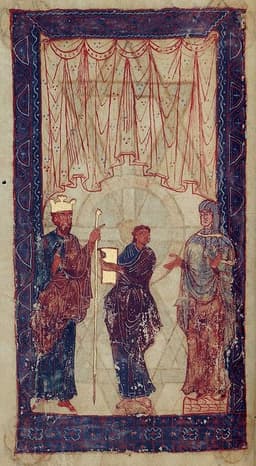
Ferdinand I of Leon
Emperor · Medieval
59.2Total
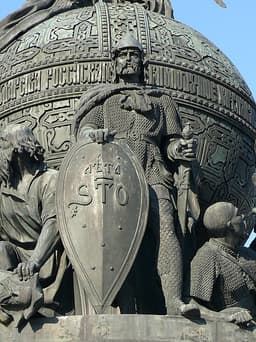
Rurik
Emperor · Medieval
59.6Total
Basic Information
Born
1015
830
Died
1065
879
Era
Medieval
Medieval
Nationality
Leon
Kievan Rus
Occupation
Emperor
Emperor
Civilization
Western
Western
Score Comparison
Military (10%)
70.0
50.0
Political (20%)
68.0
35.1
Influence (20%)
56.4
82.0
Legacy (20%)
49.2
68.0
Leadership (15%)
66.0
55.3
Strategy (15%)
57.5
35.7
TOTAL
59.2
59.6
Ferdinand I of Leon — Complete Timeline
1029 AD
Inheritance of the County of CastilePolitical Action◆ Major
Ferdinand I inherited the County of Castile from his father Sancho III of Navarre. He later expanded his territory through conquest and marriage, laying the foundation for the Kingdom of Castile.
Impact: regionalconstructive
1037 AD
Conquest of LeónWar◆ Major
Ferdinand I defeated and killed King Bermudo III of Le
Impact: regional
1056 AD
First Emperor of SpainPolitical Action◆ Major
Ferdinand I was crowned 'Imperator totius Hispaniae' (Emperor of all Spain) in 1056, claiming suzerainty over all Christian and Muslim rulers in Iberia. This title reflected his military dominance and political ambition.
Impact: regional
1065 AD
Division of the kingdomPolitical Action◆ Major
Upon his death, Ferdinand I divided his kingdom among his sons: Sancho II received Castile, Alfonso VI received Le
Impact: regionaldestructive
Rurik — Complete Timeline
860 AD
Sent Askold and Dir to ConstantinopleWar
According to tradition, Rurik sent his lieutenants Askold and Dir to raid Constantinople. While the historicity is uncertain, this event is associated with the first Rus' attack on the Byzantine Empire, highlighting early Rus' expansion.
RaidByzantine EmpireExpansion
Impact: regional
862 AD
Founded the Rurik dynastyPolitical Action
According to the Primary Chronicle, Rurik, a Varangian chieftain, was invited by Slavic and Finnic tribes to rule over them. He established his capital at Novgorod, founding the Rurik dynasty that would rule Kievan Rus' and later the Tsardom of Russia until 1598.
FoundationVarangianKievan Rus'
Impact: global
864 AD
Consolidated control over NovgorodPolitical Action◆ Major
Rurik consolidated his rule over Novgorod and the surrounding territories, suppressing a rebellion led by Vadim the Bold. He established a centralized authority that became the basis for the early Russian state.
ConsolidationNovgorodRebellion
Impact: regional
Expert Analysis
Ferdinand I of Leon vs Rurik
### The Chieftain and the Emperor: Why Rurik and Ferdinand I Built Worlds Apart
In the low, gray light of a northern autumn, a handful of Slavic and Finnic elders gathered on the banks of Lake Ladoga. They had made a desperate choice: to invite a stranger, a Varangian from across the sea, to rule over them. A thousand miles to the south, under the hot Spanish sun, a king in León placed an ancient crown upon his own head, proclaiming himself *Imperator totius Hispaniae*—Emperor of all Spain. One man was an invited guest, his power a fragile experiment; the other was a conqueror and a claimant to a Roman legacy. Their stories, separated by two centuries, reveal how the raw material of a man’s ambition is shaped by the land and the legends he inherits.
**Origins**
Rurik emerges from a fog of legend. Born around 830, he was a Varangian, a Norse warrior-trader from the Baltic region. The *Primary Chronicle*, a text written centuries after his death, tells of a land torn by internal strife, where the tribes declared, “Our land is great and abundant, but there is no order in it. Come to rule and reign over us.” Rurik’s origin is a question, not a certainty. He is a figure of the frontier, where Viking longships met Slavic rivers.
Ferdinand I, born in 1015, had no such ambiguity. He was the son of Sancho III of Navarre, one of the most powerful Christian kings in Iberia. His world was one of established kingdoms, ancient Roman roads, and the ever-present frontier of the Reconquista. His inheritance was not a plea for order, but a claim to a contested throne. He was a prince of Christendom, raised in a court where the memory of the Visigothic kingdom and the dream of a unified Spain were living political forces.
**Rise to Power**
Rurik’s rise was a contract. In 862, according to tradition, he accepted the invitation to rule over Novgorod. He did not conquer; he was summoned. His power rested on a fragile bargain with the local elites. When a rebellion led by Vadim the Bold broke out in 864, Rurik crushed it, but the act reveals the precarious nature of his authority. He was a hired sword who became a king, but his legitimacy was always borrowed from the tribes who had called him. His sending of Askold and Dir to raid Constantinople in 860 was less a strategic masterstroke and more a chieftain’s way of rewarding followers with plunder.
Ferdinand’s rise was a brutal, dynastic chess match. He inherited the County of Castile from his father in 1029, but he wanted more. In 1037, at the Battle of Tamarón, he met King Bermudo III of León. Ferdinand killed him, claimed his kingdom, and united León and Castile under his rule. He did not wait for an invitation; he took what he believed was his by blood and by the sword. His path was one of clear, violent ambition, sanctioned by the Church and the memory of a lost Visigothic unity.
**Leadership & Governance**
Rurik’s leadership was that of a warlord building a state from scratch. He founded the Rurik dynasty, but his rule was personal, not institutional. He controlled Novgorod and its trade routes, but his “empire” was a loose confederation of tribes bound by tribute and fear. He was a political realist, consolidating power through force and marriage alliances. His military score of 41.5 reflects a man who fought, but not as a great strategist. His legacy score of 68.7, however, hints at the astonishing seed he planted: a dynasty that would rule for over seven centuries.
Ferdinand was a state-builder of a different kind. Crowned Emperor of Spain in 1056, he claimed suzerainty over all Christian Iberia. His military score of 60.1 is higher than Rurik’s, reflecting his successful campaigns against the Moors, but his strategy score of 45.7 is surprisingly low. He was a hammer, not a scalpel. He forced the taifa kingdoms of Seville, Zaragoza, and Toledo to pay tribute, but he never attempted a systematic conquest. His political wisdom (72.0) lay in how he used the imperial title to elevate his status above his rival Christian kings, creating a hierarchy that had not existed before.
**Triumph & Tragedy**
Rurik’s greatest triumph was simply surviving and founding a line. His tragedy is that we know almost nothing about him. He is a silhouette. The Primary Chronicle gives us a few lines, a few events. His greatest failure may have been the division of his nascent realm after his death, though the chronicle does not record his will.
Ferdinand’s triumph was the coronation of 1056, a moment of supreme political theater. But his tragedy was his death in 1065. Like a scene from a medieval epic, he divided his kingdom among his three sons: Sancho II received Castile, Alfonso VI received León, and García received Galicia. It was a catastrophic error, born of a father’s love or a king’s arrogance. Within years, the brothers were at war, tearing apart the empire Ferdinand had built. His legacy of unity was shattered by his own hand.
**Character & Destiny**
Rurik’s character is a blank slate, but his destiny is clear. He was the right man in the right place at the right time. The invitation to rule was a myth that became a reality. He did not shape history through grand vision; history shaped him. He was the necessary Viking who became the first Russian.
Ferdinand was a man of profound ambition and religious conviction. He saw himself as the heir to the Visigothic kings, a warrior for Christ. His destiny was to impose order on a fractured Christian Spain. But his character had a fatal flaw: the feudal instinct to divide his inheritance. He could not see that his empire needed a single heir, not a family pact. His personal piety and dynastic pride led directly to the civil war that followed.
**Legacy**
Rurik’s legacy is the Russian state. The Rurik dynasty would rule until the Time of Troubles in the 17th century. He is remembered as a founder, a mythical figure whose story gave legitimacy to the tsars. His influence score of 68.7 is a testament to the power of a founding myth.
Ferdinand’s legacy is more complex. He is remembered as the first Emperor of Spain, a title that would echo for centuries. But his division of the kingdom is a cautionary tale. His son Alfonso VI would eventually reunite the realm, but the pattern of division and reunification would plague Spain for generations. Ferdinand’s legacy score of 65.2 is lower than Rurik’s, perhaps because his achievements were undone by his own hand.
**Conclusion**
One man was invited; the other crowned himself. One built a dynasty from a rumor; the other built an empire from a claim. Rurik and Ferdinand I were both founders, but they founded different worlds. Rurik’s story is about the power of a legend to create a nation. Ferdinand’s is about the limits of ambition when it collides with the stubborn realities of family and feudalism. In the end, the Varangian chieftain who may never have existed left a deeper mark on the world than the emperor who stood in the Spanish sun. That is the strange arithmetic of history.
Rankings
🥇
RurikLeader
Mil: 50.0Pol: 35.1Inf: 82.0
59.6
🥈
Ferdinand I of Leon
Mil: 70.0Pol: 68.0Inf: 56.4
59.2
+0.4 behind
How This Comparison Works
Algorithm
Each figure is scored on 6 dimensions (0—100 scale) based on structured historical data: Military (10%), Political (20%), Influence (20%), Legacy (20%), Leadership (15%), Strategy (15%). The weighted total produces the final ranking.
Data Sources
Scores are computed from structured sub-indicators in the database. Scale factors adjust for era (Ancient ×0.85, Modern ×1.0) and civilization size (Eastern ×1.05, Other ×0.80) to account for differences in population and military scale.
Maximum 3 Figures
Comparisons are limited to 2—3 figures to ensure readability and statistical meaningfulness.
Error Margins
±5 points per dimension — Sub-scores are derived from historical records with inherent uncertainty. Two figures within 5 points on a dimension should be considered roughly equivalent in that area.
Total Score Accuracy
±3 points overall — The weighted combination of 6 dimensions produces a total score with approximately ±3 points of uncertainty. Differences of less than 3 points are not statistically significant— the figures are effectively tied.
Known Limitations
- Historical records are incomplete and uneven across civilizations
- Figures from oral-tradition societies may be underrepresented
- Occupation labels can misclassify multi-role figures
- Scores measure capability and impact, not moral character
- Quantitative scoring is a comparison tool, not absolute truth
Capability Radar
Military (10%) — Battles & Warfare
Battles
55
15
Win Rate
60
20
Expansion
60
30
Political (20%) — Governance & Reform
Reform
50
30
Diplomacy
55
35
Economy
45
25
Influence (20%) — Cultural & Global Reach
Cultural
40
50
Global
30
60
Legacy (20%) — Historical Impact
Historical
45
70
Longevity
40
80
Leadership (15%) — Power & Stability
Tenure
65
40
Stability
50
30
Strategy (15%) — Tactics & Innovation
Strategy
55
20
Tactics
50
15
Reform
40
10
Similar Comparisons
Comments & Discussion
SwordOrScepter6/16/2026
Rurik’s whole deal feels like an HR emergency disguised as origin myth. “Our land is great but we have no order” — so you import a Viking CEO? That’s not state-building, that’s outsourcing chaos. Ferdinand I at least had Roman hubris baked into his coronation; he knew exactly what he wanted. Rurik’s legacy is built on a desperate plea, not a vision. Give me the emperor who crowns himself over the chieftain who got hired. No contest.|
北欧铁腕6/16/2026
说真的,把留里克和斐迪南一世放一起比,就像拿斧头跟皇冠比。留里克是请来的外援,打不过就加入那种,基辅罗斯也就是个交易站加暴政合集。斐迪南好歹是基督徒皇帝,收复失地运动里真刀真枪杀出来的。论野心和血统,留里克就是个海盗,斐迪南才是正统。你们爱吹维京勇气的,看看西班牙史书怎么写的——不留名也留骨。|
CountTheDead6/16/2026
Every time someone romanticizes Rurik as the “founder of Russia,” I check the casualty numbers. There are none. Because his “state” was a tax-collection racket with no fixed borders. Ferdinand I, on the other hand, fought actual battles — the Battle of Tamarón (1037) secured his crown, and he pushed the Reconquista into Coimbra. Rurik’s body count is unknown; Ferdinand’s is measurable in reclaimed cities. I’m siding with the emperor who actually warred for territory, not the guy who got invited
沙皇的影子6/16/2026
别扯什么留里克开创王朝了,他连个像样的首都都没定下来,基辅还是他继任者搞的。斐迪南一世直接卡斯蒂利亚和莱昂合并,皇帝头衔自己颁给自己,政权结构比留里克那破部落联盟强一万倍。你们这些维京吹,老拿神话当历史,留里克就是个传说,斐迪南才是中世纪西班牙的硬核实干派。论根基,一个在天上飘,一个在地上扎。|
NumismaticViking6/16/2026
You want proof of legitimacy? Look at the coins. Ferdinand I minted silver denarii with “IMPERATOR” clearly stamped — he had the mints, the silver, and the propaganda machine. Rurik left nothing but sagas and maybe a few runestones. If you’re comparing founders, go with the one who left physical currency over oral legend. Rurik’s story is a historical placeholder; Ferdinand’s is a ledger of real power. Numbers don’t lie, but Norse poems sure do.|