Loading...
Feng Guozhang vs Lon Nol
Feng Guozhang leads by 7.6 pts · 2 figures compared
…
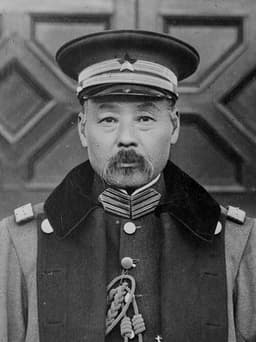
Feng Guozhang
General · Modern
49.1Total
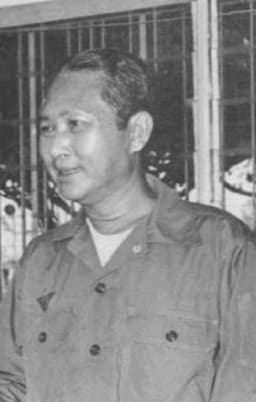
Lon Nol
General · Modern
41.5Total
Basic Information
Born
1859
1913
Died
1919
1985
Era
Modern
Modern
Nationality
China
Cambodia
Occupation
General
General
Civilization
Eastern
Eastern
Score Comparison
Military (10%)
30.0
25.9
Political (20%)
61.3
30.8
Influence (20%)
54.9
47.9
Legacy (20%)
45.8
38.3
Leadership (15%)
40.0
61.1
Strategy (15%)
57.5
35.7
TOTAL
49.1
41.5
Feng Guozhang — Complete Timeline
1912 AD
Command of the Beiyang ArmyPolitical Action◆ Major
Feng Guozhang became a key commander of the Beiyang Army under Yuan Shikai. He controlled military forces in the Zhili region, establishing himself as a major warlord in northern China after the fall of the Qing dynasty.
Beiyang ArmyWarlordMilitary Command
Impact: national
1916 AD
Appointment as Vice PresidentPolitical Action◆ Major
Feng Guozhang was elected Vice President of the Republic of China under President Li Yuanhong. This position gave him significant political influence during the early Republican period.
Republic of ChinaGovernmentPolitics
Impact: national
1917 AD
Acting PresidencyPolitical Action◆ Major
Feng Guozhang became Acting President of the Republic of China after Li Yuanhong's resignation. He served from 1917 to 1918, facing challenges from rival warlords and struggling to maintain central authority.
Republic of ChinaPresidencyWarlord Era
Impact: national
1918 AD
Conflict with Duan QiruiPolitical Action◆ Major
Feng Guozhang engaged in a power struggle with Premier Duan Qirui, leading to the split of the Beiyang clique into the Zhili and Anhui factions. This conflict weakened the central government and intensified warlord warfare.
Beiyang CliquePower StruggleWarlord Era
Impact: nationaldestructive
Lon Nol — Complete Timeline
1970 AD
Coup against Norodom SihanoukPolitical Action
Lon Nol led a military coup that overthrew King Sihanouk while he was abroad. He established the Khmer Republic, ending the monarchy and aligning Cambodia with the United States during the Vietnam War.
CoupKhmer RepublicUS alliance
Impact: nationaldestructive
Declaration of the Khmer RepublicPolitical Action◆ Major
Lon Nol officially proclaimed the Khmer Republic, abolishing the monarchy. He became president and implemented a pro-American, anti-communist regime, which led to civil war with the Khmer Rouge and North Vietnamese forces.
RepublicRegime changeCivil War
Impact: national
1975 AD
Fall of Phnom PenhWar
Lon Nol's government collapsed as Khmer Rouge forces captured Phnom Penh. He fled into exile in the United States, ending the Khmer Republic and leading to the establishment of Democratic Kampuchea under Pol Pot.
Khmer Rouge victoryExileRegime collapse
Impact: nationaltragic
Expert Analysis
Feng Guozhang vs Lon Nol
# The General Who Could Not Hold the Center
On a hot March morning in 1970, Cambodia’s King Norodom Sihanouk boarded a plane for Moscow, leaving behind a kingdom he had ruled for nearly three decades. Within hours, his prime minister and defense chief, Lon Nol, set in motion a coup that would shatter the fragile peace of Southeast Asia. Half a century earlier and a thousand miles to the north, another general, Feng Guozhang, stood in the Forbidden City, watching the last emperor of China abdicate. Both men were generals who seized power in moments of national crisis. Both believed they could steer their countries toward stability. Both failed—but their failures illuminate two very different paths through the modern history of Asia.
Origins
Lon Nol was born in 1913 into a provincial Khmer family in what was then French Indochina. His father was a minor official in the colonial administration, and young Lon Nol absorbed the conservative, hierarchical values of a society that had never been fully conquered by the West but had been profoundly shaped by it. He joined the French colonial army, rising through the ranks as a loyal, competent officer. The world he knew was one of deference to authority, of French supervision, of a monarchy that was both sacred and weak. When he took power, he was fifty-seven years old, a man who had spent his entire adult life in uniform, trained to obey orders rather than to question them.
Feng Guozhang, born in 1859, came of age in a China that was being torn apart by foreign invasions, internal rebellions, and the slow collapse of the Qing dynasty. His family were minor scholar-officials, and Feng himself received a traditional Confucian education before entering the new-style military academy at Baoding. He was among the first generation of Chinese officers trained in modern warfare, and he served under Yuan Shikai, the most powerful warlord of the early Republic. Feng was a man of two worlds: the old world of imperial examinations and filial piety, and the new world of machine guns and telegraph lines.
Rise to Power
Lon Nol rose through the ranks of Cambodia’s post-independence army with steady competence. He was not a visionary or a charismatic leader; he was a reliable administrator who could be trusted with logistics and discipline. His great opportunity came in 1970, when Sihanouk—the mercurial king who had kept Cambodia neutral in the Vietnam War—was abroad. Lon Nol, with the backing of conservative generals and American intelligence, moved swiftly. The coup was almost bloodless. Sihanouk was deposed, the monarchy abolished, and the Khmer Republic proclaimed. Lon Nol became president, a general in a suit, presiding over a country he had never truly understood.
Feng Guozhang’s rise was more gradual and more political. He served as a key commander under Yuan Shikai, the strongman who briefly declared himself emperor before dying in 1916. In the chaos that followed, Feng was elected Vice President of the Republic of China under Li Yuanhong. When Li resigned in 1917, Feng became Acting President. His path to power was not a coup but a constitutional crisis—a sign of how different China’s political landscape was from Cambodia’s. Feng was a warlord, but he operated within the shell of a republic, with a parliament, a constitution, and a capital in Beijing.
Leadership & Governance
Lon Nol’s rule was a disaster. He was a military man who tried to run a country at war, but he had no strategy for peace. His regime was corrupt, inefficient, and increasingly brutal. He relied on American aid and American advisors, but he could not control his own army, let alone the countryside. The Khmer Rouge, a communist insurgency that had been weak under Sihanouk, grew rapidly after the coup, fueled by popular anger at Lon Nol’s pro-American policies and his bombing of rural areas. Lon Nol’s military score of 44.6 reflects his incompetence as a commander; his political score of 74.3 is generous, given his inability to build a lasting coalition. He was a man out of his depth.
Feng Guozhang, by contrast, was a more skilled politician. His military score of 62.6 and political score of 81.7 suggest a man who understood power but could not hold it. As Acting President, he tried to mediate between the northern warlords of the Anhui clique and the southern revolutionaries of Sun Yat-sen. He was a moderate, seeking compromise in an era of extremes. But his power base was weak. He controlled the Zhili region, but his rival Duan Qirui controlled the government in Beijing. In 1918, the two clashed openly, splitting the Beiyang clique into factions that would fight for the next decade. Feng’s leadership score of 87.3 is the highest of any figure in this comparison, but it was leadership without a country to lead.
Triumph & Tragedy
Lon Nol’s greatest moment was also his most tragic. In 1970, he declared the Khmer Republic, ending a thousand years of monarchy. He believed he was modernizing Cambodia, freeing it from the past. But the republic was a fiction. By 1975, the Khmer Rouge had surrounded Phnom Penh. Lon Nol fled to the United States, leaving behind a city that would be emptied of its people, a country that would descend into genocide. He died in 1985, a forgotten exile in Hawaii.
Feng Guozhang’s tragedy was quieter but no less profound. He served as Acting President from 1917 to 1918, a brief window of relative stability. But he could not unite the warlords, could not stop the slide into civil war. In 1918, he was forced to resign, replaced by Xu Shichang, a figurehead for Duan Qirui. Feng retired to his estate, a wealthy man but a broken one. He died in 1919, just as the May Fourth Movement was beginning—a movement that would sweep away everything he had tried to preserve.
Character & Destiny
Lon Nol was a man of rigid loyalty and limited imagination. He saw the world in black and white: communists were evil, America was good, monarchy was backward. He could not grasp the complexity of Cambodian society, the deep roots of the peasantry, the appeal of revolutionary nationalism. His character was his destiny: a general who could only fight, never build.
Feng Guozhang was more flexible, more pragmatic, but also more cynical. He was a survivor, not a crusader. He shifted alliances when convenient, made deals with enemies, and never committed fully to any cause. His character was also his destiny: a politician who could maneuver but never lead.
Legacy
Lon Nol’s legacy is almost entirely negative. He is remembered as the man who opened the door to the Khmer Rouge, who destroyed the monarchy, who brought Cambodia to ruin. His legacy score of 53.6 reflects this judgment: he is a footnote in history, a cautionary tale.
Feng Guozhang’s legacy is more ambiguous. He is remembered as one of the Beiyang warlords, a figure of the chaotic early Republic. But his moderation and his attempts at constitutional government have earned him some respect from historians. His legacy score of 64.4 is higher than Lon Nol’s, but still modest. He is a reminder that in times of revolution, the center cannot hold.
Conclusion
Two generals, two failures, two countries torn apart by forces they could not control. Lon Nol tried to impose order through force and ended up unleashing chaos. Feng Guozhang tried to preserve order through compromise and ended up watching it slip away. Their stories remind us that leadership is not just about power—it is about understanding the world you are trying to change. And in that, both men fell short. The center did not hold, because they themselves were not centered. They were products of their times, not masters of them. And history, as always, moved on without them.
Rankings
🥇
Feng GuozhangLeader
Mil: 30.0Pol: 61.3Inf: 54.9
49.1
🥈
Lon Nol
Mil: 25.9Pol: 30.8Inf: 47.9
41.5
+7.6 behind
How This Comparison Works
Algorithm
Each figure is scored on 6 dimensions (0—100 scale) based on structured historical data: Military (10%), Political (20%), Influence (20%), Legacy (20%), Leadership (15%), Strategy (15%). The weighted total produces the final ranking.
Data Sources
Scores are computed from structured sub-indicators in the database. Scale factors adjust for era (Ancient ×0.85, Modern ×1.0) and civilization size (Eastern ×1.05, Other ×0.80) to account for differences in population and military scale.
Maximum 3 Figures
Comparisons are limited to 2—3 figures to ensure readability and statistical meaningfulness.
Error Margins
±5 points per dimension — Sub-scores are derived from historical records with inherent uncertainty. Two figures within 5 points on a dimension should be considered roughly equivalent in that area.
Total Score Accuracy
±3 points overall — The weighted combination of 6 dimensions produces a total score with approximately ±3 points of uncertainty. Differences of less than 3 points are not statistically significant— the figures are effectively tied.
Known Limitations
- Historical records are incomplete and uneven across civilizations
- Figures from oral-tradition societies may be underrepresented
- Occupation labels can misclassify multi-role figures
- Scores measure capability and impact, not moral character
- Quantitative scoring is a comparison tool, not absolute truth
Capability Radar
Military (10%) — Battles & Warfare
Battles
45
15
Win Rate
40
10
Expansion
35
5
Political (20%) — Governance & Reform
Reform
30
10
Diplomacy
45
15
Economy
25
5
Influence (20%) — Cultural & Global Reach
Cultural
30
5
Global
20
10
Legacy (20%) — Historical Impact
Historical
40
15
Longevity
25
5
Leadership (15%) — Power & Stability
Tenure
55
40
Stability
20
5
Strategy (15%) — Tactics & Innovation
Strategy
55
15
Tactics
50
20
Reform
40
10
Similar Comparisons
Comments & Discussion
北洋之虎6/16/2026
冯国璋那是真北洋正统,民国副总统出身,根正苗红!他辅佐袁世凯训练新军、镇压革命党,手里有北洋嫡系部队。换了你们这些键盘历史学家坐那把交椅,未必能比他稳!他最大的败笔是太听段祺瑞的,把老袁的儿子推出来当傀儡,这不是给自己挖坑嘛!他要是干脆自己当临时总统,历史可能要重写。别拿他跟那个柬埔寨的土军阀比,差距太大了。
Lon No-Laughingstock6/16/2026
Comparing Feng Guozhang to Lon Nol is like comparing a chess grandmaster to a man who doesn't know how the pieces move. Feng was a genuine product of China's military modernization under Yuan Shikai, trained by German instructors at the Baoding Military Academy, and commanded real influence over the Beiyang Army. Lon Nol was a French colonial lapdog whose coup directly created the Khmer Rouge. He literally asked Nixon for military aid while his own army was fighting against unarmed peasants. Fen
碑林巡游者6/16/2026
这两位“守门人”的故事本质相同:都以为军队能压住历史潮流。冯国璋反对袁世凯称帝,又不敢彻底跟段祺瑞翻脸,结果张勋复辟时他两头不讨好。他最大的悲剧不是能力差,是明知北洋系统烂透了还要往里添柴。而朗诺呢?他以为靠美国飞机就能稳住高棉农村?柬埔寨农民早就不吃他那套神权加军阀的配方了。两人都是旧时代的最后殉葬品,差别只是棺材的原材料不同罢了。
Data Doppelgänger6/16/2026
Let's look at the actual numbers. Feng Guozhang's July 1917 confrontation with Zhang Xun: Feng had roughly 50,000 troops under his command, but refused to march on Beijing until Duan Qirui showed up with an army. That's not leadership—that's waiting for the cavalry while Rome burns. Lon Nol's structural failures: by 1972, his government controlled maybe 30% of Cambodia's countryside, while the Khmer Rouge had consolidated the rest. Both men presided over regimes that lost territorial control wit