Loading...
Emperor Wen of Sui vs Ferdinand I of Leon
Emperor Wen of Sui leads by 21.1 pts · 2 figures compared
…
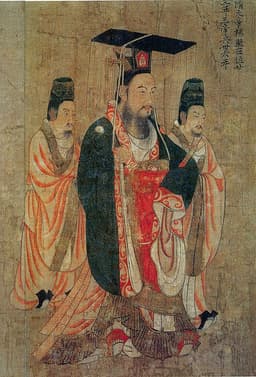
Emperor Wen of Sui
Emperor · Medieval
80.3Total
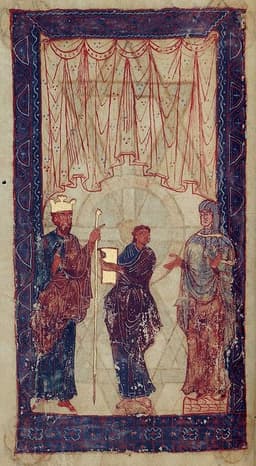
Ferdinand I of Leon
Emperor · Medieval
59.2Total
Basic Information
Born
541
1015
Died
604
1065
Era
Medieval
Medieval
Nationality
China
Leon
Occupation
Emperor
Emperor
Civilization
Eastern
Western
Score Comparison
Military (10%)
76.0
70.0
Political (20%)
75.0
68.0
Influence (20%)
88.0
56.4
Legacy (20%)
80.0
49.2
Leadership (15%)
80.0
66.0
Strategy (15%)
75.0
57.5
TOTAL
80.3
59.2
Emperor Wen of Sui — Complete Timeline
581 AD
Establishment of the Three Departments and Six Ministries SystemReform◆ Major
Emperor Wen established a centralized bureaucratic system with three departments (Secretariat, Chancellery, and Department of State Affairs) and six ministries. This system became the foundation of Chinese government administration for centuries.
Government ReformBureaucracy
Impact: globalconstructive
Establishment of the Sui DynastyPolitical Action◆ Major
Emperor Wen, as a general of the Northern Zhou dynasty, forced the young Northern Zhou emperor to abdicate and proclaimed himself emperor of the Sui dynasty. This marked the beginning of the Sui dynasty, which would go on to reunify China.
Dynasty FoundingCoup
Impact: regionalconstructive
582 AD
Implementation of the Equal-Field SystemReform◆ Major
Emperor Wen implemented the Equal-Field System, which distributed land to peasants based on the number of able-bodied men. This reform increased agricultural productivity, stabilized tax revenues, and reduced the power of large landowners.
Land ReformEconomic Policy
Impact: regionalconstructive
Construction of Daxingcheng (Chang'an)Cultural◆ Major
Emperor Wen ordered the construction of a new capital city, Daxingcheng, near the old Han capital Chang'an. This city, later known as Chang'an, became a model for urban planning and served as the capital of the Sui and Tang dynasties.
Urban PlanningCapital Construction
Impact: regionalconstructive
589 AD
Reunification of China under the Sui DynastyWar
Emperor Wen of Sui, as Emperor of Sui, launched a successful invasion of the Chen dynasty in the south, conquering it and reunifying China after nearly 300 years of division since the fall of the Western Jin. This ended the Northern and Southern Dynasties period.
UnificationConquest
Impact: globalconstructive
Ferdinand I of Leon — Complete Timeline
1029 AD
Inheritance of the County of CastilePolitical Action◆ Major
Ferdinand I inherited the County of Castile from his father Sancho III of Navarre. He later expanded his territory through conquest and marriage, laying the foundation for the Kingdom of Castile.
Impact: regionalconstructive
1037 AD
Conquest of LeónWar◆ Major
Ferdinand I defeated and killed King Bermudo III of Le
Impact: regional
1056 AD
First Emperor of SpainPolitical Action◆ Major
Ferdinand I was crowned 'Imperator totius Hispaniae' (Emperor of all Spain) in 1056, claiming suzerainty over all Christian and Muslim rulers in Iberia. This title reflected his military dominance and political ambition.
Impact: regional
1065 AD
Division of the kingdomPolitical Action◆ Major
Upon his death, Ferdinand I divided his kingdom among his sons: Sancho II received Castile, Alfonso VI received Le
Impact: regionaldestructive
Expert Analysis
Ferdinand I of Leon vs Emperor Wen of Sui
### The Reunifier and the Emperor of Spain: Two Paths to Power
In the year 589, a Chinese general-turned-emperor watched from the walls of Jiankang as his armies swept into the last bastion of the Chen dynasty, ending nearly three centuries of division. Half a world and a millennium away, in 1056, a king of Leon placed a crown upon his own head in the cathedral of León, proclaiming himself “Imperator totius Hispaniae” — Emperor of all Spain. Both men sought to forge unity from chaos. Yet one succeeded in creating a dynasty that would reshape an entire civilization, while the other left a kingdom fractured by his own hand. What drove these two rulers down such different paths?
### Origins: The Crucible of Division
Emperor Wen of Sui, born Yang Jian in 541, emerged from the blood-soaked soil of northern China during the Northern and Southern Dynasties period, an era of constant warfare and shifting alliances. His father was a general of the Western Wei state, and Yang Jian grew up in a world where survival depended on military prowess and political cunning. The chaos of his youth taught him that order was fragile, and that power must be centralized to endure.
Ferdinand I of Leon, born in 1015, came of age in a very different kind of fragmentation. The Christian kingdoms of northern Spain were locked in a centuries-long struggle against the Moorish taifas, but also against each other. His father, Sancho III of Navarre, had briefly united much of Christian Spain, but his death in 1035 shattered that unity. Ferdinand inherited the County of Castile, a small, hardscrabble territory on the frontier of faith and war. His world was one of personal loyalty, feudal bonds, and the constant threat of betrayal from brother and neighbor alike.
The difference in their formative landscapes was profound. Wen learned that chaos came from weak central authority; Ferdinand learned that power was personal, tied to land and blood.
### Rise to Power: The General and the Heir
Emperor Wen’s path to the throne was a masterpiece of calculated patience. As a general of the Northern Zhou dynasty, he had earned the trust of the imperial family. When the young emperor died in 580, Wen seized the regency, outmaneuvered rivals, and in 581 forced the child-emperor to abdicate. He did not simply take power; he constructed a narrative of legitimacy, claiming the Mandate of Heaven had passed to him. His rise was a cold, deliberate act of statecraft.
Ferdinand’s ascent was more straightforward, rooted in the feudal logic of inheritance and conquest. He inherited Castile from his father in 1029, but his real breakthrough came in 1037 at the Battle of Tamarón, where he defeated and killed King Bermudo III of León. By right of conquest and marriage to Bermudo’s sister, Ferdinand claimed the Kingdom of León. He was not a usurper in the Chinese sense; he was a warrior-king following the rules of his world, where a crown was won by the sword.
### Leadership & Governance: Bureaucracy vs. Fealty
Once on the throne, Emperor Wen revealed his true genius. In 581, he established the Three Departments and Six Ministries system, a centralized bureaucracy that would influence Chinese government for centuries. The next year, he implemented the Equal-Field System, distributing land to peasants based on able-bodied men in each household, breaking the power of landed aristocrats and creating a tax-paying peasantry. He built a new capital, Daxingcheng (later Chang’an), a symbol of order and unity. His rule was systematic, rational, and ruthless.
Ferdinand governed differently. He expanded his realm through relentless campaigns against the Moors, extracting tribute and pushing the Christian frontier southward. His military strategy was effective but not revolutionary — he relied on the traditional heavy cavalry and feudal levies of medieval Spain. Politically, he maintained power through a network of personal loyalties and church alliances. In 1056, his coronation as Emperor of Spain was a symbolic claim, not a bureaucratic reality. He had no departments, no land reforms, no new capital. His empire was a patchwork of personal domains.
The key difference lay in their vision of power. Wen saw power as a system to be designed; Ferdinand saw it as a possession to be held.
### Triumph & Tragedy: Unity and Division
Emperor Wen’s greatest triumph came in 589, when his armies conquered the Chen dynasty, reunifying China for the first time since the fall of the Han. It was a military campaign of stunning efficiency, but its true significance was political: he had ended an era of division that had lasted nearly 300 years. His tragedy was that his dynasty would not survive him by long. His son, Emperor Yang, would squander his father’s achievements through megalomaniacal projects and disastrous wars, leading to the Sui’s collapse in 618.
Ferdinand’s triumph was his coronation as Emperor of Spain, a title that reflected his dominance over the Christian kingdoms. But his tragedy was immediate and self-inflicted. Upon his death in 1065, he divided his kingdom among his three sons: Sancho received Castile, Alfonso received León, and García received Galicia. The unity he had claimed was shattered in a single act. The partition led to decades of fratricidal war, undoing much of his life’s work.
### Character & Destiny: The Architect and the Warrior
Emperor Wen was a man of iron discipline and cold calculation. He trusted no one, purged rivals without hesitation, and built systems that could outlast any individual. His personality was that of an architect: he designed for permanence, even if his materials were flawed. Ferdinand, by contrast, was a warrior-king in the medieval mold. He thought in terms of inheritance, honor, and the bonds of kinship. His decision to divide his kingdom was not a failure of vision but a reflection of his world — a world where a father’s duty was to provide for all his sons, even at the cost of unity.
### Legacy: The Founder and the Forefather
Emperor Wen’s legacy is monumental. The Sui dynasty lasted only 37 years, but its systems — the Three Departments and Six Ministries, the Equal-Field System, the Grand Canal begun by his son — became the bedrock of the Tang dynasty and Chinese imperial governance for centuries. He is remembered as a founder, the man who made the great Tang possible.
Ferdinand’s legacy is more ambiguous. He is remembered as the first to claim the title Emperor of Spain, but his division of the kingdom ensured that true unification would not come until the Catholic Monarchs, Isabella and Ferdinand, nearly 400 years later. He is a figure of potential unfulfilled, a king who reached for an empire but could not hold it.
### Conclusion: Two Kinds of Unity
Both men lived in ages of fragmentation and dreamed of unity. Emperor Wen of Sui built a machine of state that could impose order from the center, creating a template for Chinese civilization that would endure for centuries. Ferdinand I of Leon, bound by the feudal logic of his time, could only unite through personal conquest and then shattered that unity through the same logic. Their stories remind us that the tools a leader uses shape the legacy they leave. One built a system; the other built a crown. And in the end, systems outlast crowns.
Rankings
🥇
Emperor Wen of SuiLeader
Mil: 76.0Pol: 75.0Inf: 88.0
80.3
🥈
Ferdinand I of Leon
Mil: 70.0Pol: 68.0Inf: 56.4
59.2
+21.1 behind
How This Comparison Works
Algorithm
Each figure is scored on 6 dimensions (0—100 scale) based on structured historical data: Military (10%), Political (20%), Influence (20%), Legacy (20%), Leadership (15%), Strategy (15%). The weighted total produces the final ranking.
Data Sources
Scores are computed from structured sub-indicators in the database. Scale factors adjust for era (Ancient ×0.85, Modern ×1.0) and civilization size (Eastern ×1.05, Other ×0.80) to account for differences in population and military scale.
Maximum 3 Figures
Comparisons are limited to 2—3 figures to ensure readability and statistical meaningfulness.
Error Margins
±5 points per dimension — Sub-scores are derived from historical records with inherent uncertainty. Two figures within 5 points on a dimension should be considered roughly equivalent in that area.
Total Score Accuracy
±3 points overall — The weighted combination of 6 dimensions produces a total score with approximately ±3 points of uncertainty. Differences of less than 3 points are not statistically significant— the figures are effectively tied.
Known Limitations
- Historical records are incomplete and uneven across civilizations
- Figures from oral-tradition societies may be underrepresented
- Occupation labels can misclassify multi-role figures
- Scores measure capability and impact, not moral character
- Quantitative scoring is a comparison tool, not absolute truth
Capability Radar
Military (10%) — Battles & Warfare
Battles
75
55
Win Rate
80
60
Expansion
85
60
Political (20%) — Governance & Reform
Reform
95
50
Diplomacy
85
55
Economy
90
45
Influence (20%) — Cultural & Global Reach
Cultural
70
40
Global
65
30
Legacy (20%) — Historical Impact
Historical
85
45
Longevity
70
40
Leadership (15%) — Power & Stability
Tenure
80
65
Stability
75
50
Strategy (15%) — Tactics & Innovation
Strategy
85
55
Tactics
70
50
Reform
90
40
Similar Comparisons
Comments & Discussion
铁血史官6/16/2026
两个“统一者”的本质差别在史料里暴露无遗。隋文帝靠的是精密渗透——在灭陈前二十年就安插间谍、分化南朝将领,而斐迪南一世只是个挥舞十字架的军阀,连“皇帝”头衔都是死后才被追封的。要论战略眼光,杨坚甩他几条长江。数据会说话:隋朝统一后疆域约400万平方公里,斐迪南的“全西班牙”顶多25万。
ImperatorBait6/16/2026
Look, calling Ferdinand I "Emperor of all Spain" is a joke — it’s like a kid putting a paper crown on his cat. León controlled maybe 60,000 square kilometers of northern Spain. Meanwhile, Emperor Wen crushed the Chen dynasty and ruled 400 million people. One was a conqueror with a solid administrative legacy, the other was a local warlord who couldn’t even stop his kingdom from splitting three ways after his death. Medieval hubris at its finest.
隋唐掘墓人6/16/2026
别把隋文帝吹成完美统一者。他的“大隋”政策核心是均田制和府兵制,这确实稳固,但斐迪南一世干的脏活才叫硬核——他逼穆斯林小国给贡金(parias),用金银买雇佣兵蚕食领土。杨坚继承的是北周现成帝国机器,斐迪南是从基督教小王国啃出帝国梦。数据对比失衡是因为时代和资源根本不对等。批评者常常忽略:环境决定手段。
ClassicsClash6/16/2026
Both men understood legitimacy theater, but Wen’s script was Confucian bureaucracy while Ferdinand’s was Roman-imperial fantasy. Emperor Wen abolished the Nine-Rank system to centralize talent selection sheer genius. Ferdinand, however, minted coins reading "Imperator" after bullying a few Moorish taifas into submission. One created a unified tax and grain storage system that lasted centuries; the other left a partitioned kingdom where his sons fought like hungry dogs. That’s the gap between sta
乱世判官6/16/2026
说到底,两人面对的根本不是一个量级的混乱。三百年的南北朝分裂已经造就了“统一”的意识形态需求,隋文帝不过是顺势而为;而伊比利亚半岛在11世纪仍是群雄割据的碎片化状态,斐迪南一世能从血仇里拼出一顶皇冠,已经算超常发挥。客观说,他的失败不是能力问题,是历史窗口没开。硬要比?杨坚是开国基业,斐迪南只能算中难度剧本的过关玩家。