Loading...
Emperor Sujin vs Oduduwa
Oduduwa leads by 8.1 pts · 2 figures compared
…
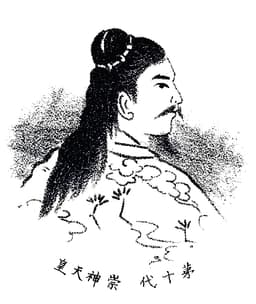
Emperor Sujin
Emperor · Ancient
51.6Total
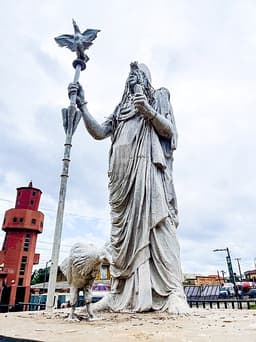
Oduduwa
Emperor · Medieval
59.7Total
Basic Information
Born
-148
950
Died
-30
1020
Era
Ancient
Medieval
Nationality
Japan
Ife
Occupation
Emperor
Emperor
Civilization
Eastern
Other
Score Comparison
Military (10%)
50.0
50.0
Political (20%)
68.0
46.6
Influence (20%)
47.1
68.0
Legacy (20%)
43.3
68.0
Leadership (15%)
72.0
67.0
Strategy (15%)
30.3
36.8
TOTAL
51.6
59.7
Emperor Sujin — Complete Timeline
100 BC
Organized the Yamato StateReform◆ Major
Emperor Sujin is recorded in the Nihon Shoki as having organized the Yamato state, establishing administrative structures and military garrisons. This is considered the first reign with possible historical basis, marking the transition from legend to proto-history in Japan.
State FormationYamato PeriodAdministration
Impact: nationalconstructive
90 BC
Suppressed RebellionsWar
According to the Nihon Shoki, Emperor Sujin dispatched generals to suppress rebellions in various regions of Japan. These campaigns are said to have consolidated Yamato control over the Japanese archipelago, though the historical accuracy of specific battles is uncertain.
Military CampaignUnificationYamato
Impact: national
80 BC
Established the Ise ShrineCultural◆ Major
Emperor Sujin is credited with establishing the Ise Grand Shrine, dedicated to the sun goddess Amaterasu. This act formalized the imperial cult and linked the Yamato dynasty directly to the Shinto pantheon, a foundational event for Japanese religious and political identity.
ShintoImperial CultReligion
Impact: nationalconstructive
Oduduwa — Complete Timeline
1000 AD
Foundation of the Yoruba civilization at Ile-IfeCultural
According to Yoruba oral tradition, Oduduwa descended from heaven at Ile-Ife and founded the Yoruba civilization. He is credited with establishing the first Yoruba kingdom and the sacred city of Ile-Ife, which became the spiritual and cultural heartland of the Yoruba people.
Impact: regionalconstructive
1010 AD
Establishment of the Yoruba royal dynastiesPolitical Action◆ Major
Oduduwa is said to have sent his sons and grandsons to found the various Yoruba kingdoms, including Oyo, Benin, and Ketu. This act established the royal lineages that ruled these states for centuries, creating a network of related kingdoms under the spiritual authority of the Ooni of Ife.
Impact: regionalconstructive
Expert Analysis
Emperor Sujin vs Oduduwa
### The First Kings: Oduduwa and Emperor Sujin, Founders of Worlds
In the shadowy dawn of a civilization, a figure descends from the heavens, bearing the tools of creation. In another, a mortal emperor, his name etched into the first chronicles of a nation, sends his armies to quell chaos. One is a myth made flesh; the other, a man made legend. Oduduwa, the progenitor of the Yoruba, and Emperor Sujin, the organizer of Yamato Japan, never met, yet their stories grapple with the same profound question: how does a ruler transform a collection of people into a kingdom? Their answers, forged in different worlds, reveal the very nature of founding power.
### Origins: Heaven and History
Oduduwa’s origins are woven from the fabric of the divine. Born around 950, he belongs not to the realm of verifiable history but to the sacred memory of the Yoruba people. According to tradition, he descended from the sky at Ile-Ife, carrying a handful of earth, a five-toed chicken, and a palm nut—the primordial ingredients of creation. He was not merely a king; he was an arch-divinity, a force of nature who shaped the world from a primordial swamp. His era was medieval, a time of emerging kingdoms in West Africa, where the spiritual and the political were one.
Emperor Sujin, by contrast, is a figure of ancient Japan, born in 148 BCE and dying in 30 BCE. He is the first emperor for whom historians can find a glimmer of historicity, a man who emerges from the fog of the *Kojiki* and *Nihon Shoki*—the mytho-historical chronicles of Japan. He was not a god who walked the earth, but a ruler who inherited a lineage claiming descent from the sun goddess Amaterasu. His world was the Yamato court, a nascent state struggling to impose order on the warring clans of the Japanese archipelago. Where Oduduwa’s authority came from the sky, Sujin’s rested on a fragile, human lineage.
### Rise to Power: The Descent and the Dispatch
For Oduduwa, power was not seized; it was bestowed in a cosmic event. The year 1000 marks the foundation of the Yoruba civilization at Ile-Ife. His rise is a single, dramatic act: the descent from heaven. He did not climb a ladder of political maneuvering; he was the ladder. His authority was absolute, unchallengeable, and immediate. The turning point of his life was not a battle, but a creation.
Emperor Sujin’s path was far more arduous. His rise is recorded in the *Nihon Shoki* as a process of organization and suppression. Around 100 BCE, he began to organize the Yamato State, establishing an administrative structure that could tax, command, and control. But order invited rebellion. Around 90 BCE, he dispatched generals to suppress uprisings in the provinces. His rise to power was not a single event but a series of campaigns, a slow, bloody consolidation of authority over a fractured land. He was a warlord-emperor, his legitimacy earned through the sword and the seal of the court.
### Leadership & Governance: The Father of Kings and the Administrator of Gods
Oduduwa’s leadership was patriarchal and spiritual. With a Political score of 72.0 and a Leadership score of 81.7, he was a master of divine governance. Around 1010, he sent his sons and grandsons to found the various Yoruba kingdoms—Oyo, Benin, Ketu, and others. This was not conquest in the military sense (his Military score is a mere 11.4); it was a sacred diaspora. He was the father of kings, and every *Oba* in Yorubaland traces their lineage back to him. His rule was about establishing a spiritual and cultural DNA, a template for kingship that would last a millennium.
Emperor Sujin’s governance was administrative and religious. His Leadership score of 86.6 reflects a hands-on, authoritative ruler. Around 80 BCE, he established the Ise Grand Shrine, dedicated to the sun goddess Amaterasu, formalizing the link between the imperial throne and the divine. This was a masterstroke of political theology. By building a shrine, he did not just honor a god; he centralized worship, creating a state religion that served the state. His reforms (Political score of 69.4) were about structure—taxes, military commands, and a bureaucracy that could hold the Yamato realm together. He was less a father and more a chief executive of the divine.
### Triumph & Tragedy: The Legacy of Progeny and the Silence of War
Oduduwa’s greatest triumph was the foundation of the Yoruba civilization itself. His legacy is not a monument or a city wall, but a people. The tragedy lies in the loss of his story to history. We know him only through myth, his life a parable rather than a biography. His military score of 11.4 and Strategy of 30.0 suggest he was no general, but he needed none—his power was not of this world.
Emperor Sujin’s triumph was the suppression of rebellions, the establishment of the Ise Shrine, and the creation of a workable state. His tragedy is the silence of the historical record. We know he acted, but we do not know his face, his voice, or his heart. The *Nihon Shoki* records his deeds, but they are laconic, stripped of personality. His wars were successful, but they were also brutal, and the cost in blood is unrecorded. He is the first emperor with a shadow of history, but also the first to be forgotten as a man.
### Character & Destiny: The Divine and the Dutiful
Oduduwa’s character is a function of his myth. He is serene, creative, and paternal. His destiny was to be the source. He did not make choices; he was the choice of the gods. His personality is that of a founder—generous, authoritative, and eternal.
Emperor Sujin’s character is one of duty and pragmatism. He was a man who had to build a state from a court. He was likely stern, decisive, and ruthless when necessary. His destiny was to be the organizer. He faced rebellion and answered with armies; he faced a disorganized religion and answered with a shrine. He was a builder, not a creator, and his personality reflects the weight of that burden.
### Legacy: The Living Tradition and the Imperial Line
Oduduwa’s legacy is immense. With scores of 69.2 for Influence and 69.9 for Legacy, he remains the spiritual father of over 40 million Yoruba people today. His name is invoked in coronations, his story told in festivals. He is not remembered; he is lived. Every Yoruba king is, in a sense, Oduduwa reborn.
Emperor Sujin’s legacy is more institutional. His organization of the Yamato state laid the foundation for the imperial system that continues in Japan today. The Ise Shrine remains the holiest site in Shinto. His influence (67.8) and legacy (62.2) are slightly lower, perhaps because he is a link in a chain, not the first link. He is honored in the imperial lineage, but he is not the progenitor—that place belongs to the mythical Emperor Jimmu.
### Conclusion: The Mirror of Founding
Oduduwa and Sujin stand as two faces of the same archetype: the founder. One built a civilization with a handful of earth and a chicken; the other, with a sword and a shrine. One is remembered in myth, the other in chronicle. Their differences are not just of time and place, but of the very nature of power. Oduduwa shows us that some kingdoms are born of faith and family; Sujin shows us that others are forged in war and administration. In the end, both succeeded. The Yoruba kings still sit on their thrones, and the Chrysanthemum Throne still stands. The first rulers, whether divine or dutiful, always leave the deepest mark.
Rankings
🥇
OduduwaLeader
Mil: 50.0Pol: 46.6Inf: 68.0
59.7
🥈
Emperor Sujin
Mil: 50.0Pol: 68.0Inf: 47.1
51.6
+8.1 behind
How This Comparison Works
Algorithm
Each figure is scored on 6 dimensions (0—100 scale) based on structured historical data: Military (10%), Political (20%), Influence (20%), Legacy (20%), Leadership (15%), Strategy (15%). The weighted total produces the final ranking.
Data Sources
Scores are computed from structured sub-indicators in the database. Scale factors adjust for era (Ancient ×0.85, Modern ×1.0) and civilization size (Eastern ×1.05, Other ×0.80) to account for differences in population and military scale.
Maximum 3 Figures
Comparisons are limited to 2—3 figures to ensure readability and statistical meaningfulness.
Error Margins
±5 points per dimension — Sub-scores are derived from historical records with inherent uncertainty. Two figures within 5 points on a dimension should be considered roughly equivalent in that area.
Total Score Accuracy
±3 points overall — The weighted combination of 6 dimensions produces a total score with approximately ±3 points of uncertainty. Differences of less than 3 points are not statistically significant— the figures are effectively tied.
Known Limitations
- Historical records are incomplete and uneven across civilizations
- Figures from oral-tradition societies may be underrepresented
- Occupation labels can misclassify multi-role figures
- Scores measure capability and impact, not moral character
- Quantitative scoring is a comparison tool, not absolute truth
Capability Radar
Military (10%) — Battles & Warfare
Battles
10
10
Win Rate
10
10
Expansion
20
30
Political (20%) — Governance & Reform
Reform
50
50
Diplomacy
30
40
Economy
30
40
Influence (20%) — Cultural & Global Reach
Cultural
30
80
Global
10
70
Legacy (20%) — Historical Impact
Historical
40
80
Longevity
30
80
Leadership (15%) — Power & Stability
Tenure
40
40
Stability
40
50
Strategy (15%) — Tactics & Innovation
Strategy
10
10
Tactics
10
10
Reform
20
10
Similar Comparisons
Comments & Discussion
BATTLEAXE BOB6/16/2026
Sujin actually deployed actual armies; Oduduwa’s "military" is his mythical chicken scratching dirt. Let’s be real—Sujin's campaigns to pacify Yamato tribes are documented in the *Nihon Shoki* with named generals and enemy chiefs. Oduduwa’s "war" is spiritual allegory. If you’re measuring founder-kings, Sujin gets the edge for historical verifiability. Myth is nice, but real steel writes history.
古卷猎手6/16/2026
Sujin不过是《古事记》里的编年史工具人,被推出来填补早期天皇的空白。他的“军事行动”更像是后世为神武天皇正统性打的补丁。反观Oduduwa,他的神圣起源直接连接着约鲁巴人的宇宙观和祖灵信仰—那枚棕榈果不仅象征创造,更暗喻非洲热带生态的结构性智慧。虚位君主哪比得上活的神话?要论根基之深,Oduduwa完胜。
DATA_DEBUNKER6/16/2026
Hold up—you’re comparing a supposed 148 BCE ascension to a 950 CE tradition? That’s a millennium of missing data. Both "reigns" are pieced together from sources centuries later: Sujin from 8th-century court chronicles, Oduduwa from 19th-century colonial ethnography. We don’t have contemporary inscriptions or archaeological proof for either. Let’s call it what it is: two origin myths competing for "best vague founder." No edge here—just two shadows.
城邦守望者6/16/2026
我想问个尖锐的问题:Sujin的“组织能力”真有那么神吗?《日本书纪》里他派兵镇压的“土蜘蛛部族”其实只是一些分散的狩猎采集社群,压根算不上王国威胁。而Oduduwa的创世神话里暗含了约鲁巴人的城市化进程—他在Ife建立的不只是王朝,更是供奉十六位部族首领的宗教-政治联盟。Suijin像在做拼图,Oduduwa直接画了地图。论文明奠基,后者更系统。
PAINTED_WARRIOR6/16/2026
Look past the chicken and the palm nut—Oduduwa’s story encodes a massive migration event. The "descent from heaven" likely masks the arrival of a new metallurgical or agricultural elite into the Niger-Congo basin around 1000 CE. His chicken? A domesticated bird spreading alongside iron tools. Sujin’s chronicles, meanwhile, are court propaganda to legitimize the imperial line during the *ritsuryō* state’s formation. One preserves real history in metaphor; the other muddies it for politics. Give m