Loading...
Emiliano Zapata vs Steve Biko
Emiliano Zapata leads by 6.1 pts · 2 figures compared
…
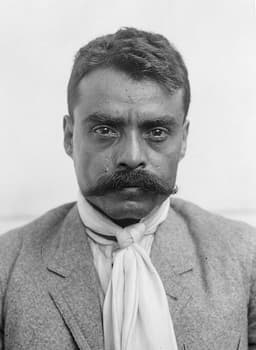
Emiliano Zapata
Revolutionary · Modern
56.3Total

Steve Biko
Revolutionary · Modern
50.2Total
Basic Information
Born
1879
1946
Died
1919
—
Era
Modern
Modern
Nationality
Mexico
South Africa
Occupation
Revolutionary
Revolutionary
Civilization
Western
Other
Score Comparison
Military (10%)
40.0
39.7
Political (20%)
68.0
36.5
Influence (20%)
58.0
58.0
Legacy (20%)
54.0
50.0
Leadership (15%)
54.2
51.7
Strategy (15%)
60.0
60.0
TOTAL
56.3
50.2
Emiliano Zapata — Complete Timeline
1911 AD
Plan of AyalaPolitical Action
Zapata issued the Plan of Ayala, denouncing Francisco I. Madero for failing to implement land reform. The plan called for the return of land to peasants and became the ideological foundation of the Zapatista movement.
Land ReformAgrarian MovementRevolution
Impact: nationalprogressive
1914 AD
Occupation of Mexico CityWar◆ Major
Zapata's forces, allied with Villa's Division of the North, occupied Mexico City. They held the capital for several weeks but failed to establish lasting control, highlighting the limits of their coalition.
Military OccupationRevolutionary AllianceCapital
Impact: national
Convention of AguascalientesPolitical Action◆ Major
Zapata attended the Convention of Aguascalientes, where revolutionary factions attempted to unify. He allied with Pancho Villa against Venustiano Carranza, but the convention failed to produce a stable government.
Revolutionary AlliancePolitical DivisionCivil War
Impact: national
1919 AD
Assassination at ChinamecaPolitical Action
Zapata was lured to the Hacienda de Chinameca by Colonel Jesus Guajardo, who pretended to defect. Guajardo's troops ambushed and killed Zapata, ending his leadership of the agrarian rebellion.
AssassinationBetrayalEnd of Leadership
Impact: nationaltragic
Steve Biko — Complete Timeline
1968 AD
Founded the South African Students' OrganisationPolitical Action
Steve Biko founded SASO, a black student organization that became the core of the Black Consciousness Movement. SASO promoted black pride and psychological liberation from apartheid oppression.
Black ConsciousnessStudent Movement
Impact: nationalconstructive
1973 AD
Banned by the Apartheid GovernmentPolitical Action◆ Major
Biko was banned by the apartheid government, restricting his movement and prohibiting him from speaking publicly. The ban aimed to silence his influence but he continued to organize underground.
Banning OrderRepression
Impact: nationaldestructive
1977 AD
Arrested and Killed in Police CustodyPolitical Action
Biko was arrested at a police roadblock and died from brain injuries sustained during interrogation. His death sparked international outrage and made him a martyr for the anti-apartheid movement.
Death in CustodyMartyrPolice Brutality
Impact: globaltragic
1978 AD
Published 'I Write What I Like'Cultural◆ Major
A collection of Biko's writings and speeches was published posthumously as 'I Write What I Like'. The book articulated the philosophy of Black Consciousness and became a foundational text.
PublicationPhilosophy
Impact: globalconstructive
Expert Analysis
Origins
Emiliano Zapata was born on August 8, 1879, in Anenecuilco, Morelos, Mexico, into a family of mestizo peasants. His father, Gabriel Zapata, was a small-scale farmer, and his mother, Cleofas Salazar, managed the household. Zapata received limited formal education but learned farming and horse riding. He witnessed the exploitation of indigenous communities and the loss of communal lands to large haciendas, which shaped his lifelong commitment to agrarian reform.
Steve Biko was born on December 18, 1946, in Ginsberg, Eastern Cape, South Africa. His father, Mzingaye Biko, was a clerk and later a policeman, and his mother, Nokuzola, worked as a domestic servant. Biko excelled academically, attending Lovedale College and later the University of Natal Medical School. He experienced apartheid's racial segregation firsthand, which motivated him to challenge the system.
Rise to Power
Zapata entered politics in 1909 when he was elected president of the village council of Anenecuilco. He began leading land seizures and resisting the Porfirio Díaz regime. In 1910, he joined Francisco I. Madero's rebellion against Díaz, but after Madero became president and failed to enact land reform, Zapata issued the Plan of Ayala on November 25, 1911. This document demanded the return of land to peasants and denounced Madero, establishing Zapata as the leader of the radical agrarian faction. He allied with Pancho Villa and attended the Convention of Aguascalientes in 1914, but the alliance fractured, and Zapata continued his guerrilla campaign.
Biko's rise began in the late 1960s. He helped found the South African Students' Organisation (SASO) in 1968, serving as its first president. SASO was a black student group that broke away from the multiracial National Union of South African Students, arguing that black students needed their own organization to fight apartheid. In 1972, Biko helped establish the Black Peoples Convention (BPC) to coordinate black consciousness groups. He was banned in 1973, restricting his movement and speech, but he continued to work covertly. His writings, later collected in "I Write What I Like," articulated the philosophy of Black Consciousness.
Leadership & Governance
Zapata led the Liberation Army of the South, a guerrilla force that controlled much of Morelos. His leadership was decentralized, with local commanders given autonomy, but he maintained authority through charisma and shared ideology. He implemented the Plan of Ayala in areas under his control, redistributing land to peasants and establishing communal land tenure. His governance was focused on local autonomy and agrarian reform, but he lacked a broader national vision. He refused to compromise with rivals like Venustiano Carranza, which limited his political reach.
Biko's leadership was intellectual and organizational. He did not command military forces but inspired a generation of activists. His Black Consciousness Movement emphasized psychological liberation and self-reliance, encouraging blacks to reject inferiority complexes imposed by apartheid. He organized community projects, such as health clinics and literacy programs, to build self-sufficiency. His approach was non-violent but confrontational, challenging apartheid's ideology. However, his movement was suppressed by the state, and he was banned from public activity.
Triumph & Tragedy
Zapata's greatest success was the implementation of the Plan of Ayala in Morelos, where land redistribution continued even after his death. His movement forced later governments to address agrarian reform, leading to the 1917 Constitution's Article 27, which provided for land redistribution. However, his failure to ally effectively with other revolutionary factions and his refusal to negotiate led to his assassination on April 10, 1919, at the Hacienda de Chinameca. He was lured by Colonel Jesus Guajardo, who feigned defection, and shot dead. His death temporarily weakened the agrarian movement.
Biko's triumph was the creation of a lasting ideological framework. The Black Consciousness Movement inspired the Soweto Uprising in 1976, where students protested against Afrikaans instruction. Biko's death on September 12, 1977, after being beaten by police, became a global symbol of apartheid's brutality. His martyrdom galvanized international anti-apartheid sentiment. However, his movement was crushed by the state, and many leaders were imprisoned or exiled. Biko never saw the end of apartheid.
Character & Destiny
Zapata was stubborn and principled, often refusing compromise. His dedication to land reform was absolute, but his inflexibility made him enemies. He was a skilled guerrilla tactician but a poor politician. His character, while admired for integrity, contributed to his isolation and eventual killing. Historians often note his score of 60.0 in strategy and 54.2 in leadership, reflecting his effectiveness in local operations but limitations in broader strategy.
Biko was charismatic and intellectual, with a talent for organizing. His focus on psychological liberation was innovative, but his banning and death cut short his influence. He scored 51.7 in leadership and 58.0 in influence, showing strong impact despite limited time. His destiny was shaped by the brutal apartheid state, which saw him as a threat.
Legacy
Zapata's legacy is deeply embedded in Mexican identity. His image appears on currency, in murals, and in popular culture. The Zapatista Army of National Liberation (EZLN) in Chiapas adopted his name in 1994. His demand for land reform influenced Mexican politics for decades. His total score of 56.3 reflects his enduring symbolic power.
Biko's legacy is the Black Consciousness philosophy, which continues to influence South African thought. He is commemorated with statues and memorials, and his writings remain foundational. His death contributed to international sanctions against apartheid. His total score of 50.2 shows his ideological reach despite his short life.
Conclusion
Emiliano Zapata had a greater overall impact than Steve Biko, as reflected in his higher total score of 56.3 versus 50.2. Zapata's land reform efforts directly changed Mexico's land ownership structure, while Biko's primary legacy is ideological. Zapata's movement achieved tangible redistribution, while Biko's influence was more diffuse. Although Biko's ideas inspired a generation, Zapata's actions had more concrete effects on policy and society. Thus, Zapata emerges as the more impactful figure.
Rankings
🥇
Emiliano ZapataLeader
Mil: 40.0Pol: 68.0Inf: 58.0
56.3
🥈
Steve Biko
Mil: 39.7Pol: 36.5Inf: 58.0
50.2
+6.1 behind
How This Comparison Works
Algorithm
Each figure is scored on 6 dimensions (0—100 scale) based on structured historical data: Military (10%), Political (20%), Influence (20%), Legacy (20%), Leadership (15%), Strategy (15%). The weighted total produces the final ranking.
Data Sources
Scores are computed from structured sub-indicators in the database. Scale factors adjust for era (Ancient ×0.85, Modern ×1.0) and civilization size (Eastern ×1.05, Other ×0.80) to account for differences in population and military scale.
Maximum 3 Figures
Comparisons are limited to 2—3 figures to ensure readability and statistical meaningfulness.
Error Margins
±5 points per dimension — Sub-scores are derived from historical records with inherent uncertainty. Two figures within 5 points on a dimension should be considered roughly equivalent in that area.
Total Score Accuracy
±3 points overall — The weighted combination of 6 dimensions produces a total score with approximately ±3 points of uncertainty. Differences of less than 3 points are not statistically significant— the figures are effectively tied.
Known Limitations
- Historical records are incomplete and uneven across civilizations
- Figures from oral-tradition societies may be underrepresented
- Occupation labels can misclassify multi-role figures
- Scores measure capability and impact, not moral character
- Quantitative scoring is a comparison tool, not absolute truth
Capability Radar
Military (10%) — Battles & Warfare
Battles
45
39
Win Rate
50
43
Expansion
35
48
Political (20%) — Governance & Reform
Reform
70
60
Diplomacy
40
40
Economy
35
10
Influence (20%) — Cultural & Global Reach
Cultural
65
65
Global
55
55
Legacy (20%) — Historical Impact
Historical
70
70
Longevity
65
60
Leadership (15%) — Power & Stability
Tenure
30
10
Stability
25
10
Strategy (15%) — Tactics & Innovation
Strategy
50
49
Tactics
55
50
Reform
60
57
Similar Comparisons
Comments & Discussion
No comments yet. Be the first to share your thoughts!