Loading...
Emiliano Zapata vs Napoleon Bonaparte
Napoleon Bonaparte leads by 14.6 pts · 2 figures compared
…
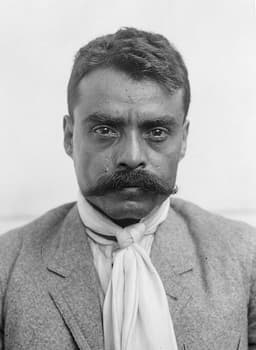
Emiliano Zapata
Revolutionary · Modern
56.3Total

Napoleon Bonaparte
General · Modern
70.9Total
Basic Information
Born
1879
1769
Died
1919
1821
Era
Modern
Modern
Nationality
Mexico
France
Occupation
Revolutionary
General
Civilization
Western
Western
Score Comparison
Military (10%)
40.0
94.0
Political (20%)
68.0
72.0
Influence (20%)
58.0
40.0
Legacy (20%)
54.0
80.0
Leadership (15%)
54.2
78.0
Strategy (15%)
60.0
90.0
TOTAL
56.3
70.9
Emiliano Zapata — Complete Timeline
1911 AD
Plan of AyalaPolitical Action
Zapata issued the Plan of Ayala, denouncing Francisco I. Madero for failing to implement land reform. The plan called for the return of land to peasants and became the ideological foundation of the Zapatista movement.
Land ReformAgrarian MovementRevolution
Impact: nationalprogressive
1914 AD
Occupation of Mexico CityWar◆ Major
Zapata's forces, allied with Villa's Division of the North, occupied Mexico City. They held the capital for several weeks but failed to establish lasting control, highlighting the limits of their coalition.
Military OccupationRevolutionary AllianceCapital
Impact: national
Convention of AguascalientesPolitical Action◆ Major
Zapata attended the Convention of Aguascalientes, where revolutionary factions attempted to unify. He allied with Pancho Villa against Venustiano Carranza, but the convention failed to produce a stable government.
Revolutionary AlliancePolitical DivisionCivil War
Impact: national
1919 AD
Assassination at ChinamecaPolitical Action
Zapata was lured to the Hacienda de Chinameca by Colonel Jesus Guajardo, who pretended to defect. Guajardo's troops ambushed and killed Zapata, ending his leadership of the agrarian rebellion.
AssassinationBetrayalEnd of Leadership
Impact: nationaltragic
Napoleon Bonaparte — Complete Timeline
1799 AD
Coup of 18 BrumaireOther◆ Major
Napoleon Bonaparte, with support from his brother Lucien and key political figures, overthrew the Directory in a bloodless coup. He established the Consulate with himself as First Consul, effectively becoming the ruler of France. This event ended the French Revolution's most unstable period.
French RevolutionCoupRise to Power
Impact: regional
1804 AD
Promulgation of the Napoleonic CodeOther◆ Major
Napoleon enacted the Civil Code of the French, known as the Napoleonic Code, a comprehensive set of laws that replaced the fragmented feudal legal systems. The code established legal equality, protected property rights, and secularized law. It became the basis for legal systems in many European and world countries.
Legal ReformNapoleonic CodeCivil Law
Impact: globalconstructive
1805 AD
Battle of AusterlitzWar◆ Major
Napoleon's Grande Arm
Napoleonic WarsBattleDecisive Victory
Impact: global
1812 AD
Invasion of RussiaWar◆ Major
Napoleon led the Grande Arm
Napoleonic WarsInvasionDisaster
Impact: globaldestructive
1815 AD
Battle of WaterlooWar◆ Major
Napoleon's French army was defeated by the combined forces of the Duke of Wellington's Anglo-Allied army and Gebhard Leberecht von Bl
Napoleonic WarsBattleFinal Defeat
Impact: globaldestructive
Expert Analysis
emiliano-zapata-vs-napoleon-bonaparte
# The Emperor and the Rebel: Two Visions of Revolution
On a June morning in 1815, Napoleon Bonaparte stood on a muddy field near Waterloo, watching his Imperial Guard advance into the muzzles of British cannon. Four years earlier, he had ruled an empire stretching from Spain to Poland. Now, his world was collapsing. Across the Atlantic, four years after Waterloo, another revolutionary met his end—not on a battlefield, but in the dusty courtyard of a hacienda in Chinameca, Mexico. Emiliano Zapata, betrayed by a man who pretended to join his cause, fell to a volley of rifle fire. Two men, separated by an ocean and a century, both consumed by the fire of revolution. One sought to conquer the world; the other sought to reclaim a piece of it for his people. What drove them to such different fates?
Origins
Napoleon was born in 1769 on the island of Corsica, a place recently annexed by France. His family was minor nobility, but poor. He spoke Italian before French, and his schoolmates mocked his accent. This outsider’s hunger for acceptance and dominance would never leave him. The French Revolution, which erupted when he was twenty, tore down the old order and opened doors to talent. Napoleon walked through them.
Emiliano Zapata was born in 1879 in Anenecuilco, a small village in the state of Morelos, Mexico. His family were mestizo peasants—farmers who had worked the land for generations but owned none of it. Under the dictatorship of Porfirio Díaz, wealthy haciendas had swallowed up communal lands, leaving villagers landless and desperate. Zapata learned early that the law was written for the rich. His father died when he was a boy, and he grew up watching his neighbors starve while the sugar barons prospered. The French Revolution had given Napoleon a ladder; Mexican feudalism gave Zapata a grievance.
Rise to Power
Napoleon’s ascent was meteoric. In 1793, at age twenty-four, he drove British forces from the port of Toulon, earning promotion to brigadier general. By 1796, he commanded the French army in Italy, where his lightning campaigns crushed Austrian forces and made him a national hero. He was not just a tactician; he understood the power of propaganda. He wrote his own bulletins, casting himself as the liberator of oppressed peoples. In 1799, he seized power in a coup, becoming First Consul. Five years later, he crowned himself Emperor.
Zapata’s rise was slower, more rooted. In 1909, at age thirty, he was elected president of his village’s land defense committee. He began organizing armed resistance after Díaz’s forces seized more communal lands. When Francisco Madero’s call for revolution came in 1910, Zapata raised an army of peasants armed with machetes and old rifles. They called themselves the Zapatistas. Unlike Napoleon, Zapata did not seek a throne. He wanted land for the landless.
Leadership & Governance
Napoleon was a military genius—his strategic score of 93 reflects that. He revolutionized warfare with speed, concentration of force, and the use of artillery. But he was also a reformer. The Napoleonic Code, established in 1804, standardized French law, abolished feudalism, and protected property rights. He built schools, roads, and canals. He centralized the state with ruthless efficiency. Yet his political score of 75 hints at a fatal flaw: he could never stop conquering. Peace bored him.
Zapata’s leadership was different. His military score of 55.8 reflects that he was no great general; his strength was moral authority. He issued the Plan of Ayala in 1911, denouncing Madero for betraying land reform. The plan demanded “Land and Liberty”—a slogan that still echoes. In 1914, he allied with Pancho Villa and occupied Mexico City. But he refused to take power. Instead, he returned to Morelos to implement land distribution. His political score of 57.6 shows he understood local governance better than national politics. He built schools and cooperatives in liberated zones, but he could not scale his vision.
Triumph & Tragedy
Napoleon’s greatest moment came in 1805 at Austerlitz, where he destroyed a combined Russian-Austrian army. It was his masterpiece. His worst came in 1812, when he invaded Russia. He reached Moscow, but the Russians burned the city and refused to surrender. His army retreated through the winter snows, losing half a million men. He never recovered.
Zapata’s triumph was more modest: by 1917, his forces controlled most of Morelos, and land reform was real. His tragedy was his assassination in 1919. Colonel Jesús Guajardo, pretending to defect, lured him to the Hacienda de Chinameca. The troops fired on command. Zapata’s body was photographed and displayed to prove he was dead. But the myth lived on.
Character & Destiny
Napoleon was driven by ambition and insecurity. He once said, “I am not a man, but a thing.” He saw himself as a force of history, and he was right—but forces are indifferent to their own destruction. His refusal to share power, his relentless expansion, his belief that he could conquer Russia—these were not errors of strategy but of character. He could not stop.
Zapata was driven by loyalty to his people. He said, “It is better to die on your feet than to live on your knees.” He refused to compromise on land reform, even when it meant isolation. His distrust of national politicians was justified, but it also limited his influence. He could not imagine a Mexico beyond the village.
Legacy
Napoleon left a mixed inheritance. The Napoleonic Code influenced legal systems across Europe and the Americas. He redrew the map of Europe and inspired nationalism. But he also caused millions of deaths. His legacy score of 78 reflects this ambiguity. He is remembered as both tyrant and genius.
Zapata’s legacy is more focused. His image appears on Mexican currency and in murals. The Zapatista Army of National Liberation, which rose in 1994, claimed his mantle. His demand for land and justice remains unfinished. His legacy score of 67.6 is modest, but his influence score of 72.8 shows his symbolic power.
Conclusion
Napoleon and Zapata both believed in revolution, but they meant different things. For Napoleon, revolution meant power, order, and glory. For Zapata, it meant justice, land, and dignity. One built an empire that collapsed under its own weight. The other built a memory that still inspires. Perhaps the deepest difference is this: Napoleon wanted to change the world so that he could rule it. Zapata wanted to change the world so that his people could live in it. History judges them by different standards, but both remind us that revolutions consume their children—whether they wear a crown or a peasant’s hat.
Rankings
🥇
Napoleon BonaparteLeader
Mil: 94.0Pol: 72.0Inf: 40.0
70.9
🥈
Emiliano Zapata
Mil: 40.0Pol: 68.0Inf: 58.0
56.3
+14.6 behind
How This Comparison Works
Algorithm
Each figure is scored on 6 dimensions (0—100 scale) based on structured historical data: Military (10%), Political (20%), Influence (20%), Legacy (20%), Leadership (15%), Strategy (15%). The weighted total produces the final ranking.
Data Sources
Scores are computed from structured sub-indicators in the database. Scale factors adjust for era (Ancient ×0.85, Modern ×1.0) and civilization size (Eastern ×1.05, Other ×0.80) to account for differences in population and military scale.
Maximum 3 Figures
Comparisons are limited to 2—3 figures to ensure readability and statistical meaningfulness.
Error Margins
±5 points per dimension — Sub-scores are derived from historical records with inherent uncertainty. Two figures within 5 points on a dimension should be considered roughly equivalent in that area.
Total Score Accuracy
±3 points overall — The weighted combination of 6 dimensions produces a total score with approximately ±3 points of uncertainty. Differences of less than 3 points are not statistically significant— the figures are effectively tied.
Known Limitations
- Historical records are incomplete and uneven across civilizations
- Figures from oral-tradition societies may be underrepresented
- Occupation labels can misclassify multi-role figures
- Scores measure capability and impact, not moral character
- Quantitative scoring is a comparison tool, not absolute truth
Capability Radar
Military (10%) — Battles & Warfare
Battles
45
95
Win Rate
50
90
Expansion
35
95
Political (20%) — Governance & Reform
Reform
70
95
Diplomacy
40
80
Economy
35
85
Influence (20%) — Cultural & Global Reach
Cultural
65
85
Global
55
90
Legacy (20%) — Historical Impact
Historical
70
95
Longevity
65
90
Leadership (15%) — Power & Stability
Tenure
30
85
Stability
25
70
Strategy (15%) — Tactics & Innovation
Strategy
50
95
Tactics
55
98
Reform
60
92
Similar Comparisons
Comments & Discussion
No comments yet. Be the first to share your thoughts!