Loading...
Edward VI of England vs Wilhelm I
Wilhelm I leads by 27.5 pts · 2 figures compared
…
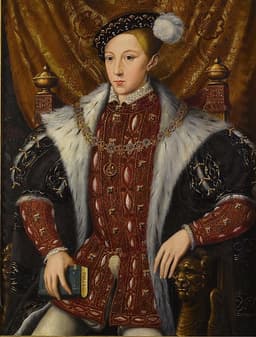
Edward VI of England
Emperor · Modern
43.8Total
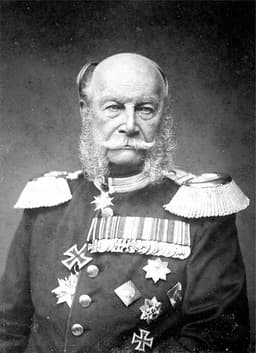
Wilhelm I
Emperor · Modern
71.3Total
Basic Information
Born
1537
1797
Died
1553
1888
Era
Modern
Modern
Nationality
England
Germany
Occupation
Emperor
Emperor
Civilization
Western
Western
Score Comparison
Military (10%)
19.3
65.0
Political (20%)
42.2
72.0
Influence (20%)
51.8
72.0
Legacy (20%)
43.3
72.0
Leadership (15%)
38.1
80.0
Strategy (15%)
60.0
60.0
TOTAL
43.8
71.3
Edward VI of England — Complete Timeline
1547 AD
Coronation of Edward VIPolitical Action◆ Major
Edward VI was crowned king of England at age nine, succeeding his father Henry VIII. His reign was dominated by regents, first Edward Seymour, Duke of Somerset, and later John Dudley, Duke of Northumberland.
CoronationMinor KingTudor
Impact: national
1549 AD
Act of Uniformity 1549Reform◆ Major
Edward VI's government passed the Act of Uniformity, imposing the Book of Common Prayer in English. This reform advanced the Protestant Reformation in England, replacing Latin services with English ones and standardizing worship.
ReformationReligionLiturgy
Impact: nationalprogressive
1553 AD
Forty-Two ArticlesReform◆ Major
Edward VI's government issued the Forty-Two Articles, defining the doctrinal basis of the Church of England. These articles were more Protestant than earlier reforms, but were repealed after Edward's death under Mary I.
ReformationDoctrineChurch of England
Impact: nationalprogressive
Devise for the SuccessionPolitical Action
Edward VI, on his deathbed, drafted a will excluding his half-sisters Mary and Elizabeth from the succession, naming Lady Jane Grey as his heir. This attempt to maintain Protestant rule failed after his death, leading to Mary I's accession.
SuccessionProtestantCrisis
Impact: national
Wilhelm I — Complete Timeline
1862 AD
Appointed Otto von Bismarck as Minister President of PrussiaPolitical Action
Wilhelm I appointed Otto von Bismarck as Minister President of Prussia to resolve a constitutional crisis over military reforms. Bismarck's appointment led to a period of conservative dominance and aggressive foreign policy that culminated in German unification.
BismarckPrussiaGerman Unification
Impact: global
1866 AD
Led Prussia in the Austro-Prussian WarWar◆ Major
Wilhelm I, as King of Prussia, led the Prussian army in the Austro-Prussian War. The decisive Prussian victory at K
Austro-Prussian WarGerman UnificationMilitary
Impact: regional
1871 AD
Proclaimed German Emperor at VersaillesPolitical Action
Wilhelm I was proclaimed German Emperor in the Hall of Mirrors at the Palace of Versailles, following the Franco-Prussian War. This event formally unified the German states into the German Empire, with Wilhelm as hereditary emperor and Bismarck as chancellor.
German UnificationEmpireFranco-Prussian War
Impact: globalconstructive
1878 AD
Survived Two Assassination AttemptsOther◆ Major
Wilhelm I survived two assassination attempts in May and June 1878. The first attempt by Max H
Assassination AttemptAnti-Socialist LawsBismarck
Impact: nationaltragic
Expert Analysis
Origins
Edward VI was born on 12 October 1537, the only surviving son of Henry VIII and Jane Seymour. His mother died shortly after his birth. He was educated as a humanist and Protestant scholar, learning Latin, Greek, French, and theology. His tutors included Richard Cox and John Cheke, who instilled in him a strong Protestant faith. Edward's upbringing was isolated, surrounded by courtiers and scholars, preparing him for kingship from a young age.
Wilhelm I was born on 22 March 1797 in Berlin, the second son of King Frederick William III of Prussia. He served in the Prussian army during the Napoleonic Wars, gaining military experience. His upbringing was military-oriented, and he held various army commands. Unlike Edward, Wilhelm was not groomed for the throne until his older brother Frederick William IV died childless in 1861. Wilhelm's early life was marked by conservative values and a strong sense of duty.
Rise to Power
Edward became king at age nine on 28 January 1547, succeeding Henry VIII. His minority led to a regency council initially led by his uncle Edward Seymour, Duke of Somerset. Seymour pursued Protestant reforms and war with Scotland. After Seymour's fall in 1549, John Dudley, Duke of Northumberland, took control. Edward's reign was dominated by these regents, but he actively participated in religious matters, supporting the Reformation.
Wilhelm became King of Prussia on 2 January 1861. His early reign faced a constitutional crisis over military reforms. He appointed Otto von Bismarck as Minister President in 1862, a turning point. Bismarck's policies strengthened the army and pursued German unification through wars: the Second Schleswig War (1864), Austro-Prussian War (1866), and Franco-Prussian War (1870-71). Wilhelm's rise to power was tied to Bismarck's statecraft, culminating in his proclamation as German Emperor on 18 January 1871.
Leadership & Governance
Edward's leadership was symbolic due to his age, but his government enacted significant religious reforms. The Act of Uniformity 1549 and the Forty-Two Articles of 1553 standardized Protestant worship. Edward's personal involvement in religious policy shows his commitment to Calvinist principles. However, his reign was marked by factionalism and economic troubles, including Kett's Rebellion in 1549.
Wilhelm's leadership was more hands-on, especially in military affairs. He supported Bismarck's policies, though often reluctantly. Wilhelm allowed Bismarck to govern effectively, providing stability. His military leadership during the Austro-Prussian and Franco-Prussian Wars was decisive. Wilhelm's governance style was constitutional but authoritarian, relying on the army and bureaucracy. He scored 80.0 in leadership compared to Edward's 38.1.
Triumph & Tragedy
Edward's greatest triumph was advancing Protestantism in England. The Book of Common Prayer and the Forty-Two Articles laid foundations for the Church of England. His tragedy was his early death at 15 on 6 July 1553, leaving a succession crisis. His attempt to alter the succession via the 'Devise for the Succession' failed, leading to Lady Jane Grey's nine-day reign and the eventual Catholic reaction under Mary I.
Wilhelm's greatest triumph was unifying Germany and becoming its first emperor. His military victories established Prussia as a European power. His tragedy included surviving two assassination attempts in 1878, which Bismarck used to pass anti-socialist laws. Wilhelm also faced criticism for his conservative stance and limited political role. His score in political influence is 72.0, while Edward's is 42.2.
Character & Destiny
Edward was a devout Protestant, intelligent and stubborn. His early death cut short a reign that might have solidified Protestantism. His character shaped his fate: his determination to exclude his Catholic half-sisters led to a contested succession. Historians view him as a tool of his regents, but his personal beliefs were genuine.
Wilhelm was cautious, conservative, and duty-bound. He relied heavily on Bismarck, allowing the 'Iron Chancellor' to shape policy. His character was suited for a constitutional monarch—deferential to his ministers but firm on military matters. His destiny was to be the figurehead of German unification, a role he fulfilled with dignity.
Legacy
Edward's legacy is the establishment of Protestantism in England. His religious reforms survived under Elizabeth I, shaping Anglican identity. However, his short reign and the subsequent Marian reaction limited his immediate impact. His score in legacy is 43.3.
Wilhelm's legacy is the German Empire, which lasted until 1918. He is remembered as the first Kaiser, a symbol of national unity. His support for Bismarck's policies created a powerful, militaristic state. Wilhelm's legacy score is 72.0, reflecting his enduring impact on German and European history.
Conclusion
Wilhelm I had a greater impact than Edward VI. With a total score of 71.3 compared to Edward's 43.8, Wilhelm's unification of Germany reshaped Europe. Edward's reforms were significant but temporary, whereas Wilhelm's empire altered the balance of power for decades. Wilhelm's leadership, political influence, and legacy far exceed Edward's, making him the more consequential figure.
Rankings
🥇
Wilhelm ILeader
Mil: 65.0Pol: 72.0Inf: 72.0
71.3
🥈
Edward VI of England
Mil: 19.3Pol: 42.2Inf: 51.8
43.8
+27.5 behind
How This Comparison Works
Algorithm
Each figure is scored on 6 dimensions (0—100 scale) based on structured historical data: Military (10%), Political (20%), Influence (20%), Legacy (20%), Leadership (15%), Strategy (15%). The weighted total produces the final ranking.
Data Sources
Scores are computed from structured sub-indicators in the database. Scale factors adjust for era (Ancient ×0.85, Modern ×1.0) and civilization size (Eastern ×1.05, Other ×0.80) to account for differences in population and military scale.
Maximum 3 Figures
Comparisons are limited to 2—3 figures to ensure readability and statistical meaningfulness.
Error Margins
±5 points per dimension — Sub-scores are derived from historical records with inherent uncertainty. Two figures within 5 points on a dimension should be considered roughly equivalent in that area.
Total Score Accuracy
±3 points overall — The weighted combination of 6 dimensions produces a total score with approximately ±3 points of uncertainty. Differences of less than 3 points are not statistically significant— the figures are effectively tied.
Known Limitations
- Historical records are incomplete and uneven across civilizations
- Figures from oral-tradition societies may be underrepresented
- Occupation labels can misclassify multi-role figures
- Scores measure capability and impact, not moral character
- Quantitative scoring is a comparison tool, not absolute truth
Capability Radar
Military (10%) — Battles & Warfare
Battles
36
40
Win Rate
37
75
Expansion
44
80
Political (20%) — Governance & Reform
Reform
55
70
Diplomacy
20
65
Economy
10
60
Influence (20%) — Cultural & Global Reach
Cultural
30
50
Global
20
75
Legacy (20%) — Historical Impact
Historical
40
80
Longevity
30
70
Leadership (15%) — Power & Stability
Tenure
15
85
Stability
10
75
Strategy (15%) — Tactics & Innovation
Strategy
47
60
Tactics
50
30
Reform
49
55
Similar Comparisons
Comments & Discussion
No comments yet. Be the first to share your thoughts!