Loading...
Edward VI of England vs Julius Caesar
Julius Caesar leads by 39.0 pts · 2 figures compared
…
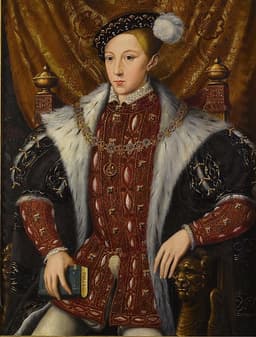
Edward VI of England
Emperor · Modern
43.8Total

Julius Caesar
General · Ancient
82.8Total
Basic Information
Born
1537
-100
Died
1553
-44
Era
Modern
Ancient
Nationality
England
Roman Republic
Occupation
Emperor
General
Civilization
Western
Western
Score Comparison
Military (10%)
19.3
88.0
Political (20%)
42.2
78.0
Influence (20%)
51.8
85.0
Legacy (20%)
43.3
82.0
Leadership (15%)
38.1
80.0
Strategy (15%)
60.0
85.0
TOTAL
43.8
82.8
Edward VI of England — Complete Timeline
1547 AD
Coronation of Edward VIPolitical Action◆ Major
Edward VI was crowned king of England at age nine, succeeding his father Henry VIII. His reign was dominated by regents, first Edward Seymour, Duke of Somerset, and later John Dudley, Duke of Northumberland.
CoronationMinor KingTudor
Impact: national
1549 AD
Act of Uniformity 1549Reform◆ Major
Edward VI's government passed the Act of Uniformity, imposing the Book of Common Prayer in English. This reform advanced the Protestant Reformation in England, replacing Latin services with English ones and standardizing worship.
ReformationReligionLiturgy
Impact: nationalprogressive
1553 AD
Forty-Two ArticlesReform◆ Major
Edward VI's government issued the Forty-Two Articles, defining the doctrinal basis of the Church of England. These articles were more Protestant than earlier reforms, but were repealed after Edward's death under Mary I.
ReformationDoctrineChurch of England
Impact: nationalprogressive
Devise for the SuccessionPolitical Action
Edward VI, on his deathbed, drafted a will excluding his half-sisters Mary and Elizabeth from the succession, naming Lady Jane Grey as his heir. This attempt to maintain Protestant rule failed after his death, leading to Mary I's accession.
SuccessionProtestantCrisis
Impact: national
Julius Caesar — Complete Timeline
58 BC
Gallic WarsWar◆ Major
Caesar, as proconsul of Gaul, launched a series of campaigns that conquered all of Gaul (modern France, Belgium, and parts of Switzerland). He fought numerous battles, including against the Helvetii, the Belgae, and the Gallic chieftain Vercingetorix. The wars brought immense wealth and a loyal army to Caesar.
Gallic WarsConquestRoman Expansion
Impact: regional
49 BC
Crossing the RubiconPolitical Action◆ Major
Caesar led Legio XIII across the Rubicon River into Italy, defying the Roman Senate's order to disband his army. This act triggered a civil war against Pompey and the Optimates, ultimately leading to Caesar's dictatorship and the end of the Roman Republic.
Roman Civil WarEnd of RepublicPower Struggle
Impact: global
48 BC
Battle of PharsalusWar◆ Major
Caesar's outnumbered army defeated the larger forces of Pompey the Great at Pharsalus in Greece. Caesar's tactical use of a reserve line to counter Pompey's cavalry charge proved decisive. Pompey fled to Egypt, where he was assassinated, leaving Caesar as the undisputed master of the Roman world.
Roman Civil WarBattleDecisive Victory
Impact: regional
44 BC
Appointment as Dictator for LifePolitical Action◆ Major
The Roman Senate appointed Caesar dictator perpetuo (dictator for life), granting him unprecedented personal power. This move concentrated military, legislative, and judicial authority in one person, effectively ending the Roman Republic's traditional system of checks and balances and alarming many senators.
DictatorshipEnd of RepublicPower Consolidation
Impact: regionaldestructive
Assassination on the Ides of MarchPolitical Action◆ Major
A group of Roman senators, led by Marcus Junius Brutus and Gaius Cassius Longinus, stabbed Caesar to death at a meeting of the Senate in the Theatre of Pompey. The assassination was intended to restore the Republic, but instead triggered another civil war that led to the rise of the Roman Empire.
AssassinationRoman PoliticsEnd of Republic
Impact: globaldestructive
Expert Analysis
Origins
Edward VI was born on 12 October 1537 at Hampton Court Palace, the long-awaited male heir of Henry VIII and his third wife, Jane Seymour. His mother died shortly after childbirth. Edward received a rigorous humanist education under tutors like John Cheke and Richard Cox, learning Latin, Greek, and theology. He was raised in a strictly Protestant court, surrounded by reformers who shaped his religious convictions. In contrast, Gaius Julius Caesar was born on 12 or 13 July 100 BCE into the patrician Julian clan, though his family was not politically powerful. He received a standard elite education in rhetoric, philosophy, and military history. Caesar's early life was marked by political turmoil: his uncle Marius was a populist leader, and Caesar himself was briefly proscribed by Sulla, forcing him into hiding.
Rise to Power
Edward became king at age nine on 28 January 1547, following Henry VIII's death. His uncle Edward Seymour, Duke of Somerset, served as Lord Protector and dominated the early years. Seymour pursued aggressive Protestant reforms, including the 1549 Act of Uniformity and the imposition of the Book of Common Prayer. However, his governance was destabilized by economic crises and rebellions like Kett's Rebellion. In 1549, John Dudley, Earl of Warwick (later Duke of Northumberland), seized power and executed Seymour. Northumberland continued Protestant reforms, issuing the Forty-Two Articles in 1553, which defined the Church of England's Calvinist leanings. Edward, though young, actively participated in religious debates and personally endorsed radical reforms. Caesar's rise followed a different path. He gained prominence through military command and political alliances. In 60 BCE, he formed the First Triumvirate with Pompey and Crassus, securing the consulship for 59 BCE. As proconsul of Gaul from 58 BCE, he launched the Gallic Wars, conquering vast territories and building a loyal army. His victories, including the subjugation of the Veneti and the defeat of Vercingetorix at Alesia (52 BCE), made him immensely popular. When the Senate ordered him to disband his army, Caesar crossed the Rubicon in 49 BCE, sparking a civil war. He defeated Pompey at Pharsalus in 48 BCE and later consolidated power, becoming dictator for life in 44 BCE.
Leadership & Governance
Edward's governance was indirect due to his age. He relied on regents, but his personal influence was significant. He supported the dissolution of chantries, the removal of images from churches, and the enforcement of Protestant doctrines. His government also reformed the coinage and attempted to address poverty through the 1547 Vagrancy Act, which was harshly punitive. Edward's leadership score of 37.5 reflects his limited autonomy. In contrast, Caesar was a hands-on leader who centralized power, reformed the calendar (Julian calendar), initiated public works, and granted citizenship to provincials. He also reduced debt and reformed provincial administration. Caesar's political score of 78.0 indicates his effectiveness in navigating the complex Roman political system. However, his authoritarian tendencies alienated the Senate, leading to his assassination.
Triumph & Tragedy
Edward's greatest triumph was advancing the Protestant Reformation in England. His reign saw the establishment of a more Protestant liturgy and doctrine, which endured after his death. His tragedy was his premature death at age 15 on 6 July 1553, likely from tuberculosis. His attempt to alter the succession through the "Devise for the Succession" failed; Lady Jane Grey was queen for only nine days before Mary I took the throne and reversed most Protestant reforms. Edward's legacy score of 59.5 reflects the temporary nature of his achievements. Caesar's triumphs include the conquest of Gaul, which expanded Roman territory and enriched the state. His military score of 88.0 and strategy score of 85.0 highlight his tactical brilliance. His tragedy was his assassination on the Ides of March (15 March 44 BCE), which plunged Rome into further civil wars. However, his reforms and centralization paved the way for the Roman Empire. Caesar's influence score of 85.0 and legacy score of 82.0 indicate his enduring impact.
Character & Destiny
Edward was devout, intelligent, and stubborn. He wrote extensively on theology and personally supervised the drafting of the Forty-Two Articles. His early death cut short a potentially transformative reign. Caesar was ambitious, charismatic, and ruthless. He took risks, such as crossing the Rubicon, and was a master propagandist. His character led him to seek absolute power, which ultimately caused his downfall. Historical assessments of Edward note his piety and promise, while Caesar is seen as a genius who destroyed the Roman Republic.
Legacy
Edward's legacy is mixed. His religious reforms were reversed by Mary I but later reinstated by Elizabeth I, forming the basis of the Elizabethan Religious Settlement. His reign established Protestantism as a defining feature of English identity. Caesar's legacy is monumental: he transformed Rome from a republic into an empire, and his name became synonymous with imperial rule (Kaiser, Tsar). His military innovations, such as the use of a reserve line at Pharsalus, influenced tactics for centuries. The Julian calendar was used until the 16th century. Caesar's writings, especially his Commentaries, remain classics.
Conclusion
While Edward VI scored a total of 55.2 and Caesar scored 82.8, the gap is not merely numerical. Caesar's impact on global history is far greater. He reshaped the political structure of the Mediterranean world, and his legacy influenced governance, military strategy, and culture for two millennia. Edward's influence was confined to England and largely temporary. Caesar's conquests and reforms had a direct, lasting effect on the course of Western civilization. Therefore, Julius Caesar had greater impact.
Rankings
🥇
Julius CaesarLeader
Mil: 88.0Pol: 78.0Inf: 85.0
82.8
🥈
Edward VI of England
Mil: 19.3Pol: 42.2Inf: 51.8
43.8
+39.0 behind
How This Comparison Works
Algorithm
Each figure is scored on 6 dimensions (0—100 scale) based on structured historical data: Military (10%), Political (20%), Influence (20%), Legacy (20%), Leadership (15%), Strategy (15%). The weighted total produces the final ranking.
Data Sources
Scores are computed from structured sub-indicators in the database. Scale factors adjust for era (Ancient ×0.85, Modern ×1.0) and civilization size (Eastern ×1.05, Other ×0.80) to account for differences in population and military scale.
Maximum 3 Figures
Comparisons are limited to 2—3 figures to ensure readability and statistical meaningfulness.
Error Margins
±5 points per dimension — Sub-scores are derived from historical records with inherent uncertainty. Two figures within 5 points on a dimension should be considered roughly equivalent in that area.
Total Score Accuracy
±3 points overall — The weighted combination of 6 dimensions produces a total score with approximately ±3 points of uncertainty. Differences of less than 3 points are not statistically significant— the figures are effectively tied.
Known Limitations
- Historical records are incomplete and uneven across civilizations
- Figures from oral-tradition societies may be underrepresented
- Occupation labels can misclassify multi-role figures
- Scores measure capability and impact, not moral character
- Quantitative scoring is a comparison tool, not absolute truth
Capability Radar
Military (10%) — Battles & Warfare
Battles
36
95
Win Rate
37
92
Expansion
44
97
Political (20%) — Governance & Reform
Reform
55
90
Diplomacy
20
85
Economy
10
82
Influence (20%) — Cultural & Global Reach
Cultural
30
88
Global
20
94
Legacy (20%) — Historical Impact
Historical
40
95
Longevity
30
96
Leadership (15%) — Power & Stability
Tenure
15
75
Stability
10
60
Strategy (15%) — Tactics & Innovation
Strategy
47
94
Tactics
50
96
Reform
49
88
Similar Comparisons
Comments & Discussion
No comments yet. Be the first to share your thoughts!