Loading...
Edward VI of England vs Napoleon Bonaparte
Napoleon Bonaparte leads by 27.1 pts · 2 figures compared
…
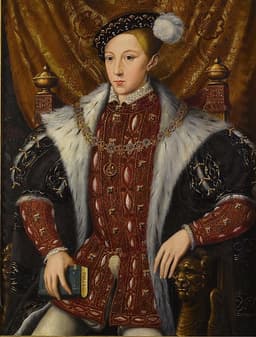
Edward VI of England
Emperor · Modern
43.8Total

Napoleon Bonaparte
General · Modern
70.9Total
Basic Information
Born
1537
1769
Died
1553
1821
Era
Modern
Modern
Nationality
England
France
Occupation
Emperor
General
Civilization
Western
Western
Score Comparison
Military (10%)
19.3
94.0
Political (20%)
42.2
72.0
Influence (20%)
51.8
40.0
Legacy (20%)
43.3
80.0
Leadership (15%)
38.1
78.0
Strategy (15%)
60.0
90.0
TOTAL
43.8
70.9
Edward VI of England — Complete Timeline
1547 AD
Coronation of Edward VIPolitical Action◆ Major
Edward VI was crowned king of England at age nine, succeeding his father Henry VIII. His reign was dominated by regents, first Edward Seymour, Duke of Somerset, and later John Dudley, Duke of Northumberland.
CoronationMinor KingTudor
Impact: national
1549 AD
Act of Uniformity 1549Reform◆ Major
Edward VI's government passed the Act of Uniformity, imposing the Book of Common Prayer in English. This reform advanced the Protestant Reformation in England, replacing Latin services with English ones and standardizing worship.
ReformationReligionLiturgy
Impact: nationalprogressive
1553 AD
Forty-Two ArticlesReform◆ Major
Edward VI's government issued the Forty-Two Articles, defining the doctrinal basis of the Church of England. These articles were more Protestant than earlier reforms, but were repealed after Edward's death under Mary I.
ReformationDoctrineChurch of England
Impact: nationalprogressive
Devise for the SuccessionPolitical Action
Edward VI, on his deathbed, drafted a will excluding his half-sisters Mary and Elizabeth from the succession, naming Lady Jane Grey as his heir. This attempt to maintain Protestant rule failed after his death, leading to Mary I's accession.
SuccessionProtestantCrisis
Impact: national
Napoleon Bonaparte — Complete Timeline
1799 AD
Coup of 18 BrumaireOther◆ Major
Napoleon Bonaparte, with support from his brother Lucien and key political figures, overthrew the Directory in a bloodless coup. He established the Consulate with himself as First Consul, effectively becoming the ruler of France. This event ended the French Revolution's most unstable period.
French RevolutionCoupRise to Power
Impact: regional
1804 AD
Promulgation of the Napoleonic CodeOther◆ Major
Napoleon enacted the Civil Code of the French, known as the Napoleonic Code, a comprehensive set of laws that replaced the fragmented feudal legal systems. The code established legal equality, protected property rights, and secularized law. It became the basis for legal systems in many European and world countries.
Legal ReformNapoleonic CodeCivil Law
Impact: globalconstructive
1805 AD
Battle of AusterlitzWar◆ Major
Napoleon's Grande Arm
Napoleonic WarsBattleDecisive Victory
Impact: global
1812 AD
Invasion of RussiaWar◆ Major
Napoleon led the Grande Arm
Napoleonic WarsInvasionDisaster
Impact: globaldestructive
1815 AD
Battle of WaterlooWar◆ Major
Napoleon's French army was defeated by the combined forces of the Duke of Wellington's Anglo-Allied army and Gebhard Leberecht von Bl
Napoleonic WarsBattleFinal Defeat
Impact: globaldestructive
Expert Analysis
edward-vi-of-england-vs-napoleon-bonaparte
### The Boy King and the Emperor of Men
On a cold January morning in 1547, a nine-year-old boy sat on the ancient throne of England, his feet dangling above the stone floor. Across the Channel, a twenty-year-old artillery officer in Corsica was still a decade away from firing his first cannon at Toulon. One was born to rule; the other was born to conquer. Yet within a few short years, the boy would be dead of a consumptive cough, his Reformation left half-finished, while the Corsican would stand astride a continent, his name a synonym for ambition itself. Why did one reign end as a footnote and the other as a legend? The answer lies not in crowns, but in the furnace of character and circumstance.
### Origins
Edward Tudor arrived into the world as the long-prayed-for male heir of Henry VIII. His mother, Jane Seymour, died days after his birth, leaving him a precious, fragile jewel in a court of ruthless ambition. He was raised in a cocoon of theology and Latin, surrounded by Protestant tutors who filled his mind with the righteousness of reform. He was never a child; he was a vessel for a kingdom’s religious future. His body, however, was weak from the start, prone to fevers that his physicians could only treat with leeches and prayer.
Napoleon Buonaparte, by contrast, was born a second son on a Mediterranean island that had just become French. His family was minor Corsican nobility, poor and proud. He spoke Italian before French, and his schoolmates at Brienne mocked his accent. Where Edward was sheltered, Napoleon was scrapping. He read Plutarch by candlelight, dreamed of Alexander, and learned that the world was a place to be taken, not inherited. His era was one of revolution, where birth meant nothing and talent meant everything. Edward’s world was static, hierarchical, and dying. Napoleon’s was fluid, violent, and being born.
### Rise to Power
Edward’s rise was a formality. At nine, he was crowned, and his uncle, Edward Seymour, became Lord Protector. The boy signed documents he could barely understand. His power was not earned; it was a function of his bloodline. The real struggle was among the men around him—Seymour, then John Dudley, the Duke of Northumberland, who schemed to control the throne. Edward was a puppet, albeit a learned one, who wrote pious letters and approved acts of Parliament that he had no hand in crafting.
Napoleon’s rise was a masterpiece of opportunism. He seized his moment at the Siege of Toulon in 1793, when he was just twenty-four. The revolutionary government needed a man who knew how to place cannon, and he did. He was promoted to brigadier general overnight. Then came the Italian campaign of 1796, where he turned a ragged army into a conquering force, dazzling Europe with speed and audacity. He did not inherit power; he ripped it from the hands of a collapsing Directory in the coup of 18 Brumaire in 1799. By thirty, he was First Consul. By thirty-five, Emperor.
### Leadership & Governance
Edward never truly governed. His reign was a regency. The Act of Uniformity of 1549 and the Forty-Two Articles of 1553 were the work of his councillors, though he sincerely believed in them. His leadership score of 37.5 reflects a boy who could not command a regiment, let alone a kingdom. He was a symbol, a pious face for a faction’s agenda. When he drafted his “Devise for the Succession” on his deathbed, excluding his Catholic sister Mary, it was the desperate act of a dying teenager, not a king.
Napoleon governed with iron and ink. His Napoleonic Code streamlined French law, enshrining merit over birth, property rights over feudal privilege. He built roads, founded banks, and centralized education. As a military leader, his score of 94 is nearly perfect—he was a master of the decisive battle, from Austerlitz in 1805 to Jena in 1806. But his political score of 75 hints at his flaw: he could conquer but not consolidate. He placed his brothers on thrones across Europe, but they were puppets who could not hold them. His genius was tactical; his wisdom, strategic—but only in war, not in peace.
### Triumph & Tragedy
Edward’s greatest triumph was the spread of Protestantism. The Book of Common Prayer, written in English, shaped the soul of a nation for centuries. His tragedy was his body. He died of tuberculosis at fifteen, his voice barely changed, his work undone. Mary would undo his reforms with fire and blood.
Napoleon’s triumph was the sun at Austerlitz, where he destroyed the armies of Austria and Russia in a single day. His tragedy was the snow at Moscow in 1812. The Russian winter, the vast distances, his own hubris—these swallowed the Grande Armée. He was exiled to Elba, returned for a hundred days, and then defeated at Waterloo in 1815. He died on Saint Helena, a prisoner, dictating his memoirs. His total score of 82.4 reflects a man who reached the heavens and fell to the earth.
### Character & Destiny
Edward was pious, bookish, and frail. He believed he was doing God’s work. His character was shaped by his tutors and his illness. He had no time to develop ambition; death came too fast. He was a child in a man’s game, and the game used him up.
Napoleon was restless, brilliant, and insatiable. He said, “Impossible is a word to be found only in the dictionary of fools.” His character drove him to conquer, but also to overreach. He could not stop. His destiny was to be the man who remade Europe and then was broken by it. He was a force of nature, and like nature, he was indifferent to the wreckage he left behind.
### Legacy
Edward’s legacy is the Church of England, a via media between Rome and Geneva. His score of 59.5 for legacy is modest, but his influence on the English Reformation is profound. He is remembered as the boy king who might have been.
Napoleon’s legacy is the modern state. His legal codes, his administrative systems, his idea of a meritocracy—these outlasted his empire. He is remembered as the man who rode an eagle and fell with a crash. His influence score of 82 is a testament to a shadow that still falls over Europe.
### Conclusion
One was born to the throne and died before he could sit upon it. The other was born a foreigner and died the master of the world he had lost. Edward’s story is a tragedy of potential unfulfilled; Napoleon’s, a tragedy of ambition overreaching. Both were prisoners of their times—Edward of his fragile blood, Napoleon of his burning will. In the end, the boy king and the emperor of men teach us the same lesson: that power is a loan, not a gift, and history collects its debts with interest.
Rankings
🥇
Napoleon BonaparteLeader
Mil: 94.0Pol: 72.0Inf: 40.0
70.9
🥈
Edward VI of England
Mil: 19.3Pol: 42.2Inf: 51.8
43.8
+27.1 behind
How This Comparison Works
Algorithm
Each figure is scored on 6 dimensions (0—100 scale) based on structured historical data: Military (10%), Political (20%), Influence (20%), Legacy (20%), Leadership (15%), Strategy (15%). The weighted total produces the final ranking.
Data Sources
Scores are computed from structured sub-indicators in the database. Scale factors adjust for era (Ancient ×0.85, Modern ×1.0) and civilization size (Eastern ×1.05, Other ×0.80) to account for differences in population and military scale.
Maximum 3 Figures
Comparisons are limited to 2—3 figures to ensure readability and statistical meaningfulness.
Error Margins
±5 points per dimension — Sub-scores are derived from historical records with inherent uncertainty. Two figures within 5 points on a dimension should be considered roughly equivalent in that area.
Total Score Accuracy
±3 points overall — The weighted combination of 6 dimensions produces a total score with approximately ±3 points of uncertainty. Differences of less than 3 points are not statistically significant— the figures are effectively tied.
Known Limitations
- Historical records are incomplete and uneven across civilizations
- Figures from oral-tradition societies may be underrepresented
- Occupation labels can misclassify multi-role figures
- Scores measure capability and impact, not moral character
- Quantitative scoring is a comparison tool, not absolute truth
Capability Radar
Military (10%) — Battles & Warfare
Battles
36
95
Win Rate
37
90
Expansion
44
95
Political (20%) — Governance & Reform
Reform
55
95
Diplomacy
20
80
Economy
10
85
Influence (20%) — Cultural & Global Reach
Cultural
30
85
Global
20
90
Legacy (20%) — Historical Impact
Historical
40
95
Longevity
30
90
Leadership (15%) — Power & Stability
Tenure
15
85
Stability
10
70
Strategy (15%) — Tactics & Innovation
Strategy
47
95
Tactics
50
98
Reform
49
92
Similar Comparisons
Comments & Discussion
EDWARD'S GHOST6/17/2026
The romanticization of Edward VI as a would-be reformer king ignores the obvious: he was a puppet. His entire reign was engineered by Protestant fixers like Somerset and Northumberland. Meanwhile, Napoleon actually executed his reforms—the Code, the lycées, the metric system—through sheer will. One was a sickly boy reading theology; the other was a man building institutions that outlasted his empire. Give me the Corsican who legislated over the Italian who inherited.
寒鸦观察者6/17/2026
拿历史长度比高低简直可笑。爱德华六世短短六年统治,却为英格兰宗教改革打下了不可逆的根基——1549年的《公祷书》和1552年的《四十二条信纲》,至今仍在塑造英国圣公会的轮廓。拿破仑的滑铁卢只用了一夜就毁掉他二十年的建树。一个奠基,一个崩塌;我选那个让教堂钟声至今仍按他的节奏敲响的男孩。
REVISIONIST'S RETORT6/17/2026
Edward wasn't a footnote; he was the tragic hinge of English history. Without his aggressive Protestantization, Mary's fires wouldn't have burned so bright, and Elizabeth's "middle way" wouldn't have been so necessary. Napoleon, for all his noise, ended up dead on a volcanic island, his son never ruled, and France was back to monarchy within years. Edward's legacy is subtler but more enduring: he set a religious course that England never fully abandoned.
数据拆解师6/17/2026
来点硬数字:拿破仑统治期间法国人口约2800万,指挥过60万大军出征俄国,死伤至少半百万人。爱德华在位时英格兰人口仅约300万,军队从不超过两万,死亡人数以百计。这两人本就不是一个量级——一个是中国象棋的車,一个是跳棋的弹珠。拿破仑是历史的风暴,爱德华只是阵雨。别拿茶杯里的风波比海啸。
CLASSICIST'S WIT6/17/2026
One died of consumption at fifteen, the other of stomach cancer at fifty-one. One left a diary full of Latin prayers and complaints about his councilors; the left memoirs ghostwritten by generals on Saint Helena. Edward was a schoolboy who never grew up; Napoleon was a grown-up who never stopped being a soldier. I respect the one who actually dodged the bullets, not the one who dodged the measles.