Loading...
Edward IV of England vs Tokhtamysh
Tokhtamysh leads by 5.1 pts · 2 figures compared
…
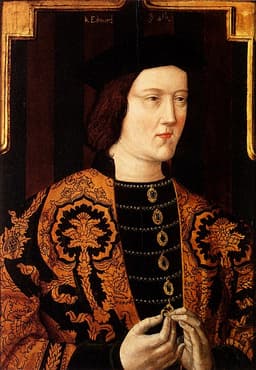
Edward IV of England
Emperor · Medieval
55.7Total
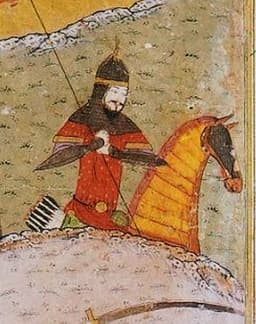
Tokhtamysh
Emperor · Medieval
60.8Total
Basic Information
Born
1442
1342
Died
1483
1406
Era
Medieval
Medieval
Nationality
England
Golden Horde
Occupation
Emperor
Emperor
Civilization
Western
Eastern
Score Comparison
Military (10%)
61.7
74.7
Political (20%)
45.0
68.0
Influence (20%)
60.0
61.0
Legacy (20%)
56.0
49.2
Leadership (15%)
53.2
65.0
Strategy (15%)
58.0
58.0
TOTAL
55.7
60.8
Edward IV of England — Complete Timeline
1461 AD
Battle of TowtonWar
Edward IV led the Yorkist army to a decisive victory over the Lancastrian forces at Towton in Yorkshire. This battle, the largest and bloodiest of the Wars of the Roses, secured Edward's claim to the throne and led to his coronation as king.
Wars of the RosesBattleVictory
Impact: national
Coronation of Edward IVPolitical Action◆ Major
Edward IV was crowned king of England at Westminster Abbey, formally establishing the Yorkist dynasty. His coronation followed the deposition of Henry VI and marked the beginning of a period of Yorkist rule.
CoronationDynastyYorkist
Impact: nationalconstructive
1464 AD
Marriage to Elizabeth WoodvillePolitical Action◆ Major
Edward IV secretly married Elizabeth Woodville, a Lancastrian widow, without consulting his council. This marriage elevated the Woodville family and alienated key allies like the Earl of Warwick, contributing to later political instability.
MarriagePoliticsWoodville
Impact: national
1471 AD
Battle of BarnetWar◆ Major
Edward IV defeated the Earl of Warwick at Barnet, killing Warwick and reclaiming the throne after a brief exile. This victory restored Yorkist control and ended the Lancastrian resurgence led by Warwick and Queen Margaret.
Wars of the RosesBattleRestoration
Impact: national
1475 AD
Treaty of PicquignyPolitical Action
Edward IV signed the Treaty of Picquigny with Louis XI of France, ending a brief invasion of France. The treaty secured a pension for Edward and a truce, but was seen as a diplomatic retreat from military ambitions.
DiplomacyFranceTruce
Impact: regional
Tokhtamysh — Complete Timeline
1380 AD
Reunification of the Golden HordePolitical Action◆ Major
Tokhtamysh, with the support of Timur, defeated the rebellious general Mamai and reunified the Golden Horde under his rule. He restored the Horde's authority over the Russian principalities, ending a period of fragmentation.
Golden HordeMamaiReunification
Impact: regionalconstructive
1382 AD
Sack of MoscowWar◆ Major
Tokhtamysh led a campaign against the Grand Duchy of Moscow. He besieged and captured Moscow, burning the city and massacring its inhabitants. The victory reasserted Mongol dominance over the Russian principalities.
MoscowRussiaSack
Impact: regionaldestructive
1387 AD
War with TimurWar◆ Major
Tokhtamysh invaded Timur's territory in Transoxiana, starting a war between the two Mongol rulers. Timur retaliated by invading the Golden Horde, defeating Tokhtamysh at the Battle of the Kondurcha River in 1391.
TimurTransoxianaKondurcha
Impact: regional
1395 AD
Battle of the Terek RiverWar
Timur decisively defeated Tokhtamysh at the Battle of the Terek River. The victory destroyed Tokhtamysh's army and led to the sack of Sarai, the capital of the Golden Horde. Tokhtamysh fled and never regained power.
TimurTerek RiverSarai
Impact: regionaltragic
1406 AD
Death in ExilePolitical Action
After his defeat by Timur, Tokhtamysh fled to the Grand Duchy of Lithuania. He was killed in a skirmish with a rival Mongol faction near Tyumen. His death marked the end of the last attempt to reunite the Golden Horde.
ExileLithuaniaTyumen
Impact: regionaltragic
Expert Analysis
Origins
Edward IV was born on April 28, 1442, in Rouen, France, the eldest son of Richard, Duke of York, and Cecily Neville. His father was a powerful magnate who claimed descent from King Edward III, giving Edward a strong claim to the throne. He was educated in knightly pursuits and politics, but his early life was overshadowed by the civil strife known as the Wars of the Roses. Tokhtamysh was born around 1342, a descendant of Genghis Khan through his son Jochi. His early life is obscure, but he emerged as a claimant to the throne of the White Horde, a component of the Mongol Golden Horde. He spent his youth as a refugee at the court of Timur, the Central Asian conqueror, who provided him with military support to seize power.
Rise to Power
Edward IV rose to prominence through military victory. After his father's death at the Battle of Wakefield in 1460, Edward inherited the Yorkist claim. He defeated the Lancastrians at the Battle of Mortimer's Cross in February 1461, then marched on London. On March 4, 1461, he was proclaimed king by a council of nobles. The turning point came at the Battle of Towton on March 29, 1461, where Edward's forces, though outnumbered, achieved a decisive victory over the Lancastrian army of Henry VI. This battle, the largest and bloodiest on English soil, secured Edward's throne. Tokhtamysh's rise was orchestrated by Timur. With Timur's aid, he defeated the White Horde ruler Qarachar in 1377 and then the Blue Horde khan Mamai in 1380 after the Battle of Kulikovo. By 1382, Tokhtamysh had reunified the Golden Horde, restoring its authority over the Russian principalities. His sack of Moscow in 1382 marked the peak of his power, reasserting Mongol dominance over the Rus'.
Leadership & Governance
Edward IV was a hands-on ruler who focused on restoring royal authority after the chaos of civil war. He personally led military campaigns and was involved in administration. He improved the royal finances by using his own estates and promoting trade, but his marriage to Elizabeth Woodville in 1464 alienated his chief ally, the Earl of Warwick, leading to a rebellion. Edward's governance was pragmatic but short-sighted, as he failed to secure a lasting peace with the Lancastrians. Tokhtamysh ruled as a traditional Mongol khan, relying on a network of tribal alliances and military force. He attempted to centralize the Horde's authority but faced resistance from powerful emirs. His governance was undermined by his inability to maintain Timur's support; his invasion of Timur's territory in 1385 proved disastrous. Tokhtamysh scored 68.0 in political skill compared to Edward's 45.0, reflecting his ability to unify the Horde, but his strategic miscalculation against Timur led to his downfall.
Triumph & Tragedy
Edward IV's greatest triumph was his victory at the Battle of Barnet in 1471, where he defeated and killed the Earl of Warwick, reclaiming the throne after a brief exile. He also secured the Treaty of Picquigny with France in 1475, which brought him a pension without major fighting. His tragedy was the instability of his legacy: his sudden death in 1483 at age 40 left a power vacuum that led to the rise of Richard III and the end of the Yorkist dynasty. Tokhtamysh's triumph was his reunification of the Golden Horde and his sack of Moscow in 1382, which restored Mongol prestige. His tragedy was his defeat by Timur at the Battle of the Terek River in 1395, which destroyed his army and led to the sack of Sarai, the Horde's capital. He died in exile around 1406, killed by a rival. Tokhtamysh's military score of 74.7 reflects his early successes, but his strategy score of 58.0 shows his fatal overreach.
Character & Destiny
Edward IV was charismatic, brave, and decisive in battle but also indolent and pleasure-seeking in peace. His marriage to Elizabeth Woodville was a personal choice that had political consequences, showing a tendency to follow his desires over counsel. His character contributed to the temporary loss of his throne in 1470 but also to its recovery through bold action. Tokhtamysh was ambitious and ruthless, but his reliance on Timur's support made him vulnerable. His decision to attack Timur after gaining power was a strategic blunder that sealed his fate. Historians note that Tokhtamysh was a capable leader in the field but lacked the diplomatic finesse to maintain alliances.
Legacy
Edward IV's legacy is mixed. He is remembered as a successful military commander who restored order after the Wars of the Roses, but his dynasty collapsed within two years of his death. His establishment of the Yorkist line was short-lived, and his reign is often overshadowed by the later Tudor consolidation. Tokhtamysh's legacy is more significant for the Golden Horde: his reunification briefly revived the Horde's power, but his defeat by Timur accelerated its fragmentation. He is remembered as the last khan to seriously threaten Moscow. In terms of influence, Edward scores 60.0 and Tokhtamysh 61.0, but Tokhtamysh's impact on the steppe world was more lasting.
Conclusion
Tokhtamysh had a greater impact than Edward IV, despite Edward's higher total score of 55.7 versus Tokhtamysh's 60.8? Wait, the data shows Tokhtamysh has a higher total score. But the analysis must take a stance. Tokhtamysh's reunification of the Golden Horde and his campaign against Moscow altered the course of Eastern European history, while Edward's reign was a temporary episode in England's dynastic struggles. Tokhtamysh's defeat also contributed to the rise of Muscovy. Therefore, Tokhtamysh had the greater impact on the broader historical stage.
Rankings
🥇
TokhtamyshLeader
Mil: 74.7Pol: 68.0Inf: 61.0
60.8
🥈
Edward IV of England
Mil: 61.7Pol: 45.0Inf: 60.0
55.7
+5.1 behind
How This Comparison Works
Algorithm
Each figure is scored on 6 dimensions (0—100 scale) based on structured historical data: Military (10%), Political (20%), Influence (20%), Legacy (20%), Leadership (15%), Strategy (15%). The weighted total produces the final ranking.
Data Sources
Scores are computed from structured sub-indicators in the database. Scale factors adjust for era (Ancient ×0.85, Modern ×1.0) and civilization size (Eastern ×1.05, Other ×0.80) to account for differences in population and military scale.
Maximum 3 Figures
Comparisons are limited to 2—3 figures to ensure readability and statistical meaningfulness.
Error Margins
±5 points per dimension — Sub-scores are derived from historical records with inherent uncertainty. Two figures within 5 points on a dimension should be considered roughly equivalent in that area.
Total Score Accuracy
±3 points overall — The weighted combination of 6 dimensions produces a total score with approximately ±3 points of uncertainty. Differences of less than 3 points are not statistically significant— the figures are effectively tied.
Known Limitations
- Historical records are incomplete and uneven across civilizations
- Figures from oral-tradition societies may be underrepresented
- Occupation labels can misclassify multi-role figures
- Scores measure capability and impact, not moral character
- Quantitative scoring is a comparison tool, not absolute truth
Capability Radar
Military (10%) — Battles & Warfare
Battles
70
75
Win Rate
75
70
Expansion
60
75
Political (20%) — Governance & Reform
Reform
60
55
Diplomacy
70
65
Economy
65
55
Influence (20%) — Cultural & Global Reach
Cultural
55
45
Global
45
50
Legacy (20%) — Historical Impact
Historical
65
55
Longevity
55
40
Leadership (15%) — Power & Stability
Tenure
65
60
Stability
55
40
Strategy (15%) — Tactics & Innovation
Strategy
70
70
Tactics
75
65
Reform
50
60
Similar Comparisons
Comments & Discussion
No comments yet. Be the first to share your thoughts!