Loading...
Edward IV of England vs Julius Caesar
Julius Caesar leads by 27.1 pts · 2 figures compared
…
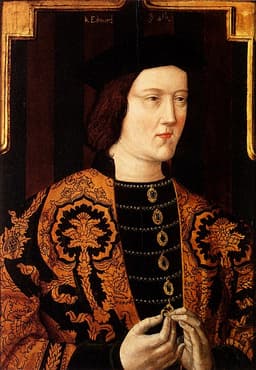
Edward IV of England
Emperor · Medieval
55.7Total

Julius Caesar
General · Ancient
82.8Total
Basic Information
Born
1442
-100
Died
1483
-44
Era
Medieval
Ancient
Nationality
England
Roman Republic
Occupation
Emperor
General
Civilization
Western
Western
Score Comparison
Military (10%)
61.7
88.0
Political (20%)
45.0
78.0
Influence (20%)
60.0
85.0
Legacy (20%)
56.0
82.0
Leadership (15%)
53.2
80.0
Strategy (15%)
58.0
85.0
TOTAL
55.7
82.8
Edward IV of England — Complete Timeline
1461 AD
Battle of TowtonWar
Edward IV led the Yorkist army to a decisive victory over the Lancastrian forces at Towton in Yorkshire. This battle, the largest and bloodiest of the Wars of the Roses, secured Edward's claim to the throne and led to his coronation as king.
Wars of the RosesBattleVictory
Impact: national
Coronation of Edward IVPolitical Action◆ Major
Edward IV was crowned king of England at Westminster Abbey, formally establishing the Yorkist dynasty. His coronation followed the deposition of Henry VI and marked the beginning of a period of Yorkist rule.
CoronationDynastyYorkist
Impact: nationalconstructive
1464 AD
Marriage to Elizabeth WoodvillePolitical Action◆ Major
Edward IV secretly married Elizabeth Woodville, a Lancastrian widow, without consulting his council. This marriage elevated the Woodville family and alienated key allies like the Earl of Warwick, contributing to later political instability.
MarriagePoliticsWoodville
Impact: national
1471 AD
Battle of BarnetWar◆ Major
Edward IV defeated the Earl of Warwick at Barnet, killing Warwick and reclaiming the throne after a brief exile. This victory restored Yorkist control and ended the Lancastrian resurgence led by Warwick and Queen Margaret.
Wars of the RosesBattleRestoration
Impact: national
1475 AD
Treaty of PicquignyPolitical Action
Edward IV signed the Treaty of Picquigny with Louis XI of France, ending a brief invasion of France. The treaty secured a pension for Edward and a truce, but was seen as a diplomatic retreat from military ambitions.
DiplomacyFranceTruce
Impact: regional
Julius Caesar — Complete Timeline
58 BC
Gallic WarsWar◆ Major
Caesar, as proconsul of Gaul, launched a series of campaigns that conquered all of Gaul (modern France, Belgium, and parts of Switzerland). He fought numerous battles, including against the Helvetii, the Belgae, and the Gallic chieftain Vercingetorix. The wars brought immense wealth and a loyal army to Caesar.
Gallic WarsConquestRoman Expansion
Impact: regional
49 BC
Crossing the RubiconPolitical Action◆ Major
Caesar led Legio XIII across the Rubicon River into Italy, defying the Roman Senate's order to disband his army. This act triggered a civil war against Pompey and the Optimates, ultimately leading to Caesar's dictatorship and the end of the Roman Republic.
Roman Civil WarEnd of RepublicPower Struggle
Impact: global
48 BC
Battle of PharsalusWar◆ Major
Caesar's outnumbered army defeated the larger forces of Pompey the Great at Pharsalus in Greece. Caesar's tactical use of a reserve line to counter Pompey's cavalry charge proved decisive. Pompey fled to Egypt, where he was assassinated, leaving Caesar as the undisputed master of the Roman world.
Roman Civil WarBattleDecisive Victory
Impact: regional
44 BC
Appointment as Dictator for LifePolitical Action◆ Major
The Roman Senate appointed Caesar dictator perpetuo (dictator for life), granting him unprecedented personal power. This move concentrated military, legislative, and judicial authority in one person, effectively ending the Roman Republic's traditional system of checks and balances and alarming many senators.
DictatorshipEnd of RepublicPower Consolidation
Impact: regionaldestructive
Assassination on the Ides of MarchPolitical Action◆ Major
A group of Roman senators, led by Marcus Junius Brutus and Gaius Cassius Longinus, stabbed Caesar to death at a meeting of the Senate in the Theatre of Pompey. The assassination was intended to restore the Republic, but instead triggered another civil war that led to the rise of the Roman Empire.
AssassinationRoman PoliticsEnd of Republic
Impact: globaldestructive
Expert Analysis
Origins
Edward IV was born in 1442 in Rouen, France, the eldest son of Richard, Duke of York, a powerful English nobleman with a claim to the throne. His childhood was marked by the escalating conflict between the Houses of York and Lancaster, known as the Wars of the Roses. He received training in martial skills and governance, but his formal education was limited. Julius Caesar was born in 100 BCE into the patrician Julian family in Rome, though his family was not wealthy. He received a rigorous education in rhetoric, philosophy, and law, and his early exposure to politics came through his uncle Gaius Marius, a populist leader. Caesar's formative years included military service and a capture by pirates, which he famously vowed to crucify.
Rise to Power
Edward IV's rise came through battlefield success. In 1461, at age 18, he won the Battle of Towton, the bloodiest battle on English soil, securing the throne for the Yorkists. His coronation followed in June 1461. He faced challenges from Lancastrian loyalists and former allies like the Earl of Warwick, who turned against him. Caesar's rise was more gradual and political. He gained prominence as a military commander in Spain and through the political alliance with Pompey and Crassus (the First Triumvirate) in 60 BCE. His conquest of Gaul (58-50 BCE) gave him wealth, a loyal army, and a reputation. The Senate's attempt to strip him of command led to his crossing of the Rubicon in 49 BCE, triggering a civil war that culminated in his dictatorship.
Leadership & Governance
Edward IV's leadership was pragmatic and focused on consolidating power. He restored royal authority after years of civil war, reformed the royal finances through efficient administration and trade, and promoted justice. However, his marriage to Elizabeth Woodville alienated many nobles. He scored 72.7 in leadership and 62.3 in political. Caesar's leadership was transformative. He implemented land reforms, reorganized the calendar (Julian calendar), and granted citizenship to provincials. His centralization of power, however, alarmed the senatorial class. He scored 82.0 in leadership and 78.0 in political. Caesar's governance was more systematic and far-reaching, while Edward's was reactive and focused on stability.
Triumph & Tragedy
Edward IV's greatest triumph was his victory at Towton and the restoration of Yorkist rule. He successfully defended his throne against Warwick's rebellion (Battle of Barnet, 1471) and secured a peace with France (Treaty of Picquigny, 1475). His greatest failure was his reliance on unreliable nobles and his untimely death at age 40 in 1483, which left a power vacuum that led to the rise of Richard III and the end of the Yorkist dynasty. Caesar's triumphs include the conquest of Gaul, the defeat of Pompey at Pharsalus (48 BCE), and his reforms. His greatest failure was his assassination in 44 BCE, which plunged Rome into another civil war and ended his dream of a stable autocracy. Both died prematurely, but Caesar's death had greater historical repercussions.
Character & Destiny
Edward IV was charismatic, capable, and indulgent. His love for luxury and women (many mistresses) contrasted with his military discipline. He made strategic errors, such as trusting Warwick after the latter's betrayal. Caesar was ambitious, calculating, and decisive. His clemency toward enemies (e.g., Brutus) was a political tool but also a flaw that allowed conspirators to survive. Historians note that Caesar's personality—his drive for personal glory and his disregard for republican norms—made his assassination almost inevitable. Edward's character was more conventional; his destiny was shaped by the dynastic struggles of his time.
Legacy
Edward IV's legacy is mixed. He stabilized England after the Wars of the Roses but his dynasty was short-lived. His administrative reforms influenced later Tudor governance. He is remembered as a capable but not transformative king. In the overall scores, he scores 69.1 in legacy. Caesar's legacy is immense. He ended the Roman Republic and paved the way for the Roman Empire. His name became synonymous with imperial rule (Kaiser, Tsar). His military tactics are still studied, and his writings (Commentarii) are classics. He scores 82.0 in legacy. Caesar's influence on Western civilization is far greater than Edward's, both in scope and duration.
Conclusion
Julius Caesar had a greater impact than Edward IV. Caesar's total score of 83.3 versus Edward's 69.7 reflects his superior military (88.0 vs 71.2), political (78.0 vs 62.3), and strategic (88.0 vs 72.0) abilities. While Edward was a successful medieval king, his influence was largely confined to England and the 15th century. Caesar's actions transformed the Roman world and set the course for Western history. The 13.6-point gap underscores the difference in scale and significance.
Rankings
🥇
Julius CaesarLeader
Mil: 88.0Pol: 78.0Inf: 85.0
82.8
🥈
Edward IV of England
Mil: 61.7Pol: 45.0Inf: 60.0
55.7
+27.1 behind
How This Comparison Works
Algorithm
Each figure is scored on 6 dimensions (0—100 scale) based on structured historical data: Military (10%), Political (20%), Influence (20%), Legacy (20%), Leadership (15%), Strategy (15%). The weighted total produces the final ranking.
Data Sources
Scores are computed from structured sub-indicators in the database. Scale factors adjust for era (Ancient ×0.85, Modern ×1.0) and civilization size (Eastern ×1.05, Other ×0.80) to account for differences in population and military scale.
Maximum 3 Figures
Comparisons are limited to 2—3 figures to ensure readability and statistical meaningfulness.
Error Margins
±5 points per dimension — Sub-scores are derived from historical records with inherent uncertainty. Two figures within 5 points on a dimension should be considered roughly equivalent in that area.
Total Score Accuracy
±3 points overall — The weighted combination of 6 dimensions produces a total score with approximately ±3 points of uncertainty. Differences of less than 3 points are not statistically significant— the figures are effectively tied.
Known Limitations
- Historical records are incomplete and uneven across civilizations
- Figures from oral-tradition societies may be underrepresented
- Occupation labels can misclassify multi-role figures
- Scores measure capability and impact, not moral character
- Quantitative scoring is a comparison tool, not absolute truth
Capability Radar
Military (10%) — Battles & Warfare
Battles
70
95
Win Rate
75
92
Expansion
60
97
Political (20%) — Governance & Reform
Reform
60
90
Diplomacy
70
85
Economy
65
82
Influence (20%) — Cultural & Global Reach
Cultural
55
88
Global
45
94
Legacy (20%) — Historical Impact
Historical
65
95
Longevity
55
96
Leadership (15%) — Power & Stability
Tenure
65
75
Stability
55
60
Strategy (15%) — Tactics & Innovation
Strategy
70
94
Tactics
75
96
Reform
50
88
Similar Comparisons
Comments & Discussion
No comments yet. Be the first to share your thoughts!