Loading...
Edgar the Peaceful vs Wu Zetian
Wu Zetian leads by 16.5 pts · 2 figures compared
…
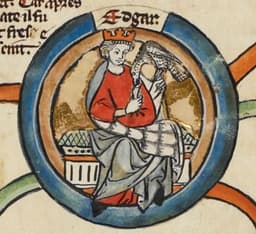
Edgar the Peaceful
Emperor · Medieval
53.5Total

Wu Zetian
Emperor · Medieval
70.0Total
Basic Information
Born
943
624
Died
975
705
Era
Medieval
Medieval
Nationality
England
China
Occupation
Emperor
Emperor
Civilization
Western
Eastern
Score Comparison
Military (10%)
21.2
60.0
Political (20%)
65.0
62.7
Influence (20%)
56.4
65.0
Legacy (20%)
49.2
80.0
Leadership (15%)
78.0
78.0
Strategy (15%)
35.7
66.3
TOTAL
53.5
70.0
Edgar the Peaceful — Complete Timeline
959 AD
Coronation as King of EnglandPolitical Action◆ Major
Edgar succeeded his brother Eadwig as King of England. His reign was marked by stability and the consolidation of monastic reform under Dunstan.
Impact: nationalconstructive
970 AD
Naval defense reformsReform
Edgar organized a standing navy and divided England into naval districts to defend against Viking raids. This created a period of peace and security along the coasts.
Impact: nationalconstructive
Council of WinchesterCultural◆ Major
Edgar convened the Council of Winchester, which established the Regularis Concordia, a code for monastic life. This standardized Benedictine practices across England.
Impact: nationalconstructive
Wu Zetian — Complete Timeline
655 AD
Became Empress ConsortPolitical Action◆ Major
Wu Zetian was elevated from concubine to empress consort of Emperor Gaozong of Tang in 655. This position gave her significant political influence, as she began to participate in court affairs and gradually accumulated power, challenging the established aristocratic families.
Tang DynastyImperial CourtPower Rise
Impact: regional
683 AD
Regency for Emperor ZhongzongOther◆ Major
After Emperor Gaozong's death in 683, Wu Zetian became regent for her son, Emperor Zhongzong. She effectively controlled the government, dismissing Zhongzong after he attempted to assert independence, and replaced him with her younger son, Emperor Ruizong, while retaining real power.
Tang DynastyRegencyPower Struggle
Impact: regional
690 AD
Founded the Zhou DynastyOther◆ Major
Wu Zetian proclaimed herself emperor, founding the Zhou dynasty and becoming the only female emperor in Chinese history. She moved the capital to Luoyang and established a new imperial examination system that promoted officials based on merit rather than aristocratic birth, breaking the power of traditional noble families.
Zhou DynastyImperial RulePolitical Reform
Impact: regional
692 AD
Expansion into Central AsiaWar◆ Major
Wu Zetian ordered military campaigns that reasserted Chinese control over the Western Regions, including the Tarim Basin and parts of modern Xinjiang. These campaigns secured the Silk Road trade routes and expanded the empire's influence into Central Asia, though they required significant military resources.
Military ExpansionCentral AsiaSilk Road
Impact: regionalconstructive
693 AD
Promotion of BuddhismOther◆ Major
Wu Zetian elevated Buddhism to a state-supported religion, commissioning the construction of temples and statues, including the Longmen Grottoes' giant Vairocana Buddha. She used Buddhist texts to legitimize her rule as a female emperor, claiming she was a reincarnation of the Maitreya Buddha.
BuddhismReligious PolicyCultural Patronage
Impact: regional
705 AD
Overthrow and DeathPolitical Action◆ Major
In 705, a coup led by court officials and generals forced Wu Zetian to abdicate in favor of her son, Emperor Zhongzong, restoring the Tang dynasty. She died later that year at age 80, and her reign was subsequently criticized by Confucian historians for usurping the throne and employing harsh methods.
Tang DynastyCoupAbdication
Impact: regionaldestructive
Expert Analysis
Wu Zetian vs Edgar the Peaceful
# The Emperor and the King: Two Crowns, Two Worlds
In the year 970, as a woman in her mid-forties sat upon the Dragon Throne in Luoyang, commanding an empire that stretched from the Gobi Desert to the South China Sea, a young man of twenty-seven ruled over a damp island kingdom where monks chanted in newly reformed monasteries. Wu Zetian, the only female emperor in Chinese history, and Edgar the Peaceful, the boy-king of England, could not have inhabited more different worlds. Yet both ascended to power in the same medieval century, both sought to consolidate authority through religious and administrative reform, and both left legacies that would echo long after their deaths. The question is not merely who was greater—the scores speak clearly enough—but what drove such different outcomes from such different lives.
Origins
Wu Zetian was born in 624 into a world of imperial ambition. Her father was a timber merchant who had helped the founding Tang emperor seize power, and her mother came from a noble family. But in Tang China, a woman’s path was narrow: she entered the palace at age fourteen as a low-ranking concubine of Emperor Taizong. When he died, she was sent to a Buddhist convent—the fate of all imperial women without children. Yet Wu Zetian possessed a mind that refused confinement. She had learned to read and write in the palace, and she understood that knowledge was power in a civilization that revered scholarship.
Edgar, born in 943, came to kingship through blood, not wit. His grandfather, Alfred the Great, had saved Wessex from Viking conquest, and his father, Edmund I, had been murdered. Edgar was only sixteen when his older brother Eadwig died in 959, leaving him the crown of a kingdom still fragmented by Danish invasions and monastic decay. Where Wu Zetian had to claw her way upward through a system designed to exclude her, Edgar inherited a throne that, while unstable, was his by birthright. The difference in their starting points is not just biographical—it is the difference between the Chinese civil service state and the Anglo-Saxon hereditary monarchy.
Rise to Power
Wu Zetian’s ascent is a story of calculated patience. After Emperor Taizong’s death in 649, she maneuvered her way back from the convent into the palace of his son, Emperor Gaozong. She became his concubine, then his empress, and gradually, as Gaozong suffered from debilitating illnesses, she took over the running of the empire. By 660, she was effectively ruling China. When Gaozong died in 683, she placed her sons on the throne as puppets, then deposed them. In 690, she declared herself emperor—not empress consort, not regent, but *Huangdi*, the Son of Heaven. This was unprecedented in Chinese history and would never be repeated.
Edgar’s rise was simpler. He became king in 959 at age sixteen, and his reign was defined not by struggle but by stability. He did not fight for his throne; he inherited it and kept it. His key turning point came in 970, when he convened the Council of Winchester, which established the Regularis Concordia—a standardized code for monastic life that brought order to England’s fragmented religious houses. This was reform from above, not revolution from below.
Leadership & Governance
Here the contrast sharpens. Wu Zetian ruled with an iron hand and a strategic mind. She promoted officials based on merit, not birth, expanding the imperial examination system to allow commoners—and even women—to serve in government. She conquered territory in Korea and Central Asia, pushing Tang borders to their greatest extent. Her military score of 62 reflects real conquests, though not the genius of a Genghis Khan. Her political score of 80 shows a ruler who understood that power required both fear and patronage.
Edgar’s governance was quieter. His military score of 30 is telling: he was called “the Peaceful” for good reason. In 970, he organized a standing navy and divided England into naval districts to defend against Viking raids—a defensive, not expansionist, strategy. His political score of 67 reflects his success in consolidating monastic reform and stabilizing the kingdom after decades of turmoil. But where Wu Zetian transformed Chinese government, Edgar mostly preserved what existed. The Regularis Concordia standardized monastic life, but it did not create a new order.
Triumph & Tragedy
Wu Zetian’s greatest triumph was her very existence as emperor. She ruled for fifteen years, founded her own Zhou dynasty, and died in bed at age eighty-one—a remarkable feat given the constant plots against her. Her tragedy was that her dynasty died with her. After her death in 705, her son was restored to the Tang throne, and her name was erased from official histories for centuries. She was remembered as a usurper, a seductress, a monster.
Edgar’s triumph was peace itself. He died in 975 at age thirty-two, having given England a decade and a half of stability after the chaos of his predecessors. His tragedy was that he died young, leaving his teenage son Edward the Martyr to be murdered three years later, plunging England back into conflict. Edgar’s legacy was fragile; Wu Zetian’s was indelible, even if condemned.
Character & Destiny
Wu Zetian was ruthless, brilliant, and paranoid. She executed rivals, promoted sycophants, and used Buddhism to legitimize her rule. Her character was forged by the constant threat of death—as a concubine, as a former nun, as a woman in a man’s world. She had to be harder than any man to survive.
Edgar was, by all accounts, a pious and capable administrator. He was not a warrior or a visionary, but a consolidator. His character suited his era: England needed healing, not conquest. Where Wu Zetian’s ambition reshaped an empire, Edgar’s moderation preserved a kingdom.
Legacy
Today, Wu Zetian is remembered as the only female emperor in Chinese history—a symbol of female power in a patriarchal civilization. Her legacy score of 85 reflects this enduring fascination. Edgar, with a legacy score of 65, is a footnote in English history, remembered mainly by historians of monastic reform. Yet both achieved what their times demanded: Wu Zetian broke the ultimate glass ceiling of the medieval world; Edgar gave England a generation of peace.
Conclusion
In the end, these two rulers illuminate the different possibilities of medieval power. Wu Zetian’s story is one of ambition overcoming structure; Edgar’s is one of structure enabling stability. One woman changed the rules; one man followed them. Both succeeded, but only one changed history. The other simply kept it going. And perhaps that, too, is a kind of greatness.
Rankings
🥇
Wu ZetianLeader
Mil: 60.0Pol: 62.7Inf: 65.0
70.0
🥈
Edgar the Peaceful
Mil: 21.2Pol: 65.0Inf: 56.4
53.5
+16.5 behind
How This Comparison Works
Algorithm
Each figure is scored on 6 dimensions (0—100 scale) based on structured historical data: Military (10%), Political (20%), Influence (20%), Legacy (20%), Leadership (15%), Strategy (15%). The weighted total produces the final ranking.
Data Sources
Scores are computed from structured sub-indicators in the database. Scale factors adjust for era (Ancient ×0.85, Modern ×1.0) and civilization size (Eastern ×1.05, Other ×0.80) to account for differences in population and military scale.
Maximum 3 Figures
Comparisons are limited to 2—3 figures to ensure readability and statistical meaningfulness.
Error Margins
±5 points per dimension — Sub-scores are derived from historical records with inherent uncertainty. Two figures within 5 points on a dimension should be considered roughly equivalent in that area.
Total Score Accuracy
±3 points overall — The weighted combination of 6 dimensions produces a total score with approximately ±3 points of uncertainty. Differences of less than 3 points are not statistically significant— the figures are effectively tied.
Known Limitations
- Historical records are incomplete and uneven across civilizations
- Figures from oral-tradition societies may be underrepresented
- Occupation labels can misclassify multi-role figures
- Scores measure capability and impact, not moral character
- Quantitative scoring is a comparison tool, not absolute truth
Capability Radar
Military (10%) — Battles & Warfare
Battles
10
65
Win Rate
10
70
Expansion
10
75
Political (20%) — Governance & Reform
Reform
70
85
Diplomacy
70
80
Economy
65
85
Influence (20%) — Cultural & Global Reach
Cultural
40
85
Global
20
70
Legacy (20%) — Historical Impact
Historical
45
90
Longevity
40
85
Leadership (15%) — Power & Stability
Tenure
65
90
Stability
75
75
Strategy (15%) — Tactics & Innovation
Strategy
15
75
Tactics
10
60
Reform
20
80
Similar Comparisons
Comments & Discussion
绿林老吏6/16/2026
数据讲究的是体量,别装糊涂。武周疆域最大时近500万平方公里,人口快5000万,科举进士数翻了五倍。埃德加治下的英格兰,能凑出百万人口都悬,经济全靠修道院种地。你非说两国没法比,那结论就是一位是女皇,一位是村霸。别扯文化差异,数字不会骗人,谁的担子更重一目了然。
Peacemonger's Ghost6/16/2026
Classics scholar here. Edgar’s *Regularis Concordia* unified England’s monastic rules and revived Latin learning—that’s why Bede’s histories survived. Wu Zetian printed a million Buddhist sutras, but she also burned Confucian texts. Power built on fear leaves no classics. Edgar’s quiet reforms let literacy trickle down for three centuries. She was a builder; he was an irrigator. Which legacy actually watered the roots?
折戟宫花6/16/2026
别把埃德加捧成圣人了。他去世时儿子才13岁,直接导致贵族内乱、丹麦人卷土重来。这叫“和平”?武曌临终前虽被迫退位,但传给儿子的朝局安稳,制度成熟。埃德加那个“和平王”的名号,不过是死得早,没来得及暴露问题。武曌六十岁还能杀伐决断,他三十岁就埋下了亡国的祸根——论政治智商,不是一个等级。
Wu's Ghost Burns Books6/16/2026
Revisionist take: Edgar's *Peaceful* label is a royal myth. His three usurpers—Dunstan, Athelwold, Oswald—ran the show while he prayed. He didn't unify England; he just finished what Alfred started. Wu Zetian's legacy is brutal: she executed rivals, crushed rebellions, and forced a dynasty to bow to a woman. Edgar inherited a kingdom; Wu carved one. History loves order over origin. I'll take the builder of new thrones over a caretaker of old ones.
Historian4896/16/2026
Military historian here. Wu Zetian transformed the Tang military from an aristocratic club into a merit-based machine—she expanded the *fubing* militia system, purged corrupt generals, and conquered the Korean peninsula temporarily. Edgar’s "peace" was just a Viking truce. He never fought a real war; his monks just graphed tax rolls. Give me the lady who crushed the Göktürks over the kid who visited monasteries. That’s a real ruler.