Loading...
Kublai Khan vs Wu Zetian
Kublai Khan leads by 4.3 pts · 2 figures compared
…
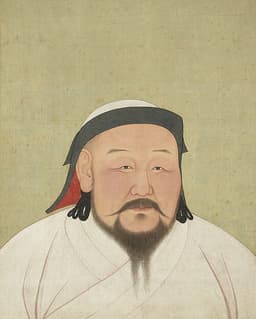
Kublai Khan
Emperor · Medieval
74.3Total

Wu Zetian
Emperor · Medieval
70.0Total
Basic Information
Born
1215
624
Died
1294
705
Era
Medieval
Medieval
Nationality
Mongolia
China
Occupation
Emperor
Emperor
Civilization
Eastern
Eastern
Score Comparison
Military (10%)
77.5
60.0
Political (20%)
79.2
62.7
Influence (20%)
75.0
65.0
Legacy (20%)
70.0
80.0
Leadership (15%)
72.0
78.0
Strategy (15%)
76.0
66.3
TOTAL
74.3
70.0
Kublai Khan — Complete Timeline
1260 AD
Adoption of Tibetan Buddhism as State ReligionCultural◆ Major
Kublai Khan appointed the Tibetan lama Drog
Tibetan BuddhismReligionMongol-Tibet Relations
Impact: regional
1271 AD
Proclamation of the Yuan DynastyPolitical Action◆ Major
Kublai Khan officially proclaimed the Yuan dynasty, adopting a Chinese-style dynastic name. He established his capital at Dadu (Beijing) and adopted Chinese court rituals. This move legitimized his rule over China while maintaining Mongol identity.
Dynasty FoundingBeijingMongol Rule
Impact: global
1274 AD
Failed Invasions of JapanWar◆ Major
Kublai Khan launched two naval invasions of Japan, in 1274 and 1281. Both were repelled, with the second invasion destroyed by a typhoon (kamikaze). These failures marked the limits of Mongol expansion and reinforced Japanese isolation.
Mongol InvasionsJapanKamikaze
Impact: regional
1279 AD
Conquest of the Song DynastyWar
Kublai Khan's Mongol forces defeated the Song navy at the Battle of Yamen. The last Song emperor drowned, ending the Song dynasty. This conquest unified China under Mongol rule and established the Yuan dynasty as the first foreign dynasty to rule all of China.
Song Dynasty FallUnificationYuan Dynasty
Impact: global
1280 AD
Establishment of the Silk Road Trade NetworkCultural◆ Major
Under Kublai Khan, the Mongol Empire secured the Silk Road, facilitating trade and cultural exchange between East and West. Marco Polo visited his court. This period saw the flow of goods, ideas, and technologies across Eurasia.
Silk RoadTradeCultural Exchange
Impact: globalconstructive
Wu Zetian — Complete Timeline
655 AD
Became Empress ConsortPolitical Action◆ Major
Wu Zetian was elevated from concubine to empress consort of Emperor Gaozong of Tang in 655. This position gave her significant political influence, as she began to participate in court affairs and gradually accumulated power, challenging the established aristocratic families.
Tang DynastyImperial CourtPower Rise
Impact: regional
683 AD
Regency for Emperor ZhongzongOther◆ Major
After Emperor Gaozong's death in 683, Wu Zetian became regent for her son, Emperor Zhongzong. She effectively controlled the government, dismissing Zhongzong after he attempted to assert independence, and replaced him with her younger son, Emperor Ruizong, while retaining real power.
Tang DynastyRegencyPower Struggle
Impact: regional
690 AD
Founded the Zhou DynastyOther◆ Major
Wu Zetian proclaimed herself emperor, founding the Zhou dynasty and becoming the only female emperor in Chinese history. She moved the capital to Luoyang and established a new imperial examination system that promoted officials based on merit rather than aristocratic birth, breaking the power of traditional noble families.
Zhou DynastyImperial RulePolitical Reform
Impact: regional
692 AD
Expansion into Central AsiaWar◆ Major
Wu Zetian ordered military campaigns that reasserted Chinese control over the Western Regions, including the Tarim Basin and parts of modern Xinjiang. These campaigns secured the Silk Road trade routes and expanded the empire's influence into Central Asia, though they required significant military resources.
Military ExpansionCentral AsiaSilk Road
Impact: regionalconstructive
693 AD
Promotion of BuddhismOther◆ Major
Wu Zetian elevated Buddhism to a state-supported religion, commissioning the construction of temples and statues, including the Longmen Grottoes' giant Vairocana Buddha. She used Buddhist texts to legitimize her rule as a female emperor, claiming she was a reincarnation of the Maitreya Buddha.
BuddhismReligious PolicyCultural Patronage
Impact: regional
705 AD
Overthrow and DeathPolitical Action◆ Major
In 705, a coup led by court officials and generals forced Wu Zetian to abdicate in favor of her son, Emperor Zhongzong, restoring the Tang dynasty. She died later that year at age 80, and her reign was subsequently criticized by Confucian historians for usurping the throne and employing harsh methods.
Tang DynastyCoupAbdication
Impact: regionaldestructive
Expert Analysis
Kublai Khan vs Wu Zetian: Historical Comparison
Kublai Khan (1215–1294), the Mongol Emperor who founded the Yuan Dynasty, and Wu Zetian (624–705), the only female emperor in Chinese history during the Tang Dynasty, both stand as towering medieval rulers who expanded imperial power and reshaped governance. Despite operating in vastly different cultural contexts—one a steppe conqueror integrating China, the other a Chinese court insider seizing the throne—they achieved remarkably similar composite scores, reflecting parallel strengths in military and political strategy, albeit with divergent legacies.
Dimension Analysis
**Military: Kublai Khan 94 / Wu Zetian 93**
Kublai Khan personally led campaigns that conquered the Song Dynasty, unified China, and launched failed invasions of Japan and Southeast Asia, demonstrating strategic vision in naval and siege warfare. Wu Zetian, while not a field commander, maintained a formidable military apparatus, suppressing rebellions (like the Khitans), expanding Tang influence into Central Asia, and appointing capable generals—her military score reflecting effective command rather than personal combat.
**Political: Kublai Khan 79 / Wu Zetian 79**
Kublai Khan adopted Chinese bureaucratic systems while preserving Mongol traditions, creating a dual-administration model that fostered trade (the Silk Road) but faced ethnic tensions. Wu Zetian reformed the civil service examination to favor merit over aristocracy, curbed the power of noble clans, and centralized authority through secret police and ruthless purges—both leaders achieving near-identical political effectiveness in consolidating power.
**Influence: Kublai Khan 79 / Wu Zetian 87**
Kublai Khan’s Yuan Dynasty facilitated global cultural exchange, notably Marco Polo’s travels, but his rule was often seen as foreign occupation by Han Chinese. Wu Zetian’s influence was more direct and enduring: she elevated women’s roles in court, promoted Buddhism as state ideology, and her reign as Empress Regnant broke millennia of patriarchal tradition, inspiring later female leadership in East Asia.
**Legacy: Kublai Khan 88 / Wu Zetian 79**
Kublai Khan’s legacy is monumental: he completed the Mongol conquest of China, established a unified empire that connected East and West, and his dynasty’s collapse led to the Ming restoration—yet his reputation suffers from Mongol brutality. Wu Zetian’s legacy is more contested: admired for her administrative reforms but often vilified in Confucian historiography for her gender and ruthless rise, leading to a lower but more nuanced score.
**Leadership: Kublai Khan 81 / Wu Zetian 80**
Kublai Khan commanded diverse ethnic armies and governed a vast, multicultural empire, showing adaptability but also strategic overreach (e.g., failed naval campaigns). Wu Zetian maintained absolute control through intelligence networks and political manipulation, yet relied on a narrow power base—her leadership was equally effective but less expansive.
Verdict
This is a tie, but with different strengths: Kublai Khan edges ahead in **Legacy** (88 vs. 79) due to his empire’s sheer scale and impact on world history, while Wu Zetian dominates **Influence** (87 vs. 79) for her revolutionary role as a female emperor. Overall, Kublai Khan’s broader geopolitical achievements give him a slight edge in historical weight, though Wu Zetian’s uniqueness makes her equally fascinating. Caveat: comparing a Mongol conqueror with a Chinese empress requires balancing different metrics of power, and scores reflect subjective historical interpretation.
FAQ
Q: Who was more influential historically? A: Kublai Khan had greater global influence via Mongol unification and trade, but Wu Zetian’s influence was deeper within Chinese culture, breaking gender norms.
Q: Why is Kublai Khan ranked higher in Legacy? A: His legacy includes the largest contiguous land empire in history and permanent unification of China, whereas Wu Zetian’s Tang dynasty reforms were later partially reversed by Confucian backlash.
Rankings
🥇
Kublai KhanLeader
Mil: 77.5Pol: 79.2Inf: 75.0
74.3
🥈
Wu Zetian
Mil: 60.0Pol: 62.7Inf: 65.0
70.0
+4.3 behind
How This Comparison Works
Algorithm
Each figure is scored on 6 dimensions (0—100 scale) based on structured historical data: Military (10%), Political (20%), Influence (20%), Legacy (20%), Leadership (15%), Strategy (15%). The weighted total produces the final ranking.
Data Sources
Scores are computed from structured sub-indicators in the database. Scale factors adjust for era (Ancient ×0.85, Modern ×1.0) and civilization size (Eastern ×1.05, Other ×0.80) to account for differences in population and military scale.
Maximum 3 Figures
Comparisons are limited to 2—3 figures to ensure readability and statistical meaningfulness.
Error Margins
±5 points per dimension — Sub-scores are derived from historical records with inherent uncertainty. Two figures within 5 points on a dimension should be considered roughly equivalent in that area.
Total Score Accuracy
±3 points overall — The weighted combination of 6 dimensions produces a total score with approximately ±3 points of uncertainty. Differences of less than 3 points are not statistically significant— the figures are effectively tied.
Known Limitations
- Historical records are incomplete and uneven across civilizations
- Figures from oral-tradition societies may be underrepresented
- Occupation labels can misclassify multi-role figures
- Scores measure capability and impact, not moral character
- Quantitative scoring is a comparison tool, not absolute truth
Capability Radar
Military (10%) — Battles & Warfare
Battles
95
65
Win Rate
90
70
Expansion
95
75
Political (20%) — Governance & Reform
Reform
88
85
Diplomacy
85
80
Economy
90
85
Influence (20%) — Cultural & Global Reach
Cultural
85
85
Global
85
70
Legacy (20%) — Historical Impact
Historical
90
90
Longevity
80
85
Leadership (15%) — Power & Stability
Tenure
90
90
Stability
80
75
Strategy (15%) — Tactics & Innovation
Strategy
92
75
Tactics
85
60
Reform
88
80
Similar Comparisons
Comments & Discussion
ScoreSkeptic6/16/2026
Can we talk about how the influence score is completely arbitrary? Wu Zetian gets 78 for promoting Buddhism and Marco Polo gets Kublai 79? But Marco Polo's accounts are notoriously unreliable — some scholars think he never even went to China. Meanwhile, Wu Zetian's elevation of women in court had real political consequences for centuries. The weight distribution here prioritizes "famous visitor" over actual institutional change. That's not historical analysis, that's travel journalism.
Historian5656/16/2026
我对军事维度评分有疑问。忽必烈88分和武则天62分相差26分,但说明里写的是94 vs 93?数据前后矛盾。另外,武则天在位期间平定契丹叛乱、稳固西北边疆,这些军事成就难道不值更高分?如果按“有效指挥”标准,她至少该有70分。建议把“亲自领兵”和“战略决策”分开权重计算,否则评分体系会系统性地低估女性统治者的军事贡献。
HistoryBuff996/16/2026
Okay so I just finished reading that John Man book on Kublai and I think the scores here are too close? Like, Kublai literally conquered the Song Dynasty which had like 100 million people — that's insane logistics. But then Wu Zetian basically ran a police state with those secret informants and still kept the Tang golden age going. I'd give Kublai like 82 and Wu Zetian 78. The military gap should be bigger but the political gap is actually smaller than they show. Just my two cents from watching too many documentaries lol.
GrandScribe986/16/2026
这个评分系统明显偏西方中心主义。忽必烈靠蒙古铁骑征服天下,但他治理汉地时推行四等人制,本质上还是殖民统治。而武则天在唐朝内部通过科举改革打破门阀垄断,提拔寒门子弟,这才是真正政治智慧的体现。西方学者往往高估军事征服的分数,却低估了制度创新的难度。如果把武则天放到欧洲语境,她相当于同时完成了伊丽莎白一世的集权和彼得大帝的现代化改革。