Loading...
Edgar the Peaceful vs Julius Caesar
Julius Caesar leads by 29.3 pts · 2 figures compared
…
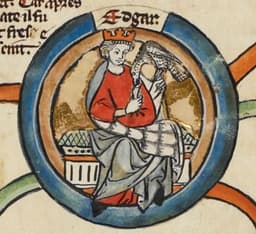
Edgar the Peaceful
Emperor · Medieval
53.5Total

Julius Caesar
General · Ancient
82.8Total
Basic Information
Born
943
-100
Died
975
-44
Era
Medieval
Ancient
Nationality
England
Roman Republic
Occupation
Emperor
General
Civilization
Western
Western
Score Comparison
Military (10%)
21.2
88.0
Political (20%)
65.0
78.0
Influence (20%)
56.4
85.0
Legacy (20%)
49.2
82.0
Leadership (15%)
78.0
80.0
Strategy (15%)
35.7
85.0
TOTAL
53.5
82.8
Edgar the Peaceful — Complete Timeline
959 AD
Coronation as King of EnglandPolitical Action◆ Major
Edgar succeeded his brother Eadwig as King of England. His reign was marked by stability and the consolidation of monastic reform under Dunstan.
Impact: nationalconstructive
970 AD
Naval defense reformsReform
Edgar organized a standing navy and divided England into naval districts to defend against Viking raids. This created a period of peace and security along the coasts.
Impact: nationalconstructive
Council of WinchesterCultural◆ Major
Edgar convened the Council of Winchester, which established the Regularis Concordia, a code for monastic life. This standardized Benedictine practices across England.
Impact: nationalconstructive
Julius Caesar — Complete Timeline
58 BC
Gallic WarsWar◆ Major
Caesar, as proconsul of Gaul, launched a series of campaigns that conquered all of Gaul (modern France, Belgium, and parts of Switzerland). He fought numerous battles, including against the Helvetii, the Belgae, and the Gallic chieftain Vercingetorix. The wars brought immense wealth and a loyal army to Caesar.
Gallic WarsConquestRoman Expansion
Impact: regional
49 BC
Crossing the RubiconPolitical Action◆ Major
Caesar led Legio XIII across the Rubicon River into Italy, defying the Roman Senate's order to disband his army. This act triggered a civil war against Pompey and the Optimates, ultimately leading to Caesar's dictatorship and the end of the Roman Republic.
Roman Civil WarEnd of RepublicPower Struggle
Impact: global
48 BC
Battle of PharsalusWar◆ Major
Caesar's outnumbered army defeated the larger forces of Pompey the Great at Pharsalus in Greece. Caesar's tactical use of a reserve line to counter Pompey's cavalry charge proved decisive. Pompey fled to Egypt, where he was assassinated, leaving Caesar as the undisputed master of the Roman world.
Roman Civil WarBattleDecisive Victory
Impact: regional
44 BC
Appointment as Dictator for LifePolitical Action◆ Major
The Roman Senate appointed Caesar dictator perpetuo (dictator for life), granting him unprecedented personal power. This move concentrated military, legislative, and judicial authority in one person, effectively ending the Roman Republic's traditional system of checks and balances and alarming many senators.
DictatorshipEnd of RepublicPower Consolidation
Impact: regionaldestructive
Assassination on the Ides of MarchPolitical Action◆ Major
A group of Roman senators, led by Marcus Junius Brutus and Gaius Cassius Longinus, stabbed Caesar to death at a meeting of the Senate in the Theatre of Pompey. The assassination was intended to restore the Republic, but instead triggered another civil war that led to the rise of the Roman Empire.
AssassinationRoman PoliticsEnd of Republic
Impact: globaldestructive
Expert Analysis
Julius Caesar vs Edgar the Peaceful
# The General and the Peacemaker
On a March morning in 44 BCE, Julius Caesar fell beneath twenty-three dagger blows at the foot of Pompey’s Theater in Rome. The man who had conquered Gaul, crossed the Rubicon, and made himself dictator for life bled out on the Senate floor, his blood pooling around the marble base of his murdered rival’s statue. Across a thousand years and a thousand miles, another king died quietly in his bed. Edgar the Peaceful, ruler of England, passed away in 975 CE at the age of thirty-two, leaving behind a realm so stable that his contemporaries called it a golden age. One death shook the world; the other barely disturbed it. Yet both men were kings in all but name, and both reshaped the lands they ruled. Why did their paths diverge so dramatically? The answer lies not in their greatness, but in the worlds they inherited.
Origins
Julius Caesar was born into the twilight of the Roman Republic, a world of senatorial intrigue, civil wars, and endless expansion. His family, the Julii, claimed descent from the goddess Venus, but they were political outsiders in a system dominated by the old patrician elite. From his earliest years, Caesar breathed the air of ambition. He was kidnapped by pirates as a young man, laughed at their ransom demand, and promised to crucify them—a promise he kept. His world demanded audacity, and he gave it.
Edgar was born in 943 CE, a prince of the House of Wessex, in a kingdom still healing from the ravages of Viking invasions. His grandfather, Alfred the Great, had saved England from annihilation; his father, Edmund I, had been stabbed to death in his own hall. England was a patchwork of warring kingdoms, and the crown was a prize for the ruthless. Yet Edgar’s world was not Caesar’s. The Anglo-Saxon kings ruled through councils of nobles and bishops, not through a Senate of equals. Power was personal, local, and fragile. Edgar learned early that survival meant building consensus, not conquering enemies.
Rise to Power
Caesar’s path to dominance was a masterclass in calculated risk. He climbed the Roman political ladder—quaestor, aedile, praetor—but his true ascent began in 58 BCE, when he took command of the Roman provinces in Gaul. Over eight years, he waged a war of annihilation against the Gallic tribes, slaughtering perhaps a million people and enslaving another million. He wrote his own propaganda in elegant Latin, the *Commentaries*, which made him a hero in Rome. When his political enemies moved to strip him of command, he crossed the Rubicon River in 49 BCE with a single legion, sparking a civil war. Within four years, he was dictator for life. His rise was a thunderbolt.
Edgar’s rise was a gentle dawn. He became king in 959 CE at the age of sixteen, after his brother Eadwig died in suspicious circumstances. Edgar had no legions, no Gallic wars, no dramatic river crossings. Instead, he inherited a kingdom exhausted by conflict. His first act was not conquest but reconciliation. He recalled the exiled monastic reformer Dunstan from Flanders, made him Archbishop of Canterbury, and set about healing the wounds of his brother’s chaotic reign. Where Caesar broke the old order, Edgar mended it.
Leadership & Governance
As dictator of Rome, Caesar governed like a hurricane. He reformed the calendar (creating the Julian calendar we still use), granted citizenship to provincials, and launched massive building projects. He centralized power in his own hands, packed the Senate with his supporters, and treated the Republic as a corpse to be dissected. His military genius was undeniable—his sieges at Alesia and his lightning campaigns in Gaul remain textbook examples of strategy—but his political wisdom was brittle. He pardoned his enemies, but he never trusted them, and they repaid his mercy with daggers.
Edgar governed like a gardener. He convened the Council of Winchester in 970 CE, which established the *Regularis Concordia*, a single code of monastic practice for all of England. This standardized religious life and tied the Church firmly to the crown. He reorganized the navy, dividing England into naval districts and maintaining a standing fleet that kept Viking raiders at bay. His military score of 30.0 reflects a king who fought no great battles—because he didn’t need to. He ruled through law, not war. His political score of 67.6, modest by Roman standards, was extraordinary for a medieval king who kept peace for sixteen years without a single major rebellion.
Triumph & Tragedy
Caesar’s greatest triumph was his conquest of Gaul, which doubled Rome’s territory and made him the richest man in the Republic. His greatest tragedy was his own success: he destroyed the Republic he claimed to save, and his assassination in 44 BCE plunged Rome into another civil war. His adopted son, Octavian, would finish what Caesar started, transforming the Republic into an empire. Caesar’s legacy was written in blood.
Edgar’s greatest triumph was his peaceful reign. He was crowned twice—once at Bath, once at Kingston—in a ceremony that emphasized his role as a sacred king, chosen by God. He never fought a major battle, never faced a rebellion, never executed a rival. His tragedy was his early death at thirty-two, which left his young son, Edward the Martyr, to inherit a throne that soon collapsed into fratricide and Viking invasion. Edgar’s golden age lasted only as long as he did.
Character & Destiny
Caesar was a gambler. He bet everything on his own brilliance, and he was right—until he wasn’t. His arrogance, his refusal to accept limits, his belief that he could bend the world to his will—these made him great and killed him. He once said, “It is easier to find men who will volunteer to die than to find those who are willing to endure pain with patience.” He died by the sword because he never learned patience.
Edgar was a builder. He understood that power was not about conquest but about consensus. He surrounded himself with wise counselors like Dunstan, listened to his nobles, and governed through law rather than force. He was called “the Peaceful” not because he was weak, but because he knew that lasting peace requires compromise. He once said, “A kingdom is like a ship: it must be steered with a light hand, or it will founder.”
Legacy
Caesar’s name became a title: Kaiser, Tsar, Caesar. His reforms shaped Western civilization for two millennia. But his legacy is also a warning. He showed that one man’s ambition can destroy a republic, and that greatness without restraint is a form of madness.
Edgar’s legacy is quieter. He is remembered as the king who unified England, who gave the Church a single rule, who kept the Vikings at bay. His name appears in history books as a footnote between the martyrs and the conquerors. But his legacy is no less real: the England he left behind was stable, prosperous, and ready for the challenges ahead. He proved that peace is not the absence of war, but the presence of justice.
Conclusion
Standing on the Ides of March, Caesar’s blood soaking into the marble floor, one might think he was the greater man. He conquered the world; Edgar only ruled a small island. But perhaps the real measure of greatness is not what you destroy, but what you build. Caesar built an empire on the ruins of a republic. Edgar built a kingdom on the foundations of peace. One changed the world forever; the other kept it from falling apart. In the end, both were necessary. But if history teaches us anything, it is that the peacemakers are often forgotten, while the conquerors are remembered—and that is its own kind of tragedy.
Rankings
🥇
Julius CaesarLeader
Mil: 88.0Pol: 78.0Inf: 85.0
82.8
🥈
Edgar the Peaceful
Mil: 21.2Pol: 65.0Inf: 56.4
53.5
+29.3 behind
How This Comparison Works
Algorithm
Each figure is scored on 6 dimensions (0—100 scale) based on structured historical data: Military (10%), Political (20%), Influence (20%), Legacy (20%), Leadership (15%), Strategy (15%). The weighted total produces the final ranking.
Data Sources
Scores are computed from structured sub-indicators in the database. Scale factors adjust for era (Ancient ×0.85, Modern ×1.0) and civilization size (Eastern ×1.05, Other ×0.80) to account for differences in population and military scale.
Maximum 3 Figures
Comparisons are limited to 2—3 figures to ensure readability and statistical meaningfulness.
Error Margins
±5 points per dimension — Sub-scores are derived from historical records with inherent uncertainty. Two figures within 5 points on a dimension should be considered roughly equivalent in that area.
Total Score Accuracy
±3 points overall — The weighted combination of 6 dimensions produces a total score with approximately ±3 points of uncertainty. Differences of less than 3 points are not statistically significant— the figures are effectively tied.
Known Limitations
- Historical records are incomplete and uneven across civilizations
- Figures from oral-tradition societies may be underrepresented
- Occupation labels can misclassify multi-role figures
- Scores measure capability and impact, not moral character
- Quantitative scoring is a comparison tool, not absolute truth
Capability Radar
Military (10%) — Battles & Warfare
Battles
10
95
Win Rate
10
92
Expansion
10
97
Political (20%) — Governance & Reform
Reform
70
90
Diplomacy
70
85
Economy
65
82
Influence (20%) — Cultural & Global Reach
Cultural
40
88
Global
20
94
Legacy (20%) — Historical Impact
Historical
45
95
Longevity
40
96
Leadership (15%) — Power & Stability
Tenure
65
75
Stability
75
60
Strategy (15%) — Tactics & Innovation
Strategy
15
94
Tactics
10
96
Reform
20
88
Similar Comparisons
Comments & Discussion
GAULLEAN6/16/2026
Caesar didn't just conquer Gaul—he engineered a demographic genocide that killed over a million people by his own admission. That's not greatness, that's industrial-scale slaughter dressed in Latin rhetoric. Edgar the Peaceful actually reformed his kingdom's monasteries and minted sound coinage. One man built civilization, the other burnt it for ego. History's obsession with Caesar is just celebrity worship for genocide.
甲胄书生6/16/2026
拿凯撒和埃德加比根本上是个错误——大指挥官和好管家怎么能放一块?凯撒的成就建立在对高卢人的系统性屠杀和罗马共和法的践踏上,他的真正遗产是用白银和尸骨铺出来的独裁者模板。而埃德加登基时才十四岁,没用一滴血就整合了威塞克斯和麦西亚,还搞出了影响英国几百年的郡制改革。你要一个战神还是要一位真正的治国者?
THE_BOOKWORM6/16/2026
Let's be real: calling Edgar "the Peaceful" is like calling your goldfish "the Aquatic." The title was retroactively applied by 12th-century monks who loved his monastic patronage. In his actual reign, he had to brutally suppress a revolt in Thanet and constantly bribe Norse raiders. Caesar at least earned his reputation with actual military genius—the siege of Alesia is still studied at West Point. Edgar's legacy is second-hand smoke from Dunstan's reforms.
铁幕史眼6/16/2026
我承认埃德加是个被低估的统治者,但他的"黄金时代"很大程度是靠他叔叔埃德蒙和父亲埃德雷德的努力奠定的,他不过是接过了一个已经整合好的盘子。凯撒则是从共和制的废墟中自己建起一座帝国大厦,他的《高卢战记》至今仍是军事教科书。两人差了九个世纪,放在一起比就像让一个200斤举重运动员和50公斤书法家比力气——类别都不一样。
Quaestor_Rerum6/16/2026
Caesar's assassination wasn't a tragedy—it was the logical endpoint of his political philosophy. By accepting dictatorship and destroying senatorial norms, he literally asked for twenty-three stab wounds. Edgar died at 32 of natural causes without a single conspiracy formed against him. That's not luck. That's the result of ruling with moderation and consensus rather than ego. The "great" conqueror died hated; the "peaceful" king died mourned.