Loading...
This comparison has not been analyzed yet.
One-time AI generation (~1 minute). Scores and timeline are already available below.
Dungar Singh of Bikaner vs Kirti Sri Rajasinha
Kirti Sri Rajasinha leads by 8.9 pts · 2 figures compared
…
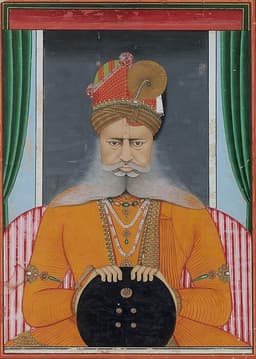
Dungar Singh of Bikaner
Emperor · Modern
48.6Total

Kirti Sri Rajasinha
Emperor · Modern
57.5Total
Basic Information
Born
1854
1747
Died
1887
1782
Era
Modern
Modern
Nationality
India
Sri Lanka
Occupation
Emperor
Emperor
Civilization
Indian
Indian
Score Comparison
Military (10%)
21.2
50.0
Political (20%)
68.0
72.0
Influence (20%)
50.2
59.0
Legacy (20%)
40.0
50.0
Leadership (15%)
68.0
72.0
Strategy (15%)
35.7
36.8
TOTAL
48.6
57.5
Dungar Singh of Bikaner — Complete Timeline
1880 AD
Construction of the Junagarh Fort additionsCultural◆ Major
Dungar Singh oversaw the construction of new additions to the Junagarh Fort in Bikaner, including the Anup Mahal and the Karan Mahal. These structures featured intricate mirror work, frescoes, and carved marble, enhancing the fort's architectural grandeur.
ArchitectureFortPatronage
Impact: regionalconstructive
1885 AD
Modernization of Bikaner's infrastructureReform◆ Major
Dungar Singh initiated modernization projects in Bikaner, including the construction of roads, a telegraph system, and a water supply network. These improvements connected Bikaner to broader colonial infrastructure and improved urban living conditions.
InfrastructureModernizationUrban Development
Impact: regionalconstructive
1887 AD
Establishment of the Bikaner State MuseumCultural
Dungar Singh founded the Bikaner State Museum within the Junagarh Fort, housing a collection of artifacts, manuscripts, and weapons. The museum preserved the cultural heritage of Bikaner and made it accessible to the public.
MuseumCultural PreservationEducation
Impact: regionalconstructive
Kirti Sri Rajasinha — Complete Timeline
1753 AD
Revival of Buddhism in KandyCultural◆ Major
Kirti Sri Rajasinha, with the assistance of the Siamese monk Upali, re-established the higher ordination (Upasampada) for Buddhist monks in Sri Lanka. This revived the Buddhist Sangha, which had declined under earlier Nayakkar and Portuguese rule, and restored Buddhism as the state religion of the Kandyan Kingdom.
Buddhist RevivalReligious ReformKandyan Kingdom
Impact: nationalconstructive
1760 AD
Construction of the Temple of the Tooth RelicCultural◆ Major
Kirti Sri Rajasinha commissioned the construction of the current Temple of the Tooth (Sri Dalada Maligawa) in Kandy to house the sacred tooth relic of the Buddha. This temple became the most important Buddhist shrine in Sri Lanka and a symbol of Kandyan sovereignty.
Religious ArchitectureBuddhist ShrineCultural Heritage
Impact: nationalconstructive
1765 AD
Defense against Dutch InvasionWar◆ Major
Kirti Sri Rajasinha successfully repelled a Dutch invasion of the Kandyan Kingdom. The Dutch East India Company (VOC) attempted to conquer Kandy but were defeated by the Kandyan army, forcing the Dutch to sign a peace treaty in 1766 that recognized Kandyan independence.
Dutch-Kandyan WarMilitary VictoryIndependence
Impact: regional
1770 AD
Promotion of Literature and ArtsCultural
Kirti Sri Rajasinha patronized Sinhalese literature, poetry, and traditional arts. He sponsored the composition of Buddhist texts and the revival of classical Sinhalese poetry, contributing to a cultural renaissance in the Kandyan court during his reign.
Cultural PatronageLiteratureArts
Impact: nationalconstructive
This comparison has not been analyzed yet.
One-time AI generation (~1 minute). Scores and timeline are already available below.
Rankings
🥇
Kirti Sri RajasinhaLeader
Mil: 50.0Pol: 72.0Inf: 59.0
57.5
🥈
Dungar Singh of Bikaner
Mil: 21.2Pol: 68.0Inf: 50.2
48.6
+8.9 behind
How This Comparison Works
Algorithm
Each figure is scored on 6 dimensions (0—100 scale) based on structured historical data: Military (10%), Political (20%), Influence (20%), Legacy (20%), Leadership (15%), Strategy (15%). The weighted total produces the final ranking.
Data Sources
Scores are computed from structured sub-indicators in the database. Scale factors adjust for era (Ancient ×0.85, Modern ×1.0) and civilization size (Eastern ×1.05, Other ×0.80) to account for differences in population and military scale.
Maximum 3 Figures
Comparisons are limited to 2—3 figures to ensure readability and statistical meaningfulness.
Error Margins
±5 points per dimension — Sub-scores are derived from historical records with inherent uncertainty. Two figures within 5 points on a dimension should be considered roughly equivalent in that area.
Total Score Accuracy
±3 points overall — The weighted combination of 6 dimensions produces a total score with approximately ±3 points of uncertainty. Differences of less than 3 points are not statistically significant— the figures are effectively tied.
Known Limitations
- Historical records are incomplete and uneven across civilizations
- Figures from oral-tradition societies may be underrepresented
- Occupation labels can misclassify multi-role figures
- Scores measure capability and impact, not moral character
- Quantitative scoring is a comparison tool, not absolute truth
Capability Radar
Military (10%) — Battles & Warfare
Battles
10
20
Win Rate
10
25
Expansion
10
10
Political (20%) — Governance & Reform
Reform
60
75
Diplomacy
40
60
Economy
50
40
Influence (20%) — Cultural & Global Reach
Cultural
30
65
Global
10
30
Legacy (20%) — Historical Impact
Historical
30
60
Longevity
20
55
Leadership (15%) — Power & Stability
Tenure
50
70
Stability
55
50
Strategy (15%) — Tactics & Innovation
Strategy
15
20
Tactics
15
15
Reform
30
10
Similar Comparisons
Comments & Discussion
No comments yet. Be the first to share your thoughts!