Loading...
Ivan V vs Kirti Sri Rajasinha
Kirti Sri Rajasinha leads by 11.5 pts · 2 figures compared
…
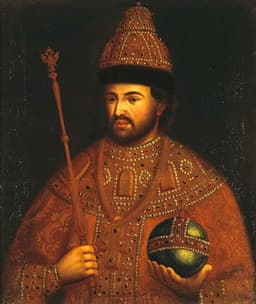
Ivan V
Emperor · Modern
46.0Total

Kirti Sri Rajasinha
Emperor · Modern
57.5Total
Basic Information
Born
1666
1747
Died
1696
1782
Era
Modern
Modern
Nationality
Russia
Sri Lanka
Occupation
Emperor
Emperor
Civilization
Western
Indian
Score Comparison
Military (10%)
10.6
50.0
Political (20%)
68.0
72.0
Influence (20%)
60.0
59.0
Legacy (20%)
35.0
50.0
Leadership (15%)
33.6
72.0
Strategy (15%)
60.0
36.8
TOTAL
46.0
57.5
Ivan V — Complete Timeline
1682 AD
Coronation as Co-Tsar with Peter IPolitical Action◆ Major
Following the death of Feodor III, Ivan V was crowned co-tsar alongside his half-brother Peter I, with his sister Sophia Alekseyevna acting as regent. This arrangement was forced by the Streltsy uprising and aimed to prevent a succession crisis, but Ivan's mental disabilities left him as a figurehead.
SuccessionRegencyStreltsy Uprising
Impact: national
Streltsy Uprising of 1682Political Action◆ Major
The Moscow Streltsy (musketeers) revolted, demanding that Ivan V be crowned tsar alongside Peter I. The uprising resulted in the massacre of several Naryshkin family members and the installation of Sophia as regent. Ivan's role was passive, but the event defined his reign.
RebellionRegencyViolence
Impact: nationaldestructive
Reign as Figurehead Co-TsarPolitical Action
From 1682 to 1696, Ivan V served as co-tsar with Peter I, but due to his mental and physical disabilities, he took no part in governance. Real power was held by his sister Sophia until 1689, and then by Peter. Ivan's reign was nominal, and he remained a ceremonial figure.
FigureheadCo-RulerCeremonial
Impact: national
Kirti Sri Rajasinha — Complete Timeline
1753 AD
Revival of Buddhism in KandyCultural◆ Major
Kirti Sri Rajasinha, with the assistance of the Siamese monk Upali, re-established the higher ordination (Upasampada) for Buddhist monks in Sri Lanka. This revived the Buddhist Sangha, which had declined under earlier Nayakkar and Portuguese rule, and restored Buddhism as the state religion of the Kandyan Kingdom.
Buddhist RevivalReligious ReformKandyan Kingdom
Impact: nationalconstructive
1760 AD
Construction of the Temple of the Tooth RelicCultural◆ Major
Kirti Sri Rajasinha commissioned the construction of the current Temple of the Tooth (Sri Dalada Maligawa) in Kandy to house the sacred tooth relic of the Buddha. This temple became the most important Buddhist shrine in Sri Lanka and a symbol of Kandyan sovereignty.
Religious ArchitectureBuddhist ShrineCultural Heritage
Impact: nationalconstructive
1765 AD
Defense against Dutch InvasionWar◆ Major
Kirti Sri Rajasinha successfully repelled a Dutch invasion of the Kandyan Kingdom. The Dutch East India Company (VOC) attempted to conquer Kandy but were defeated by the Kandyan army, forcing the Dutch to sign a peace treaty in 1766 that recognized Kandyan independence.
Dutch-Kandyan WarMilitary VictoryIndependence
Impact: regional
1770 AD
Promotion of Literature and ArtsCultural
Kirti Sri Rajasinha patronized Sinhalese literature, poetry, and traditional arts. He sponsored the composition of Buddhist texts and the revival of classical Sinhalese poetry, contributing to a cultural renaissance in the Kandyan court during his reign.
Cultural PatronageLiteratureArts
Impact: nationalconstructive
Expert Analysis
Origins
Ivan V Alekseyevich was born on September 6, 1666, in Moscow, the fifth son of Tsar Alexis I and Maria Miloslavskaya. He suffered from physical and mental disabilities, including poor eyesight and speech difficulties, likely due to a genetic disorder. His education was minimal, and he was overshadowed by his healthier half-brother Peter. In contrast, Kirti Sri Rajasinha (born c. 1734) was a Nayakkar prince from South India, who ascended the throne of Kandy in 1747. He was the son of a Nayakkar noble and was raised in the Hindu tradition but later converted to Buddhism. His early life was steeped in the courtly traditions of the Kandyan Kingdom, and he received training in governance and military tactics.
Rise to Power
Ivan V became co-tsar in 1682 following the Streltsy Uprising. After the death of Tsar Feodor III, the Naryshkin family proclaimed Peter I as sole tsar, bypassing Ivan. However, the Streltsy, manipulated by Ivan's sister Sophia, revolted, demanding Ivan be crowned alongside Peter. On June 25, 1682, the dual coronation took place, with Ivan as the senior tsar. Sophia acted as regent until 1689, when Peter assumed power. Ivan remained a figurehead until his death in 1696. Kirti Sri Rajasinha rose to power after the death of King Vijaya Rajasinha (his maternal uncle) in 1747. He was chosen as successor by the Kandyan court. His early reign was marked by challenges from rival claimants and Dutch encroachment. He consolidated power by suppressing internal dissent and focusing on cultural revival.
Leadership & Governance
Ivan V held the title of tsar but exerted no influence on governance. His physical and mental condition rendered him incapable of ruling; he spent his reign in seclusion, engaging in religious observances. Real power rested with Sophia (1682-1689) and then Peter I. Ivan's score in leadership is 33.6, reflecting his nominal role. In contrast, Kirti Sri Rajasinha scored 72.0 in leadership. He actively governed the Kandyan Kingdom, implementing policies to revive Buddhism, which had declined under colonial pressure. He invited the Siamese monk Upali to re-establish higher ordination (Upasampada) for monks, a move that revitalized the Sangha. He also commissioned the construction of the Temple of the Tooth Relic in Kandy, centralizing Buddhist worship. His political score of 72.0 indicates effective governance, though his military score of 50.0 reflects mixed success against the Dutch.
Triumph & Tragedy
Ivan V's greatest triumph was surviving the political turmoil of the Streltsy Uprising and maintaining his position as co-tsar, which prevented civil war. His tragedy was his inability to rule; he died at age 29 in 1696, leaving no significant legacy. His score in legacy is 35.0. Kirti Sri Rajasinha's greatest triumph was the revival of Buddhism in Sri Lanka, which had lasting cultural and religious impact. He successfully repelled a Dutch invasion in 1761, defending Kandyan sovereignty. However, his tragedy was the eventual erosion of Kandyan power; after his death in 1782, the kingdom fell to the British in 1815. His legacy score is 50.0, higher than Ivan's.
Character & Destiny
Ivan V was described as pious and gentle but mentally disabled. His character shaped his destiny as a passive figurehead, allowing his half-brother Peter to transform Russia. Kirti Sri Rajasinha was devout, determined, and culturally focused. His character drove him to prioritize religious revival over military expansion, which limited his kingdom's ability to resist colonialism. Historical assessments praise his cultural contributions but note his strategic weaknesses (strategy score 36.8).
Legacy
Ivan V's legacy is minimal; he is remembered primarily as the co-tsar who ceded power to Peter the Great. His reign did not produce lasting institutions. Kirti Sri Rajasinha's legacy is profound in Sri Lanka: he is credited with reviving Buddhism, building the Temple of the Tooth, and patronizing arts and literature. The higher ordination he re-established continues to this day. His influence score of 59.0 reflects his cultural impact.
Conclusion
Kirti Sri Rajasinha had a greater impact than Ivan V. His total score of 57.5 surpasses Ivan's 46.0. While Ivan was a victim of circumstance, Kirti Sri Rajasinha actively shaped his kingdom's religious and cultural identity. His revival of Buddhism endures, whereas Ivan's reign was a footnote to Peter the Great's reforms. The data supports Kirti Sri Rajasinha as the more influential figure.
Rankings
🥇
Kirti Sri RajasinhaLeader
Mil: 50.0Pol: 72.0Inf: 59.0
57.5
🥈
Ivan V
Mil: 10.6Pol: 68.0Inf: 60.0
46.0
+11.5 behind
How This Comparison Works
Algorithm
Each figure is scored on 6 dimensions (0—100 scale) based on structured historical data: Military (10%), Political (20%), Influence (20%), Legacy (20%), Leadership (15%), Strategy (15%). The weighted total produces the final ranking.
Data Sources
Scores are computed from structured sub-indicators in the database. Scale factors adjust for era (Ancient ×0.85, Modern ×1.0) and civilization size (Eastern ×1.05, Other ×0.80) to account for differences in population and military scale.
Maximum 3 Figures
Comparisons are limited to 2—3 figures to ensure readability and statistical meaningfulness.
Error Margins
±5 points per dimension — Sub-scores are derived from historical records with inherent uncertainty. Two figures within 5 points on a dimension should be considered roughly equivalent in that area.
Total Score Accuracy
±3 points overall — The weighted combination of 6 dimensions produces a total score with approximately ±3 points of uncertainty. Differences of less than 3 points are not statistically significant— the figures are effectively tied.
Known Limitations
- Historical records are incomplete and uneven across civilizations
- Figures from oral-tradition societies may be underrepresented
- Occupation labels can misclassify multi-role figures
- Scores measure capability and impact, not moral character
- Quantitative scoring is a comparison tool, not absolute truth
Capability Radar
Military (10%) — Battles & Warfare
Battles
39
20
Win Rate
39
25
Expansion
42
10
Political (20%) — Governance & Reform
Reform
0
75
Diplomacy
0
60
Economy
0
40
Influence (20%) — Cultural & Global Reach
Cultural
0
65
Global
0
30
Legacy (20%) — Historical Impact
Historical
5
60
Longevity
5
55
Leadership (15%) — Power & Stability
Tenure
5
70
Stability
5
50
Strategy (15%) — Tactics & Innovation
Strategy
48
20
Tactics
48
15
Reform
53
10
Similar Comparisons
Comments & Discussion
No comments yet. Be the first to share your thoughts!