Loading...
Dungar Singh of Bikaner vs Julius Caesar
Julius Caesar leads by 34.2 pts · 2 figures compared
…
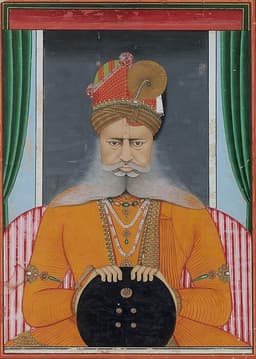
Dungar Singh of Bikaner
Emperor · Modern
48.6Total

Julius Caesar
General · Ancient
82.8Total
Basic Information
Born
1854
-100
Died
1887
-44
Era
Modern
Ancient
Nationality
India
Roman Republic
Occupation
Emperor
General
Civilization
Indian
Western
Score Comparison
Military (10%)
21.2
88.0
Political (20%)
68.0
78.0
Influence (20%)
50.2
85.0
Legacy (20%)
40.0
82.0
Leadership (15%)
68.0
80.0
Strategy (15%)
35.7
85.0
TOTAL
48.6
82.8
Dungar Singh of Bikaner — Complete Timeline
1880 AD
Construction of the Junagarh Fort additionsCultural◆ Major
Dungar Singh oversaw the construction of new additions to the Junagarh Fort in Bikaner, including the Anup Mahal and the Karan Mahal. These structures featured intricate mirror work, frescoes, and carved marble, enhancing the fort's architectural grandeur.
ArchitectureFortPatronage
Impact: regionalconstructive
1885 AD
Modernization of Bikaner's infrastructureReform◆ Major
Dungar Singh initiated modernization projects in Bikaner, including the construction of roads, a telegraph system, and a water supply network. These improvements connected Bikaner to broader colonial infrastructure and improved urban living conditions.
InfrastructureModernizationUrban Development
Impact: regionalconstructive
1887 AD
Establishment of the Bikaner State MuseumCultural
Dungar Singh founded the Bikaner State Museum within the Junagarh Fort, housing a collection of artifacts, manuscripts, and weapons. The museum preserved the cultural heritage of Bikaner and made it accessible to the public.
MuseumCultural PreservationEducation
Impact: regionalconstructive
Julius Caesar — Complete Timeline
58 BC
Gallic WarsWar◆ Major
Caesar, as proconsul of Gaul, launched a series of campaigns that conquered all of Gaul (modern France, Belgium, and parts of Switzerland). He fought numerous battles, including against the Helvetii, the Belgae, and the Gallic chieftain Vercingetorix. The wars brought immense wealth and a loyal army to Caesar.
Gallic WarsConquestRoman Expansion
Impact: regional
49 BC
Crossing the RubiconPolitical Action◆ Major
Caesar led Legio XIII across the Rubicon River into Italy, defying the Roman Senate's order to disband his army. This act triggered a civil war against Pompey and the Optimates, ultimately leading to Caesar's dictatorship and the end of the Roman Republic.
Roman Civil WarEnd of RepublicPower Struggle
Impact: global
48 BC
Battle of PharsalusWar◆ Major
Caesar's outnumbered army defeated the larger forces of Pompey the Great at Pharsalus in Greece. Caesar's tactical use of a reserve line to counter Pompey's cavalry charge proved decisive. Pompey fled to Egypt, where he was assassinated, leaving Caesar as the undisputed master of the Roman world.
Roman Civil WarBattleDecisive Victory
Impact: regional
44 BC
Appointment as Dictator for LifePolitical Action◆ Major
The Roman Senate appointed Caesar dictator perpetuo (dictator for life), granting him unprecedented personal power. This move concentrated military, legislative, and judicial authority in one person, effectively ending the Roman Republic's traditional system of checks and balances and alarming many senators.
DictatorshipEnd of RepublicPower Consolidation
Impact: regionaldestructive
Assassination on the Ides of MarchPolitical Action◆ Major
A group of Roman senators, led by Marcus Junius Brutus and Gaius Cassius Longinus, stabbed Caesar to death at a meeting of the Senate in the Theatre of Pompey. The assassination was intended to restore the Republic, but instead triggered another civil war that led to the rise of the Roman Empire.
AssassinationRoman PoliticsEnd of Republic
Impact: globaldestructive
Expert Analysis
dungar-singh-of-bikaner-vs-julius-caesar
The Crossroads of History: Caesar's Sword and Dungar Singh's Pen
On a March morning in 44 BCE, the Roman Senate erupted into chaos as sixty conspirators surrounded Gaius Julius Caesar, their daggers flashing in the morning light. Two thousand years later and half a world away, Maharaja Dungar Singh of Bikaner stood atop the ramparts of his newly expanded Junagarh Fort, watching the desert sun paint the sandstone in shades of amber and rose. One man was about to change the course of Western civilization through conquest and assassination; the other was quietly reshaping a princely state through bricks and reforms. What separates these two rulers is not merely time and geography, but the very nature of power itself—one wielded it as a sword, the other as a chisel.
Origins
Julius Caesar was born into the patrician Julian clan in 100 BCE, a time when the Roman Republic was already cracking under the weight of its own ambitions. His family claimed descent from the goddess Venus, but they were politically marginal, their fortunes diminished. Caesar grew up in the shadow of Rome’s civil wars, witnessing his uncle Marius’s brutal purges and Sulla’s proscriptions. This volatile world taught him that survival meant audacity—and that the old republican virtues were a mask for ruthless ambition.
Dungar Singh, born in 1854, entered a very different world. The Rathore dynasty of Bikaner had ruled the Thar Desert for centuries, but by the mid-19th century, they were vassals of the British Raj. Young Dungar Singh was educated in English and Persian, trained in both traditional Rajput warfare and Victorian administration. His inheritance was not a crumbling republic but a stable princely state, where the greatest threat was not civil war but stagnation. Where Caesar learned to seize power, Dungar Singh learned to preserve it.
Rise to Power
Caesar’s path was a masterclass in strategic patience. He climbed the Roman political ladder—quaestor, aedile, praetor, consul—each step financed by enormous debts and sealed by alliances with Rome’s most powerful men. His appointment as governor of Gaul in 58 BCE gave him the army he needed. For eight years, he conquered, slaughtered, and subdued the tribes of modern France and Belgium, amassing a fortune and a loyal legion that would eventually make him master of Rome.
Dungar Singh ascended the throne of Bikaner in 1872 at age eighteen, inheriting a state that was stable but backward. His rise was not a conquest but a coronation, sanctioned by British authorities who saw him as a reliable prince. The turning point came not on a battlefield but in a council chamber, where he decided that Bikaner’s future lay not in military expansion—impossible under British suzerainty—but in modernization. While Caesar crossed the Rubicon, Dungar Singh crossed into the 19th century.
Leadership & Governance
Caesar ruled through sheer force of personality and military genius. As dictator, he reformed the calendar, granted citizenship to provincials, initiated public works, and centralized power in his own hands. His military score of 88 reflects his tactical brilliance—the siege of Alesia, the lightning campaign at Pharsalus—but his political score of 78 reveals a man who understood power better than governance. He pardoned enemies and packed the Senate with his supporters, but he never built institutions that could survive his death. The Republic died with him.
Dungar Singh governed as a modernizer within constraints. His political score of 64 is modest, but it measures a different kind of leadership. He built roads that connected Bikaner to the telegraph network, introduced modern education, and founded the Bikaner State Museum in 1887—a cultural act that preserved Rajput heritage while embracing Victorian museum culture. The additions to Junagarh Fort, including the ornate Anup Mahal, were not defensive works but statements of cultural continuity. Where Caesar conquered Gaul, Dungar Singh constructed a telegraph system. Their methods could not be more different, but both understood that infrastructure is power.
Triumph & Tragedy
Caesar’s greatest triumph was the conquest of Gaul, which brought Rome its richest province and made him the most powerful man in the Mediterranean. His tragedy was his own success: the Ides of March assassination in 44 BCE, a death that proved the Republic could not contain his ambition. His last words, according to tradition, were “Et tu, Brute?”—a recognition that even his allies feared what he had become.
Dungar Singh’s triumph was subtler but real: by 1887, Bikaner was a model princely state, with modern infrastructure and a cultural revival that preserved Rajput identity under British rule. His tragedy was his early death at age 33, just as his reforms were gaining momentum. He left no heir, and the state passed to his brother Ganga Singh, who would become a legendary ruler in his own right. Dungar Singh’s story is one of promise cut short, not glory betrayed.
Character & Destiny
Caesar was driven by an insatiable need for glory. He wrote his own commentaries, controlled his own narrative, and gambled everything on his own genius. His personality—charismatic, ruthless, calculating—shaped every decision, from the crossing of the Rubicon to his refusal of a bodyguard. He believed he was destiny’s chosen instrument, and history proved him right, though not in the way he expected.
Dungar Singh was a pragmatist in a world of empires. He understood that the British were not going anywhere, so he worked within their system. His personality was shaped by the Victorian era’s faith in progress and the Rajput tradition of honor. He built not for personal glory but for his state’s survival. Where Caesar’s ambition led to assassination, Dungar Singh’s caution led to a quiet legacy.
Legacy
Caesar’s legacy is the Roman Empire itself. His name became a title—Kaiser, Tsar, Caesar—and his reforms laid the foundation for imperial rule that lasted five hundred years in the West and a thousand in the East. But his legacy is also a warning: the man who destroys a republic to save it leaves behind a void that tyrants fill.
Dungar Singh’s legacy is the Junagarh Fort additions and the Bikaner State Museum, monuments that still stand. His modernization projects made Bikaner a model for other princely states, and his brother Ganga Singh built on his foundation to make Bikaner one of the most progressive states in India. Dungar Singh’s influence score of 67.7 reflects a quiet but lasting impact—not the thunder of history, but the steady erosion of tradition by progress.
Conclusion
Standing in the Junagarh Fort today, visitors walk through halls that Dungar Singh built, past artifacts he collected, under arches he raised. Two thousand miles away, tourists in Rome throw coins into the Trevi Fountain, ignorant that the empire they celebrate was born in Caesar’s blood. Both men sought to shape their worlds, but they worked with different tools—one with a legion, the other with a blueprint. Caesar’s story is a warning about the dangers of unchecked ambition; Dungar Singh’s is a lesson in the art of the possible. In the end, both understood that power is not about the force you wield, but the change you leave behind.
Rankings
🥇
Julius CaesarLeader
Mil: 88.0Pol: 78.0Inf: 85.0
82.8
🥈
Dungar Singh of Bikaner
Mil: 21.2Pol: 68.0Inf: 50.2
48.6
+34.2 behind
How This Comparison Works
Algorithm
Each figure is scored on 6 dimensions (0—100 scale) based on structured historical data: Military (10%), Political (20%), Influence (20%), Legacy (20%), Leadership (15%), Strategy (15%). The weighted total produces the final ranking.
Data Sources
Scores are computed from structured sub-indicators in the database. Scale factors adjust for era (Ancient ×0.85, Modern ×1.0) and civilization size (Eastern ×1.05, Other ×0.80) to account for differences in population and military scale.
Maximum 3 Figures
Comparisons are limited to 2—3 figures to ensure readability and statistical meaningfulness.
Error Margins
±5 points per dimension — Sub-scores are derived from historical records with inherent uncertainty. Two figures within 5 points on a dimension should be considered roughly equivalent in that area.
Total Score Accuracy
±3 points overall — The weighted combination of 6 dimensions produces a total score with approximately ±3 points of uncertainty. Differences of less than 3 points are not statistically significant— the figures are effectively tied.
Known Limitations
- Historical records are incomplete and uneven across civilizations
- Figures from oral-tradition societies may be underrepresented
- Occupation labels can misclassify multi-role figures
- Scores measure capability and impact, not moral character
- Quantitative scoring is a comparison tool, not absolute truth
Capability Radar
Military (10%) — Battles & Warfare
Battles
10
95
Win Rate
10
92
Expansion
10
97
Political (20%) — Governance & Reform
Reform
60
90
Diplomacy
40
85
Economy
50
82
Influence (20%) — Cultural & Global Reach
Cultural
30
88
Global
10
94
Legacy (20%) — Historical Impact
Historical
30
95
Longevity
20
96
Leadership (15%) — Power & Stability
Tenure
50
75
Stability
55
60
Strategy (15%) — Tactics & Innovation
Strategy
15
94
Tactics
15
96
Reform
30
88
Similar Comparisons
Comments & Discussion
BattleAxeScholar6/17/2026
"Caesar vs Dungar Singh? Let’s not pretend they’re in the same league. Caesar crossed the Rubicon with a legion, rewriting the entire Mediterranean’s political map. Dungar Singh built a few sandstone walls and a library. One’s a thunderbolt of history; the other’s a footnote in regional reform. Even the assassination alone—sixty senators, twenty-three dagger wounds—eclipses anything from Bikaner. Don't romanticize the desert prince. Stick to the scale that actually shook civilizations."
数据铁锤6/17/2026
"拿凯撒和杜恩加·辛格比,数据上就崩了。凯撒的高卢战争让罗马控制了八十万平方英里新领土,军费全自筹;而杜恩加·辛格的改革预算连凯撒一次远征的零头都不到。一个是欧洲级变量,一个是区域级改良。史评要讲证据,不是诗歌。历史贡献看权重,不是情怀。"
LatinSkeptic6/17/2026
"Nice try, but Caesar’s ‘assassination’ was not the end—it was the catalyst for the Roman Empire, a transformation that still echoes in law and governance today. Dungar Singh? He modernized a desert state under British suzerainty—commendable, but irrelevant to the arc of Western power structures. Comparing their ‘crossroads’ is like comparing a supernova to a candle. Caesar’s death changed the world forever; Singh’s reign changed a province for half a century."
帝国遗墨6/17/2026
"你们忘了最重要的一点:杜恩加·辛格是在英国殖民框架下改革,他修铁路、建学校,都是在‘被允许’的范围内。凯撒则是主动打破旧秩序,从元老院手里夺取权力。一个是顺流而行的修复者,一个是逆天改命的缔造者。不是说后者更‘道德’,而是历史转折的力度完全不同。拿沙漠里的一粒沙比罗马城的血,过分了。"
RevisionistDagger6/17/2026
"Everyone here is falling for the Roman hype. Caesar was a brilliant but brutal warlord who destroyed the Republic to feed his ego—and got stabbed for it. Dungar Singh chose a different path: strategic patience under the Raj, preserving Bikaner’s culture while modernizing infrastructure. Which legacy is less bloody and more sustainable? Singh’s. History doesn't only celebrate conquerors. Sometimes the chisel outlasts the sword, especially when the sword ends in assassination and civil war."