Loading...
Dungar Singh of Bikaner vs Manuel II of Portugal
Dungar Singh of Bikaner leads by 11.2 pts · 2 figures compared
…
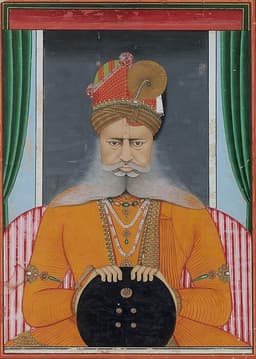
Dungar Singh of Bikaner
Emperor · Modern
48.6Total

Manuel II of Portugal
Emperor · Modern
37.4Total
Basic Information
Born
1854
1889
Died
1887
1932
Era
Modern
Modern
Nationality
India
Portugal
Occupation
Emperor
Emperor
Civilization
Indian
Western
Score Comparison
Military (10%)
21.2
22.3
Political (20%)
68.0
26.4
Influence (20%)
50.2
45.5
Legacy (20%)
40.0
33.3
Leadership (15%)
68.0
36.9
Strategy (15%)
35.7
60.0
TOTAL
48.6
37.4
Dungar Singh of Bikaner — Complete Timeline
1880 AD
Construction of the Junagarh Fort additionsCultural◆ Major
Dungar Singh oversaw the construction of new additions to the Junagarh Fort in Bikaner, including the Anup Mahal and the Karan Mahal. These structures featured intricate mirror work, frescoes, and carved marble, enhancing the fort's architectural grandeur.
ArchitectureFortPatronage
Impact: regionalconstructive
1885 AD
Modernization of Bikaner's infrastructureReform◆ Major
Dungar Singh initiated modernization projects in Bikaner, including the construction of roads, a telegraph system, and a water supply network. These improvements connected Bikaner to broader colonial infrastructure and improved urban living conditions.
InfrastructureModernizationUrban Development
Impact: regionalconstructive
1887 AD
Establishment of the Bikaner State MuseumCultural
Dungar Singh founded the Bikaner State Museum within the Junagarh Fort, housing a collection of artifacts, manuscripts, and weapons. The museum preserved the cultural heritage of Bikaner and made it accessible to the public.
MuseumCultural PreservationEducation
Impact: regionalconstructive
Manuel II of Portugal — Complete Timeline
1908 AD
Accession after the Lisbon RegicidePolitical Action◆ Major
Manuel II became king at age 18 after the assassination of his father, Carlos I, and his elder brother. He inherited a deeply unstable political situation with a powerful republican movement and a monarchy in crisis, lacking experience and support.
SuccessionMonarchy CrisisRegicide Aftermath
Impact: nationaltragic
1910 AD
5 October 1910 RevolutionPolitical Action
A republican revolution erupted in Lisbon, leading to the overthrow of the Portuguese monarchy. Manuel II, after a brief resistance at the Royal Palace, fled to exile in England. The revolution established the First Portuguese Republic, ending 770 years of monarchy.
RevolutionEnd of MonarchyRepublic
Impact: national
Exile in EnglandOther
After the revolution, Manuel II went into exile in Twickenham, England. He lived there for the rest of his life, writing historical works and maintaining contacts with monarchist circles, but never mounting a serious attempt to regain the throne.
ExileMonarchismHistorical Writing
Impact: national
Expert Analysis
Origins
Dungar Singh of Bikaner was born in 1854 into the Rathore dynasty, which ruled the princely state of Bikaner in Rajasthan, India. He was the second son of Maharaja Sardar Singh and received a traditional education in statecraft, horse riding, and weaponry. His early exposure to administrative affairs came during his father's reign. Manuel II of Portugal was born on November 15, 1889, in Lisbon, the second son of King Carlos I and Queen Amélie of Orléans. He was educated by tutors and attended the Naval School, but his upbringing was sheltered from the political turmoil that plagued Portugal. Manuel became heir after his older brother's death in 1907 and ascended the throne abruptly at age 18 following the assassination of his father and brother in 1908.
Rise to Power
Dungar Singh became Maharaja of Bikaner in 1887 after the death of his older brother, Maharaja Lall Singh. His accession was peaceful, and he inherited a state that was relatively stable but technologically backward. He quickly began modernization initiatives, leveraging British colonial support to introduce telegraphs, roads, and water systems. Manuel II's rise was traumatic: On February 1, 1908, his father and brother were shot dead by republican assassins in Lisbon. Manuel was crowned king but inherited a deeply divided political landscape, with republicans and monarchists clashing. He attempted to stabilize the government by appointing moderate leaders, but his lack of experience and the monarchy's declining popularity undermined his efforts. The crucial turning point was the 5 October 1910 Revolution, which forced him to flee to Gibraltar and later to England, ending the Portuguese monarchy.
Leadership & Governance
Dungar Singh governed as an absolute but progressive ruler. He focused on infrastructure: building roads (over 200 miles), a telegraph system connecting Bikaner to British India, and a piped water supply for the city. He also constructed the Anup Mahal and Karan Mahal within Junagarh Fort, blending Rajput and European architectural styles. His cultural contributions included founding the Bikaner State Museum in 1890, which preserved local artifacts and manuscripts. His leadership score of 68.0 reflects his effective administration within the constraints of princely rule. In contrast, Manuel II's governance was weak and reactive. He tried to reconcile republicans and monarchists but failed to enact meaningful reforms. His political score of 26.4 indicates his inability to navigate the crisis. He relied on rotating prime ministers, but the government remained paralyzed. His leadership was not autocratic like Dungar Singh's, but rather constrained by a constitutional framework he could not control.
Triumph & Tragedy
Dungar Singh's greatest success was the modernization of Bikaner's infrastructure, which improved trade, communication, and public health. The Junagarh Fort additions remain architectural landmarks. His establishment of the museum preserved historical treasures. However, his reign saw limited economic development beyond infrastructure; the state remained agrarian and dependent on the British. His military score of 21.2 reflects his lack of martial ambition, as he avoided conflicts. Manuel II's triumph was his dignified response to exile: he wrote historical works, including a study of Portuguese literature, and maintained the royal legacy. His tragedy was the loss of the throne and the dissolution of the monarchy after 770 years. He could not prevent the revolution, despite his attempts at moderation. His influence score of 45.5 is higher than his political score, suggesting his symbolic role as a tragic figure resonated more than his governance.
Character & Destiny
Dungar Singh was pragmatic and forward-looking, willing to adopt Western technology while preserving Rajput traditions. He was cautious but determined, focusing on gradual modernization. His strategy score of 35.7 suggests he was not a grand strategist but a competent administrator. His destiny was to be a transitional figure between medieval Rajput rule and modern statehood. Manuel II was scholarly and sensitive, ill-suited for the brutal politics of early 20th-century Portugal. He was described as intelligent but shy and indecisive. His character—idealistic but passive—shaped his fate: he could not rally support or use force to suppress republicans. His legacy score of 33.3 reflects how his brief reign is overshadowed by the revolution.
Legacy
Dungar Singh's legacy is tangible: the infrastructure he built served Bikaner for decades, and the museum remains a key cultural institution. He is remembered as a modernizer who brought Bikaner into the 20th century. His total score of 48.6 places him as a moderately successful ruler within the princely system. Manuel II's legacy is more symbolic: he is the last king of Portugal, a figure of the end of an era. His writings and exile life have been studied by historians, but his direct impact on Portugal is minimal. The republic that replaced his monarchy lasted until 1926, when a military coup established the Estado Novo. His total score of 37.4 reflects his limited agency in a turbulent period.
Conclusion
Dungar Singh had a greater impact than Manuel II, as evidenced by his higher total score (48.6 vs 37.4). While Manuel II was a victim of historical forces, Dungar Singh actively shaped his state's development. Dungar Singh's leadership score (68.0) dwarfs Manuel's (36.9), and his political acumen (68.0) contrasts with Manuel's failure (26.4). Dungar Singh's concrete achievements—roads, telegraph, water supply, museum—endured, while Manuel II's reign ended in exile with no lasting reforms. The score gap of 11.2 points reflects this difference in agency and tangible outcomes. Therefore, Dungar Singh of Bikaner is the more consequential historical figure.
Rankings
🥇
Dungar Singh of BikanerLeader
Mil: 21.2Pol: 68.0Inf: 50.2
48.6
🥈
Manuel II of Portugal
Mil: 22.3Pol: 26.4Inf: 45.5
37.4
+11.2 behind
How This Comparison Works
Algorithm
Each figure is scored on 6 dimensions (0—100 scale) based on structured historical data: Military (10%), Political (20%), Influence (20%), Legacy (20%), Leadership (15%), Strategy (15%). The weighted total produces the final ranking.
Data Sources
Scores are computed from structured sub-indicators in the database. Scale factors adjust for era (Ancient ×0.85, Modern ×1.0) and civilization size (Eastern ×1.05, Other ×0.80) to account for differences in population and military scale.
Maximum 3 Figures
Comparisons are limited to 2—3 figures to ensure readability and statistical meaningfulness.
Error Margins
±5 points per dimension — Sub-scores are derived from historical records with inherent uncertainty. Two figures within 5 points on a dimension should be considered roughly equivalent in that area.
Total Score Accuracy
±3 points overall — The weighted combination of 6 dimensions produces a total score with approximately ±3 points of uncertainty. Differences of less than 3 points are not statistically significant— the figures are effectively tied.
Known Limitations
- Historical records are incomplete and uneven across civilizations
- Figures from oral-tradition societies may be underrepresented
- Occupation labels can misclassify multi-role figures
- Scores measure capability and impact, not moral character
- Quantitative scoring is a comparison tool, not absolute truth
Capability Radar
Military (10%) — Battles & Warfare
Battles
10
38
Win Rate
10
38
Expansion
10
40
Political (20%) — Governance & Reform
Reform
60
5
Diplomacy
40
10
Economy
50
5
Influence (20%) — Cultural & Global Reach
Cultural
30
5
Global
10
5
Legacy (20%) — Historical Impact
Historical
30
5
Longevity
20
5
Leadership (15%) — Power & Stability
Tenure
50
2
Stability
55
5
Strategy (15%) — Tactics & Innovation
Strategy
15
46
Tactics
15
46
Reform
30
53
Similar Comparisons
Comments & Discussion
No comments yet. Be the first to share your thoughts!