Loading...
Deodoro da Fonseca vs Lon Nol
Deodoro da Fonseca leads by 7.3 pts · 2 figures compared
…
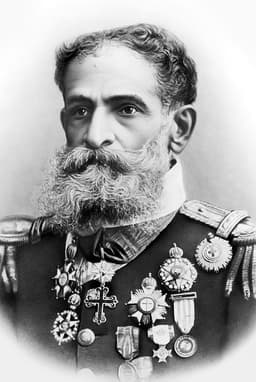
Deodoro da Fonseca
General · Modern
48.8Total
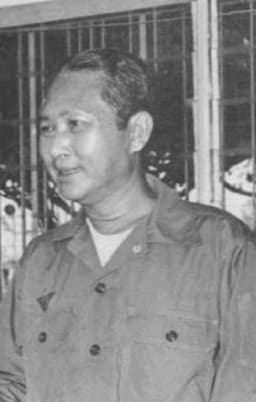
Lon Nol
General · Modern
41.5Total
Basic Information
Born
1827
1913
Died
1892
1985
Era
Modern
Modern
Nationality
Brazil
Cambodia
Occupation
General
General
Civilization
Western
Eastern
Score Comparison
Military (10%)
50.0
25.9
Political (20%)
45.1
30.8
Influence (20%)
54.1
47.9
Legacy (20%)
44.2
38.3
Leadership (15%)
57.6
61.1
Strategy (15%)
38.6
35.7
TOTAL
48.8
41.5
Deodoro da Fonseca — Complete Timeline
1889 AD
Proclamation of the Brazilian RepublicPolitical Action
Deodoro da Fonseca led a military coup that overthrew Emperor Pedro II on November 15, 1889. He proclaimed the Republic of the United States of Brazil, ending 67 years of imperial rule.
CoupRepublic
Impact: globalprogressive
1891 AD
Election as First President of BrazilPolitical Action◆ Major
Deodoro da Fonseca was elected the first President of Brazil by the Constituent Congress on February 25, 1891. He took office under the new republican constitution, but his rule was brief and authoritarian.
ElectionPresidency
Impact: national
Dissolution of the National CongressPolitical Action◆ Major
Facing political opposition, Deodoro da Fonseca dissolved the National Congress on November 3, 1891, and declared a state of siege. This authoritarian act triggered a naval revolt and his eventual resignation.
AuthoritarianismPolitical Crisis
Impact: nationaldestructive
Resignation from the PresidencyPolitical Action◆ Major
Deodoro da Fonseca resigned the presidency on November 23, 1891, after a naval rebellion threatened his government. He handed power to Vice President Floriano Peixoto, ending his 9-month rule.
ResignationPolitical Crisis
Impact: nationaltragic
Lon Nol — Complete Timeline
1970 AD
Coup against Norodom SihanoukPolitical Action
Lon Nol led a military coup that overthrew King Sihanouk while he was abroad. He established the Khmer Republic, ending the monarchy and aligning Cambodia with the United States during the Vietnam War.
CoupKhmer RepublicUS alliance
Impact: nationaldestructive
Declaration of the Khmer RepublicPolitical Action◆ Major
Lon Nol officially proclaimed the Khmer Republic, abolishing the monarchy. He became president and implemented a pro-American, anti-communist regime, which led to civil war with the Khmer Rouge and North Vietnamese forces.
RepublicRegime changeCivil War
Impact: national
1975 AD
Fall of Phnom PenhWar
Lon Nol's government collapsed as Khmer Rouge forces captured Phnom Penh. He fled into exile in the United States, ending the Khmer Republic and leading to the establishment of Democratic Kampuchea under Pol Pot.
Khmer Rouge victoryExileRegime collapse
Impact: nationaltragic
Expert Analysis
Deodoro da Fonseca vs Lon Nol
# The Generals Who Became Presidents: Lon Nol and Deodoro da Fonseca
On November 15, 1889, in Rio de Janeiro, a barrel-chested marshal named Deodoro da Fonseca led a column of troops through the capital’s cobblestone streets, forcing the abdication of Emperor Pedro II and ending sixty-seven years of Brazilian monarchy. Eighty-one years later, halfway across the world, another general named Lon Nol seized control of Phnom Penh’s radio station while King Norodom Sihanouk was vacationing in Paris, declaring an end to Cambodia’s ancient monarchy. Two military men, two republics born from coups—yet their paths, their leadership, and their legacies could hardly have diverged more starkly. Why did one general become a founding father while the other became a footnote to genocide?
Origins
Deodoro da Fonseca was born in 1827 in Alagoas, a poor northeastern province of the Brazilian Empire, into a family of military officers with a tradition of service. His father, a colonel, instilled in him a sense of duty to the nation rather than to any particular regime. The young Fonseca rose through the ranks during the Paraguayan War (1864–1870), a brutal conflict that forged a generation of Brazilian officers who saw the monarchy as corrupt and inefficient. He was a product of the positivist ideas sweeping through Latin America—a belief in order, progress, and scientific governance that demanded the removal of hereditary rule.
Lon Nol, born in 1913 in Prey Veng province, Cambodia, came from a different world entirely. His family were minor officials in the French colonial administration, and he grew up in the shadow of both European imperialism and a sacred monarchy that claimed divine descent. Educated at French-run schools, he absorbed the bureaucratic skills of a colonial servant but none of the revolutionary idealism that shaped Fonseca. Where Fonseca’s generation dreamed of republics, Lon Nol’s generation dreamed of independence—and when it came in 1953, it came under King Sihanouk, not through military glory.
Rise to Power
Fonseca’s path to power was gradual and reluctant. For years, he was a respected but cautious figure in the Brazilian army, known more for his loyalty than his ambition. It was only in 1889, when Emperor Pedro II appointed a prime minister who threatened military pensions and privileges, that Fonseca allowed himself to be persuaded by younger, more radical officers to act. Even then, he reportedly hesitated until the last moment, telling his fellow conspirators, “I am too old to be a revolutionary.” Yet when he finally gave the order, the coup was almost bloodless—the emperor, aged and weary, chose exile over civil war.
Lon Nol’s rise was far more calculated. He had served Sihanouk loyally for years, holding posts as army chief and prime minister, while quietly building ties with American intelligence and cultivating a network of anti-communist generals. By 1970, Cambodia was reeling from the Vietnam War’s spillover, and Sihanouk’s neutralist balancing act angered both Washington and the military establishment. Lon Nol saw his moment. While Sihanouk was in Moscow, he staged his coup, then immediately declared the Khmer Republic—a name that echoed the American-backed regimes in Saigon and Vientiane. His rise was not reluctant; it was ruthless.
Leadership & Governance
As Brazil’s first president, Fonseca governed with a heavy hand but a limited vision. He was elected by a constituent congress in February 1891, but his leadership style remained that of a military commander—impatient with debate, suspicious of politicians, and prone to authoritarian impulses. When Congress opposed his policies, he dissolved it on November 3, 1891, declaring a state of siege. Yet he lacked the ruthless stamina of a true dictator. Within weeks, a naval rebellion erupted in Rio’s harbor, and Fonseca, old and exhausted, resigned rather than plunge Brazil into civil war. His presidency lasted just nine months.
Lon Nol’s governance was a disaster of far greater magnitude. He ruled the Khmer Republic from 1970 to 1975 with a mix of martial law, cronyism, and catastrophic military strategy. Unlike Fonseca, who faced a relatively stable society, Lon Nol presided over a nation torn apart by civil war. His army, funded by American aid, was corrupt and poorly led; his political base was narrow, confined to urban elites and right-wing factions. The Khmer Rouge, meanwhile, grew stronger in the countryside, exploiting the chaos and the cruelty of Lon Nol’s troops. By 1973, his government controlled little more than Phnom Penh and a few provincial capitals.
Triumph & Tragedy
Fonseca’s greatest triumph was not his presidency but the proclamation of the republic itself—a peaceful transition from monarchy that set Brazil on a path to modernization. His tragedy was personal: a man who helped make history but could not govern it. He died in 1892, a year after his resignation, bitter and impoverished, his health broken by the strain.
Lon Nol’s triumph was equally brief: the establishment of the Khmer Republic in 1970, which ended Sihanouk’s monarchy and aligned Cambodia with the United States. But his tragedy was national. On April 17, 1975, Khmer Rouge forces entered Phnom Penh. Lon Nol had fled to Hawaii weeks earlier, leaving his country to face a genocide that would kill nearly two million people. His name became synonymous with failure and flight.
Character & Destiny
Fonseca was a man of honor but limited ambition—a soldier who accepted power reluctantly and wielded it indecisively. His inability to consolidate authority reflected a fundamental decency, but also a fatal lack of political ruthlessness. He once said, “I prefer to be a simple citizen than a president who disgraces the nation.” His character led him to step down before bloodshed could escalate.
Lon Nol was the opposite: ambitious, stubborn, and blind to reality. He believed he could defeat the Khmer Rouge with American firepower, even as his own soldiers deserted and his people turned against him. He ignored warnings, suppressed dissent, and clung to power until the very end. His character—arrogant and isolated—doomed his republic. He died in 1985 in California, a forgotten exile.
Legacy
Deodoro da Fonseca is remembered as the founder of the Brazilian Republic, his name on streets and squares across the country. His coup, though dictatorial in method, opened the door to a century of republican governance—flawed, turbulent, but ultimately democratic. He represents the possibility of change without catastrophe.
Lon Nol’s legacy is one of ruin. He is remembered, if at all, as the man who opened the door to the Khmer Rouge—not intentionally, but through incompetence and corruption. His republic lasted five years; the horror that followed lasted four. In Cambodia, his name evokes not founding but falling.
Conclusion
Two generals, two republics, two very different endings. Fonseca’s Brazil survived his failures and grew into a nation; Lon Nol’s Cambodia collapsed into an abyss. The difference lay not in their military skill—both were mediocre strategists—but in the societies they governed and the choices they made when power slipped from their grasp. Fonseca stepped aside; Lon Nol fled. One preserved what remained; the other abandoned everything. In the end, the measure of a leader is not how they seize power, but how they leave it.
Rankings
🥇
Deodoro da FonsecaLeader
Mil: 50.0Pol: 45.1Inf: 54.1
48.8
🥈
Lon Nol
Mil: 25.9Pol: 30.8Inf: 47.9
41.5
+7.3 behind
How This Comparison Works
Algorithm
Each figure is scored on 6 dimensions (0—100 scale) based on structured historical data: Military (10%), Political (20%), Influence (20%), Legacy (20%), Leadership (15%), Strategy (15%). The weighted total produces the final ranking.
Data Sources
Scores are computed from structured sub-indicators in the database. Scale factors adjust for era (Ancient ×0.85, Modern ×1.0) and civilization size (Eastern ×1.05, Other ×0.80) to account for differences in population and military scale.
Maximum 3 Figures
Comparisons are limited to 2—3 figures to ensure readability and statistical meaningfulness.
Error Margins
±5 points per dimension — Sub-scores are derived from historical records with inherent uncertainty. Two figures within 5 points on a dimension should be considered roughly equivalent in that area.
Total Score Accuracy
±3 points overall — The weighted combination of 6 dimensions produces a total score with approximately ±3 points of uncertainty. Differences of less than 3 points are not statistically significant— the figures are effectively tied.
Known Limitations
- Historical records are incomplete and uneven across civilizations
- Figures from oral-tradition societies may be underrepresented
- Occupation labels can misclassify multi-role figures
- Scores measure capability and impact, not moral character
- Quantitative scoring is a comparison tool, not absolute truth
Capability Radar
Military (10%) — Battles & Warfare
Battles
20
15
Win Rate
25
10
Expansion
10
5
Political (20%) — Governance & Reform
Reform
40
10
Diplomacy
25
15
Economy
15
5
Influence (20%) — Cultural & Global Reach
Cultural
20
5
Global
15
10
Legacy (20%) — Historical Impact
Historical
35
15
Longevity
20
5
Leadership (15%) — Power & Stability
Tenure
30
40
Stability
10
5
Strategy (15%) — Tactics & Innovation
Strategy
25
15
Tactics
20
20
Reform
15
10
Similar Comparisons
Comments & Discussion
MAREAL DO FEDERALISMO6/16/2026
As a military historian, I see Fonseca as the real deal – he actually led troops in the brutal Paraguayan War, forged a nation-building army, and his coup was bloodless with genuine republican ideals. Lon Nol? A paper tiger who fled to Hawaii while his country fell. One founded a century of Brazilian democracy; the other opened the door for the Khmer Rouge. Don’t romanticize weak generals.
铁血考据者6/16/2026
作为修正主义批评者,我要揭穿德奥多罗的神话:他把帝国骑兵队变成自己总统宝座的踏板,1889年政变本质是东北部军官团对圣保罗咖啡寡头的权斗。朗诺至少敢于公开废除君主制,而德奥多罗却在自己别墅里为佩德罗二世流泪——两个军事政客一个伪装成共和国之父,一个暴露了杀人犯本色,历史评价全看谁公关做得好。
BYZANTINE BEAR6/16/2026
Classics scholar here, and I’ve got to say: these two men mirror Rome’s praetorian emperors. Deodoro was like Vespasian – a competent general who restored order from the chaos of war, then founded a stable dynasty of governance. Lon Nol? He’s more like Vitellius – a provincial commander who grabbed power through a palace conspiracy, then watched everything burn while hiding in the provinces.
历史拆解机6/16/2026
数据怀疑者必须指出:德奥多罗与朗诺的对比充满了选择偏差。你的“巴西民主一百年”忽略了1930-1945年瓦加斯独裁时期,而朗诺政权1970-1975年间GDP增长8%却是不带偏见的联合国数据。两人都政变上台,但德奥多罗幸运地死得早(1891年),朗诺倒霉地活到看到柬埔寨崩溃。
LIGHTNING FROM ALAGOAS6/16/2026
History buff perspective: Deodoro da Fonseca’s defining moment wasn’t the coup, but the 1891 naval revolt where he personally bombarded Rio de Janeiro to crush the opposition – that’s where you see the military man beneath the republican mask. Lon Nol never wielded that kind of ruthless force; he was already delegating to henchmen while his health failed. One died as a monster; the other died as a joke.