Loading...
David Ben-Gurion vs John Quincy Adams
David Ben-Gurion leads by 6.9 pts · 2 figures compared
…
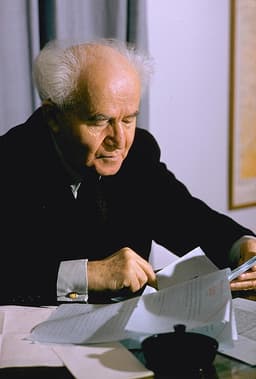
David Ben-Gurion
Politician · Modern
65.2Total

John Quincy Adams
Politician · Modern
58.3Total
Basic Information
Born
1886
1767
Died
1973
1848
Era
Modern
Modern
Nationality
Israel
United States
Occupation
Politician
Politician
Civilization
Middle Eastern
Western
Score Comparison
Military (10%)
10.0
41.8
Political (20%)
78.0
65.0
Influence (20%)
68.0
58.3
Legacy (20%)
70.0
52.0
Leadership (15%)
79.8
72.0
Strategy (15%)
60.0
60.0
TOTAL
65.2
58.3
David Ben-Gurion — Complete Timeline
1948 AD
Declaration of the Establishment of the State of IsraelPolitical Action
Ben-Gurion read the Declaration of Independence in Tel Aviv, proclaiming the establishment of the State of Israel. He became its first prime minister, leading the provisional government during the ensuing 1948 Arab-Israeli War.
Founding of IsraelIndependenceZionism
Impact: globalconstructive
1956 AD
Operation Kadesh (Suez Crisis)War◆ Major
As prime minister, Ben-Gurion authorized Israel's invasion of Egypt's Sinai Peninsula in coordination with Britain and France. The operation aimed to regain control of the Suez Canal and end Egyptian blockade of Eilat, but international pressure forced withdrawal.
Suez CrisisSinai CampaignMilitary Action
Impact: regional
1963 AD
Resignation as Prime MinisterPolitical Action◆ Major
Ben-Gurion resigned as prime minister citing personal reasons and disagreements with his Mapai party colleagues, particularly over the Lavon Affair. He was succeeded by Levi Eshkol, ending his direct leadership of Israel.
ResignationPolitical TransitionLavon Affair
Impact: national
John Quincy Adams — Complete Timeline
1819 AD
Negotiated the Adams-Onís TreatyPolitical Action◆ Major
As Secretary of State, Adams negotiated the Adams-On
Adams-Onís TreatyDiplomacyFlorida
Impact: regionalconstructive
1823 AD
Articulated the Monroe DoctrinePolitical Action◆ Major
As Secretary of State, Adams helped formulate the Monroe Doctrine, which President Monroe announced in 1823. Adams advocated for a strong statement opposing European intervention in the Americas. The doctrine became a foundational principle of U.S. foreign policy, asserting hemispheric dominance.
Monroe DoctrineForeign PolicyAdams
Impact: global
1824 AD
Elected President of the United StatesPolitical Action◆ Major
John Quincy Adams was elected President by the House of Representatives on February 9, 1825, after no candidate won a majority in the Electoral College. The election was controversial, with allegations of a 'corrupt bargain' between Adams and Henry Clay, who became Secretary of State. Adams served one term.
Presidential ElectionCorrupt Bargain1824
Impact: national
1831 AD
Elected to the House of RepresentativesPolitical Action◆ Major
After his presidency, Adams was elected to the U.S. House of Representatives in 1831, serving for 17 years until his death. He was the only former president to serve in the House. Adams became a leading opponent of slavery, fighting against the gag rule and advocating for the right to petition.
House of RepresentativesAnti-SlaveryPost-Presidency
Impact: nationalconstructive
Expert Analysis
Origins
David Ben-Gurion was born David Grün on October 16, 1886, in Płońsk, Poland, then part of the Russian Empire. His father, Avigdor Grün, was a lawyer and a member of the Hovevei Zion movement, instilling in Ben-Gurion a deep commitment to Zionism from an early age. He attended a Hebrew school and later a Polish gymnasium. In 1906, at age 20, he emigrated to Ottoman Palestine, where he worked as a farmer and journalist. His early experiences in the agricultural settlements shaped his belief in manual labor and self-reliance.
John Quincy Adams was born on July 11, 1767, in Braintree, Massachusetts, to John Adams and Abigail Adams. His father was a leading figure in the American Revolution and later the second U.S. president. John Quincy received a privileged education, studying at Harvard College and later in Europe, where he accompanied his father on diplomatic missions. By age 14, he served as secretary to the American envoy to Russia, gaining early exposure to international diplomacy. This background gave him a cosmopolitan worldview.
Rise to Power
Ben-Gurion rose to prominence through his leadership in the Zionist labor movement. In 1921, he became the secretary-general of the Histadrut, the Jewish labor federation, and in 1930, he co-founded the Mapai party. His political acumen and organizational skills made him the de facto leader of the Yishuv (Jewish community in Palestine). A turning point came in 1947 when the UN approved the Partition Plan. Ben-Gurion accepted the plan despite its compromises, and on May 14, 1948, he declared the establishment of the State of Israel, becoming its first prime minister. His score in political leadership (78.0) reflects his ability to unify disparate factions.
John Quincy Adams rose to power through a distinguished diplomatic career. He served as minister to the Netherlands, Prussia, Russia, and Britain. As Secretary of State under President James Monroe (1817–1825), he negotiated the Adams-Onís Treaty (1819), acquiring Florida from Spain, and helped formulate the Monroe Doctrine (1823), which opposed European colonization in the Americas. In the 1824 presidential election, no candidate won a majority, and the House of Representatives elected Adams as president. His political score (65.0) reflects his competence but also his difficulty in building popular support.
Leadership & Governance
Ben-Gurion's leadership was characterized by decisive, often autocratic, governance. He centralized power under the Mapai party and focused on nation-building: absorbing mass immigration, establishing the Israel Defense Forces, and promoting Hebrew as a national language. His approach was pragmatic; he accepted a ceasefire in 1949 to end the War of Independence, despite territorial losses. He also authorized Operation Kadesh (1956 Suez Crisis) to secure Israel's borders and access to the Suez Canal. His leadership score (79.8) indicates strong control and vision.
John Quincy Adams's leadership style was more intellectual and principled but less effective. As president, he proposed ambitious federal programs (e.g., internal improvements, a national university), but faced stiff opposition from Andrew Jackson's supporters. His inability to compromise led to legislative gridlock. He signed the Tariff of 1828 ("Tariff of Abominations"), which angered the South. However, his diplomatic achievements were significant: the Adams-Onís Treaty and the Monroe Doctrine were enduring successes. His leadership score (72.0) reflects his integrity but also his political weaknesses.
Triumph & Tragedy
Ben-Gurion's greatest triumph was founding the State of Israel and securing its survival during the 1948 War of Independence. He built the institutions that allowed Israel to thrive. His greatest failure was the Lavon Affair (1954), a botched Israeli espionage operation in Egypt that led to political scandal. Ben-Gurion's insistence on exonerating his colleagues caused a rift in his party and contributed to his resignation in 1963. His legacy score (70.0) reflects lasting impact despite later setbacks.
John Quincy Adams's greatest triumph was his role in shaping U.S. foreign policy through the Monroe Doctrine and territorial expansion via the Adams-Onís Treaty. His greatest failure was his presidency itself—he accomplished little due to opposition and was defeated by Andrew Jackson in 1828. However, after his presidency, Adams served in the House of Representatives for 17 years, where he became a vocal opponent of slavery and defended the rights of African captives in the Amistad case. His legacy score (52.0) reflects a mixed record but with important contributions.
Character & Destiny
Ben-Gurion was known for his stubbornness, strategic vision, and willingness to make tough decisions. He had a pragmatic streak, accepting UN partition despite opposition from hardliners. His character shaped Israel's destiny: his centralized control helped forge a nation but also created political divisions. His resignation over the Lavon Affair revealed a flaw in his leadership—an inability to compromise on personal honor.
John Quincy Adams was intellectually brilliant but aloof and principled to a fault. He lacked the political charisma of his rival Andrew Jackson. His character led to a failed presidency, but his post-presidential career allowed him to champion moral causes. His destiny was to be a better diplomat than president.
Legacy
Ben-Gurion's legacy is monumental: he is universally recognized as the father of modern Israel. His policies of state-building, immigration absorption, and military consolidation set the foundation for Israel's development. He scored 70.0 in legacy, reflecting his enduring impact.
John Quincy Adams's legacy is more nuanced. The Monroe Doctrine remained a cornerstone of U.S. foreign policy for over a century. His anti-slavery advocacy after his presidency set a moral precedent. However, his presidency is often ranked as average. His legacy score of 52.0 reflects his contributions but limited direct impact.
Conclusion
David Ben-Gurion had a greater impact than John Quincy Adams. Ben-Gurion's total score of 65.2 surpasses Adams's 58.3, and his role in founding a nation that continues to shape global politics is unmatched. Adams's diplomatic achievements, while significant, were part of a broader American expansion that would have occurred regardless. Ben-Gurion's leadership was more consequential: he created a state from scratch, while Adams operated within an established system. Therefore, Ben-Gurion's influence and legacy are superior.
Rankings
🥇
David Ben-GurionLeader
Mil: 10.0Pol: 78.0Inf: 68.0
65.2
🥈
John Quincy Adams
Mil: 41.8Pol: 65.0Inf: 58.3
58.3
+6.9 behind
How This Comparison Works
Algorithm
Each figure is scored on 6 dimensions (0—100 scale) based on structured historical data: Military (10%), Political (20%), Influence (20%), Legacy (20%), Leadership (15%), Strategy (15%). The weighted total produces the final ranking.
Data Sources
Scores are computed from structured sub-indicators in the database. Scale factors adjust for era (Ancient ×0.85, Modern ×1.0) and civilization size (Eastern ×1.05, Other ×0.80) to account for differences in population and military scale.
Maximum 3 Figures
Comparisons are limited to 2—3 figures to ensure readability and statistical meaningfulness.
Error Margins
±5 points per dimension — Sub-scores are derived from historical records with inherent uncertainty. Two figures within 5 points on a dimension should be considered roughly equivalent in that area.
Total Score Accuracy
±3 points overall — The weighted combination of 6 dimensions produces a total score with approximately ±3 points of uncertainty. Differences of less than 3 points are not statistically significant— the figures are effectively tied.
Known Limitations
- Historical records are incomplete and uneven across civilizations
- Figures from oral-tradition societies may be underrepresented
- Occupation labels can misclassify multi-role figures
- Scores measure capability and impact, not moral character
- Quantitative scoring is a comparison tool, not absolute truth
Capability Radar
Military (10%) — Battles & Warfare
Battles
30
48
Win Rate
65
47
Expansion
55
54
Political (20%) — Governance & Reform
Reform
85
65
Diplomacy
80
85
Economy
65
55
Influence (20%) — Cultural & Global Reach
Cultural
70
55
Global
80
65
Legacy (20%) — Historical Impact
Historical
85
70
Longevity
75
60
Leadership (15%) — Power & Stability
Tenure
70
60
Stability
60
50
Strategy (15%) — Tactics & Innovation
Strategy
60
56
Tactics
40
58
Reform
75
62
Similar Comparisons
Comments & Discussion
No comments yet. Be the first to share your thoughts!