Loading...
David Ben-Gurion vs Julius Caesar
Julius Caesar leads by 17.6 pts · 2 figures compared
…
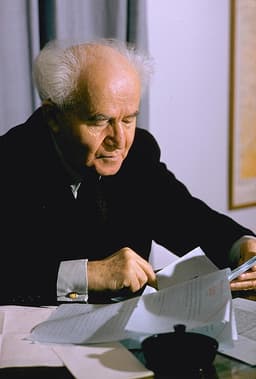
David Ben-Gurion
Politician · Modern
65.2Total

Julius Caesar
General · Ancient
82.8Total
Basic Information
Born
1886
-100
Died
1973
-44
Era
Modern
Ancient
Nationality
Israel
Roman Republic
Occupation
Politician
General
Civilization
Middle Eastern
Western
Score Comparison
Military (10%)
10.0
88.0
Political (20%)
78.0
78.0
Influence (20%)
68.0
85.0
Legacy (20%)
70.0
82.0
Leadership (15%)
79.8
80.0
Strategy (15%)
60.0
85.0
TOTAL
65.2
82.8
David Ben-Gurion — Complete Timeline
1948 AD
Declaration of the Establishment of the State of IsraelPolitical Action
Ben-Gurion read the Declaration of Independence in Tel Aviv, proclaiming the establishment of the State of Israel. He became its first prime minister, leading the provisional government during the ensuing 1948 Arab-Israeli War.
Founding of IsraelIndependenceZionism
Impact: globalconstructive
1956 AD
Operation Kadesh (Suez Crisis)War◆ Major
As prime minister, Ben-Gurion authorized Israel's invasion of Egypt's Sinai Peninsula in coordination with Britain and France. The operation aimed to regain control of the Suez Canal and end Egyptian blockade of Eilat, but international pressure forced withdrawal.
Suez CrisisSinai CampaignMilitary Action
Impact: regional
1963 AD
Resignation as Prime MinisterPolitical Action◆ Major
Ben-Gurion resigned as prime minister citing personal reasons and disagreements with his Mapai party colleagues, particularly over the Lavon Affair. He was succeeded by Levi Eshkol, ending his direct leadership of Israel.
ResignationPolitical TransitionLavon Affair
Impact: national
Julius Caesar — Complete Timeline
58 BC
Gallic WarsWar◆ Major
Caesar, as proconsul of Gaul, launched a series of campaigns that conquered all of Gaul (modern France, Belgium, and parts of Switzerland). He fought numerous battles, including against the Helvetii, the Belgae, and the Gallic chieftain Vercingetorix. The wars brought immense wealth and a loyal army to Caesar.
Gallic WarsConquestRoman Expansion
Impact: regional
49 BC
Crossing the RubiconPolitical Action◆ Major
Caesar led Legio XIII across the Rubicon River into Italy, defying the Roman Senate's order to disband his army. This act triggered a civil war against Pompey and the Optimates, ultimately leading to Caesar's dictatorship and the end of the Roman Republic.
Roman Civil WarEnd of RepublicPower Struggle
Impact: global
48 BC
Battle of PharsalusWar◆ Major
Caesar's outnumbered army defeated the larger forces of Pompey the Great at Pharsalus in Greece. Caesar's tactical use of a reserve line to counter Pompey's cavalry charge proved decisive. Pompey fled to Egypt, where he was assassinated, leaving Caesar as the undisputed master of the Roman world.
Roman Civil WarBattleDecisive Victory
Impact: regional
44 BC
Appointment as Dictator for LifePolitical Action◆ Major
The Roman Senate appointed Caesar dictator perpetuo (dictator for life), granting him unprecedented personal power. This move concentrated military, legislative, and judicial authority in one person, effectively ending the Roman Republic's traditional system of checks and balances and alarming many senators.
DictatorshipEnd of RepublicPower Consolidation
Impact: regionaldestructive
Assassination on the Ides of MarchPolitical Action◆ Major
A group of Roman senators, led by Marcus Junius Brutus and Gaius Cassius Longinus, stabbed Caesar to death at a meeting of the Senate in the Theatre of Pompey. The assassination was intended to restore the Republic, but instead triggered another civil war that led to the rise of the Roman Empire.
AssassinationRoman PoliticsEnd of Republic
Impact: globaldestructive
Expert Analysis
david-ben-gurion-vs-julius-caesar
The Crossing and the Declaration
On a winter day in 49 BCE, a fifty-year-old Roman general stood at the banks of a small river in northern Italy. The Rubicon was not a formidable obstacle—a shallow stream, easily forded—but it marked a boundary that no Roman commander could legally cross with his army. Julius Caesar hesitated, then reportedly said, *“The die is cast,”* and led his legions into history. Two millennia later, on a sweltering afternoon in May 1948, a balding, bespectacled man of sixty-two stood in a modest museum hall in Tel Aviv. David Ben-Gurion, his voice trembling with emotion, read a parchment that declared the establishment of a Jewish state. Both men were founders of new orders, yet their paths could not have been more different: one a conqueror who remade the ancient world with sword and ambition, the other a builder who forged a modern nation through politics and sheer will.
Origins
Caesar was born into the twilight of the Roman Republic, a world of senatorial intrigue, civil wars, and restless legions. His family, the Julii, claimed descent from the goddess Venus, but they were not among the ruling elite. He grew up in a Rome where power flowed from military glory and political cunning, where a man could rise by debt, bribery, and battlefield laurels. His uncle by marriage, Gaius Marius, had been a populist general who reformed the army and clashed with the aristocracy—a model Caesar would later emulate.
Ben-Gurion was born in 1886 in the Polish town of Plonsk, then part of the Russian Empire. He was raised in a world of pogroms, poverty, and Zionist dreams. His father, a lawyer, instilled in him a love of Hebrew and Jewish nationalism, but the boy’s real education came from the harsh realities of anti-Semitism. At nineteen, he emigrated to Ottoman Palestine, a barren, malaria-ridden land of sand dunes and Ottoman neglect. Where Caesar inherited a civilization in crisis, Ben-Gurion inherited a people without a home.
Rise to Power
Caesar’s ascent was a masterclass in calculated risk. He climbed the political ladder through military command, first in Spain, then in Gaul. Over eight years, from 58 to 50 BCE, he conquered what is now France and Belgium, slaughtering or enslaving perhaps a million people. The Gallic Wars made him fabulously wealthy and gave him a veteran army loyal to him, not the Republic. When the Senate ordered him to disband his legions and return to Rome as a private citizen, he refused. The Rubicon crossing was not a rebellion—it was a coup disguised as a defense of his honor.
Ben-Gurion’s rise was quieter but no less audacious. He spent decades organizing labor unions, building Jewish settlements, and lobbying British authorities. In 1947, when the United Nations voted to partition Palestine, he seized the moment. The British were leaving, Arab armies were massing, and the Jewish community had no state, no regular army, and little heavy weaponry. On May 14, 1948, hours before the British mandate expired, Ben-Gurion declared independence—a gamble that could have ended in annihilation. He had no legions, only the Haganah, a paramilitary force of part-time farmers and factory workers.
Leadership & Governance
Caesar ruled as a dictator, first temporarily, then for life. He centralized power, reformed the calendar, granted citizenship to provincials, and launched public works. His military genius was unmatched—he won battles against overwhelming odds at Alesia and Pharsalus, often by sheer speed and improvisation. But he governed through fear and favor, packing the Senate with his supporters and ignoring republican traditions. He was a brilliant strategist but a poor politician in the long run: he failed to build lasting institutions, relying instead on his personal authority.
Ben-Gurion governed as a democratic leader, albeit a domineering one. He forged a coalition government, crushed the right-wing Irgun militia to assert state monopoly on force, and built Israel’s institutions from scratch—the army, the civil service, the education system. His military decisions were less about battlefield tactics than about survival: during the 1948 War of Independence, he authorized arms purchases from Czechoslovakia and oversaw a desperate defense. In 1956, during the Suez Crisis, he allied with Britain and France to strike Egypt, a move that secured Israel’s southern border but drew international condemnation. He was no general, but he understood that politics was war by other means.
Triumph & Tragedy
Caesar’s greatest triumph was his conquest of Gaul, a feat that doubled Rome’s territory and made him the most powerful man in the Mediterranean. His greatest tragedy was his assassination on March 15, 44 BCE, stabbed twenty-three times by senators he had pardoned. He died believing he was indispensable, and in a sense, he was right: his death triggered a civil war that ended the Republic and gave birth to the Empire.
Ben-Gurion’s greatest triumph was the declaration of independence itself—a moment when a stateless people became a nation. His greatest tragedy was his resignation in 1963, after a bitter feud with his own party over the Lavon Affair, a failed Israeli espionage operation in Egypt. He left office a lonely figure, convinced that his successors lacked his vision. Unlike Caesar, he died in his bed in 1973, at the age of eighty-seven, but he, too, died fearing that his life’s work was incomplete.
Character & Destiny
Caesar was driven by *ambitio*—an insatiable hunger for glory and power. He was charming, ruthless, and endlessly calculating. He forgave his enemies because it was politically useful, and he slept with his friends’ wives because he could. His personality made him unstoppable but also blind: he could not imagine a world without him at its center.
Ben-Gurion was driven by *achrayut*—a Hebrew word meaning responsibility, burden, duty. He was ascetic, stubborn, and often insufferable. He slept on a cot in his office, ate sparingly, and demanded total loyalty. He saw himself as a servant of history, not its master. Where Caesar sought personal immortality, Ben-Gurion sought national survival.
Legacy
Caesar’s legacy is the Roman Empire, and through it, Western civilization itself. His name became a title—*Kaiser* and *Tsar*—and his writings, the *Commentaries*, are still read as military classics. But his legacy is also a warning: that one man’s genius can destroy a republic.
Ben-Gurion’s legacy is Israel—a state that has endured wars, terrorism, and internal division. His vision of a Jewish homeland, secular and democratic, remains the foundation of the country. He is remembered as the “Old Man,” the founder, but also as a figure of controversy: for his treatment of Palestinians, his authoritarian tendencies, his failure to secure peace.
Conclusion
Caesar and Ben-Gurion never met, but they would have understood each other. Both faced impossible choices and made them. Both believed that history was not something you waited for, but something you seized. Caesar crossed the Rubicon; Ben-Gurion read a declaration. One died by the sword; the other by the calendar. Yet both left the same question for posterity: Is it better to be the man who destroys an old world, or the man who builds a new one? The answer, perhaps, is that both are necessary—and both are tragic.
Rankings
🥇
Julius CaesarLeader
Mil: 88.0Pol: 78.0Inf: 85.0
82.8
🥈
David Ben-Gurion
Mil: 10.0Pol: 78.0Inf: 68.0
65.2
+17.6 behind
How This Comparison Works
Algorithm
Each figure is scored on 6 dimensions (0—100 scale) based on structured historical data: Military (10%), Political (20%), Influence (20%), Legacy (20%), Leadership (15%), Strategy (15%). The weighted total produces the final ranking.
Data Sources
Scores are computed from structured sub-indicators in the database. Scale factors adjust for era (Ancient ×0.85, Modern ×1.0) and civilization size (Eastern ×1.05, Other ×0.80) to account for differences in population and military scale.
Maximum 3 Figures
Comparisons are limited to 2—3 figures to ensure readability and statistical meaningfulness.
Error Margins
±5 points per dimension — Sub-scores are derived from historical records with inherent uncertainty. Two figures within 5 points on a dimension should be considered roughly equivalent in that area.
Total Score Accuracy
±3 points overall — The weighted combination of 6 dimensions produces a total score with approximately ±3 points of uncertainty. Differences of less than 3 points are not statistically significant— the figures are effectively tied.
Known Limitations
- Historical records are incomplete and uneven across civilizations
- Figures from oral-tradition societies may be underrepresented
- Occupation labels can misclassify multi-role figures
- Scores measure capability and impact, not moral character
- Quantitative scoring is a comparison tool, not absolute truth
Capability Radar
Military (10%) — Battles & Warfare
Battles
30
95
Win Rate
65
92
Expansion
55
97
Political (20%) — Governance & Reform
Reform
85
90
Diplomacy
80
85
Economy
65
82
Influence (20%) — Cultural & Global Reach
Cultural
70
88
Global
80
94
Legacy (20%) — Historical Impact
Historical
85
95
Longevity
75
96
Leadership (15%) — Power & Stability
Tenure
70
75
Stability
60
60
Strategy (15%) — Tactics & Innovation
Strategy
60
94
Tactics
40
96
Reform
75
88
Similar Comparisons
Comments & Discussion
Conqueror's Ghost6/17/2026
Comparing these two is like comparing a wildfire to a foundation. Caesar was a brilliant military tactician who crossed the Rubicon because he wanted power, plain and simple. Ben-Gurion declared a state because he had to, after the Holocaust proved Jews needed a homeland. Caesar's legacy is a civil war that ended the Republic; Ben-Gurion's is a nation that survived five wars. One destroyed a system; the other created one.
运河边的刀锋6/17/2026
你们都在吹罗马军团,但别忘了本-古里安才是现代史上的跨界大师。凯撒过卢比孔河时带了第13军团,不过区区五千人;而本-古里安在1948年5月14日下午4点宣布建国时,连一支正规军都没有,只有地下的哈加纳和走私的步枪。这才是真正的“孤注一掷”——而且他赢了,没有像凯撒那样被人捅死在元老院。
Data Skeptic6/17/2026
The Rubicon was a political stunt, not a military necessity. Caesar had already been ordered to disband his army by the Senate; crossing was a deliberate act of treason. Meanwhile, Ben-Gurion's declaration was a carefully timed diplomatic move, backed by years of lobbying and UN Resolution 181. Caesar gambled on civil war; Ben-Gurion gambled on international law. Apples and oranges, except one fruit spoiled the whole basket.
风骨铸国6/17/2026
军事对比是肤浅的。核心区别在于:凯撒追求的是个人不朽的荣耀,他把自己的人生写成了一部史诗;而本-古里安追求的是集体生存,他甚至拒绝在以色列的钱币上印自己的头像。凯撒获得了“终身独裁官”的头衔,本-古里安却在建国两年后主动辞去总理职务去内盖夫沙漠种地。谁才是真正的伟人?答案不言自明。
Revisionist Ghost6/17/2026
We need to stop romanticizing the Rubicon. Caesar wasn't some visionary; he was a power-hungry general who bankrupted the Republic to pay his debts. Ben-Gurion, for all his flaws, actually built a functioning democracy. Look at the numbers: Caesar's civil war killed over 100,000 Romans. Ben-Gurion's War of Independence cost about 6,000 lives—tragic, but on a completely different scale. One crossed a stream; the other crossed a century of exile.