Loading...
David Ben-Gurion vs Jusuf Kalla
David Ben-Gurion leads by 16.1 pts · 2 figures compared
…
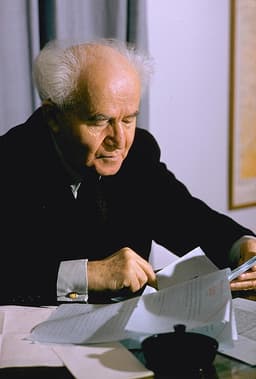
David Ben-Gurion
Politician · Modern
65.2Total

Jusuf Kalla
Politician · Modern
49.1Total
Basic Information
Born
1886
1942
Died
1973
—
Era
Modern
Modern
Nationality
Israel
Indonesia
Occupation
Politician
Politician
Civilization
Middle Eastern
Eastern
Score Comparison
Military (10%)
10.0
13.9
Political (20%)
78.0
53.8
Influence (20%)
68.0
55.7
Legacy (20%)
70.0
45.8
Leadership (15%)
79.8
72.0
Strategy (15%)
60.0
35.1
TOTAL
65.2
49.1
David Ben-Gurion — Complete Timeline
1948 AD
Declaration of the Establishment of the State of IsraelPolitical Action
Ben-Gurion read the Declaration of Independence in Tel Aviv, proclaiming the establishment of the State of Israel. He became its first prime minister, leading the provisional government during the ensuing 1948 Arab-Israeli War.
Founding of IsraelIndependenceZionism
Impact: globalconstructive
1956 AD
Operation Kadesh (Suez Crisis)War◆ Major
As prime minister, Ben-Gurion authorized Israel's invasion of Egypt's Sinai Peninsula in coordination with Britain and France. The operation aimed to regain control of the Suez Canal and end Egyptian blockade of Eilat, but international pressure forced withdrawal.
Suez CrisisSinai CampaignMilitary Action
Impact: regional
1963 AD
Resignation as Prime MinisterPolitical Action◆ Major
Ben-Gurion resigned as prime minister citing personal reasons and disagreements with his Mapai party colleagues, particularly over the Lavon Affair. He was succeeded by Levi Eshkol, ending his direct leadership of Israel.
ResignationPolitical TransitionLavon Affair
Impact: national
Jusuf Kalla — Complete Timeline
2004 AD
Elected Vice President of Indonesia (First Term)Political Action◆ Major
Jusuf Kalla was elected Vice President alongside President Susilo Bambang Yudhoyono. He played a key role in economic policy and infrastructure development, and was instrumental in negotiating the Helsinki peace deal for Aceh.
Vice PresidentSBYAceh Peace
Impact: nationalconstructive
2005 AD
Negotiated the Helsinki Peace Agreement for AcehPolitical Action
Kalla played a key role in brokering the Helsinki peace agreement between the Indonesian government and the Free Aceh Movement (GAM). The agreement ended a decades-long insurgency and granted Aceh special autonomy.
AcehPeaceHelsinki
Impact: regionalconstructive
2014 AD
Elected Vice President of Indonesia (Second Term)Political Action◆ Major
Kalla was elected Vice President for a second term, this time alongside President Joko Widodo. He brought experience in economic development and infrastructure, and helped manage the transition of power.
Vice PresidentJokowiSecond Term
Impact: nationalconstructive
Expert Analysis
Origins
David Ben-Gurion was born in 1886 in Płońsk, Poland, then part of the Russian Empire. His father, Avigdor Grün, was a lawyer and a Zionist activist. Ben-Gurion studied law in Warsaw but became deeply involved in the Zionist movement, immigrating to Ottoman Palestine in 1906. He worked as a farmer and journalist, adopting the Hebrew name Ben-Gurion.
Jusuf Kalla was born in 1942 in Watampone, South Sulawesi, Indonesia, into a wealthy Bugis family. His father, Haji Kalla, was a successful businessman and politician. Kalla studied economics at Hasanuddin University and later at the University of San Francisco, earning a degree in business administration. He joined the family business, the Kalla Group, expanding it into a conglomerate.
Rise to Power
Ben-Gurion rose through the ranks of the Zionist labor movement. In 1930, he founded the Mapai party, which became the dominant political force among Jewish settlers. He served as chairman of the Jewish Agency from 1935, effectively leading the Jewish community in Palestine. His pivotal moment came on May 14, 1948, when he declared the establishment of the State of Israel, becoming its first prime minister. He navigated the 1948 Arab-Israeli War, securing the new state's survival.
Kalla entered politics in the late 1990s. He served as Minister of Industry and Trade under President Abdurrahman Wahid (1999-2001) and later as Coordinating Minister for People's Welfare under President Megawati Sukarnoputri. His major breakthrough came in 2004 when he was elected Vice President alongside Susilo Bambang Yudhoyono. He played a crucial role in economic policy and infrastructure development. His second term as Vice President began in 2014 under President Joko Widodo.
Leadership & Governance
Ben-Gurion's leadership was authoritarian and decisive. He centralized power, built a strong military (IDF), and promoted state-building through institutions like the Histadrut labor union. He prioritized Jewish immigration (aliyah) and agricultural development. His governance scored 79.8 in Leadership, reflecting his ability to unite disparate factions. However, his political score of 78.0 was tempered by his handling of the Lavon Affair, a failed espionage operation in Egypt that led to a political crisis.
Kalla's leadership style was pragmatic and consensus-driven. He excelled in negotiation, as seen in the 2005 Helsinki peace agreement that ended the 30-year Aceh conflict. His Leadership score of 72.0 reflects his skill in brokering peace and managing economic reforms. He focused on infrastructure projects like the Trans-Java toll road. However, his Political score of 53.8 indicates limited influence in shaping national policy, often playing a supportive role to the presidents he served.
Triumph & Tragedy
Ben-Gurion's greatest triumph was founding Israel and leading it through its first years. He oversaw the absorption of hundreds of thousands of immigrants and the establishment of key institutions. His military score of 10.0 is low because he was not a military commander, but he authorized strategic operations like Operation Kadesh (1956 Suez Crisis), which secured Israel's borders. His tragedy was the Lavon Affair (1954), which forced his resignation in 1963 due to a power struggle within his party.
Kalla's greatest success was the Aceh peace deal, which earned him international recognition. He also boosted economic growth during his vice presidencies, with GDP growth averaging 5-6%. His Legacy score of 45.8 is modest, as his impact was limited to specific areas. His tragedy includes his failure to secure the presidency in 2009, losing to Yudhoyono, and his inability to fully transform Indonesia's political system.
Character & Destiny
Ben-Gurion was a visionary and stubborn leader. He believed in a Jewish state and was willing to use force to achieve it. His character shaped Israel's destiny, creating a nation that prioritized security and immigration. Historians often describe him as the "father of the nation." His total score of 65.2 reflects his foundational role.
Kalla was a pragmatic businessman-turned-politician. He focused on results rather than ideology. His character enabled him to mediate conflicts and drive economic projects. However, his destiny was to be a number two, never achieving the top office. His total score of 49.1 highlights his secondary role.
Legacy
Ben-Gurion's legacy is monumental: he founded a nation that now has 9 million people. His policies shaped Israel's military, economy, and political system. His influence score of 68.0 is justified by his lasting impact on global geopolitics. Israel's existence changed the Middle East.
Kalla's legacy is more limited. The Aceh peace agreement remains a model for conflict resolution. His infrastructure projects improved connectivity in Indonesia. However, his influence score of 55.7 is modest; he is remembered as a competent vice president but not a transformative figure.
Conclusion
David Ben-Gurion had a greater impact than Jusuf Kalla. Ben-Gurion's total score of 65.2 outweighs Kalla's 49.1 by 16.1 points. Ben-Gurion founded a state, shaped its identity, and influenced global history. Kalla, while effective, operated within an existing system. Ben-Gurion's leadership score of 79.8 and political score of 78.0 demonstrate his dominance. Kalla's leadership score of 72.0 is high, but his political score of 53.8 and legacy of 45.8 show his limited scope. The difference is clear: one built a nation, the other helped manage one.
Rankings
🥇
David Ben-GurionLeader
Mil: 10.0Pol: 78.0Inf: 68.0
65.2
🥈
Jusuf Kalla
Mil: 13.9Pol: 53.8Inf: 55.7
49.1
+16.1 behind
How This Comparison Works
Algorithm
Each figure is scored on 6 dimensions (0—100 scale) based on structured historical data: Military (10%), Political (20%), Influence (20%), Legacy (20%), Leadership (15%), Strategy (15%). The weighted total produces the final ranking.
Data Sources
Scores are computed from structured sub-indicators in the database. Scale factors adjust for era (Ancient ×0.85, Modern ×1.0) and civilization size (Eastern ×1.05, Other ×0.80) to account for differences in population and military scale.
Maximum 3 Figures
Comparisons are limited to 2—3 figures to ensure readability and statistical meaningfulness.
Error Margins
±5 points per dimension — Sub-scores are derived from historical records with inherent uncertainty. Two figures within 5 points on a dimension should be considered roughly equivalent in that area.
Total Score Accuracy
±3 points overall — The weighted combination of 6 dimensions produces a total score with approximately ±3 points of uncertainty. Differences of less than 3 points are not statistically significant— the figures are effectively tied.
Known Limitations
- Historical records are incomplete and uneven across civilizations
- Figures from oral-tradition societies may be underrepresented
- Occupation labels can misclassify multi-role figures
- Scores measure capability and impact, not moral character
- Quantitative scoring is a comparison tool, not absolute truth
Capability Radar
Military (10%) — Battles & Warfare
Battles
30
13
Win Rate
65
18
Expansion
55
20
Political (20%) — Governance & Reform
Reform
85
55
Diplomacy
80
60
Economy
65
60
Influence (20%) — Cultural & Global Reach
Cultural
70
40
Global
80
35
Legacy (20%) — Historical Impact
Historical
85
45
Longevity
75
30
Leadership (15%) — Power & Stability
Tenure
70
65
Stability
60
55
Strategy (15%) — Tactics & Innovation
Strategy
60
24
Tactics
40
28
Reform
75
26
Similar Comparisons
Comments & Discussion
No comments yet. Be the first to share your thoughts!