Loading...
David Ben-Gurion vs Napoleon Bonaparte
Napoleon Bonaparte leads by 5.7 pts · 2 figures compared
…
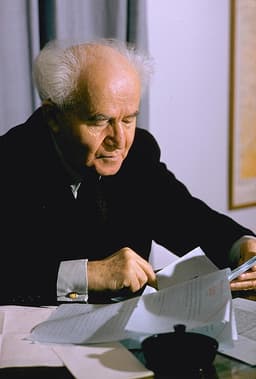
David Ben-Gurion
Politician · Modern
65.2Total

Napoleon Bonaparte
General · Modern
70.9Total
Basic Information
Born
1886
1769
Died
1973
1821
Era
Modern
Modern
Nationality
Israel
France
Occupation
Politician
General
Civilization
Middle Eastern
Western
Score Comparison
Military (10%)
10.0
94.0
Political (20%)
78.0
72.0
Influence (20%)
68.0
40.0
Legacy (20%)
70.0
80.0
Leadership (15%)
79.8
78.0
Strategy (15%)
60.0
90.0
TOTAL
65.2
70.9
David Ben-Gurion — Complete Timeline
1948 AD
Declaration of the Establishment of the State of IsraelPolitical Action
Ben-Gurion read the Declaration of Independence in Tel Aviv, proclaiming the establishment of the State of Israel. He became its first prime minister, leading the provisional government during the ensuing 1948 Arab-Israeli War.
Founding of IsraelIndependenceZionism
Impact: globalconstructive
1956 AD
Operation Kadesh (Suez Crisis)War◆ Major
As prime minister, Ben-Gurion authorized Israel's invasion of Egypt's Sinai Peninsula in coordination with Britain and France. The operation aimed to regain control of the Suez Canal and end Egyptian blockade of Eilat, but international pressure forced withdrawal.
Suez CrisisSinai CampaignMilitary Action
Impact: regional
1963 AD
Resignation as Prime MinisterPolitical Action◆ Major
Ben-Gurion resigned as prime minister citing personal reasons and disagreements with his Mapai party colleagues, particularly over the Lavon Affair. He was succeeded by Levi Eshkol, ending his direct leadership of Israel.
ResignationPolitical TransitionLavon Affair
Impact: national
Napoleon Bonaparte — Complete Timeline
1799 AD
Coup of 18 BrumaireOther◆ Major
Napoleon Bonaparte, with support from his brother Lucien and key political figures, overthrew the Directory in a bloodless coup. He established the Consulate with himself as First Consul, effectively becoming the ruler of France. This event ended the French Revolution's most unstable period.
French RevolutionCoupRise to Power
Impact: regional
1804 AD
Promulgation of the Napoleonic CodeOther◆ Major
Napoleon enacted the Civil Code of the French, known as the Napoleonic Code, a comprehensive set of laws that replaced the fragmented feudal legal systems. The code established legal equality, protected property rights, and secularized law. It became the basis for legal systems in many European and world countries.
Legal ReformNapoleonic CodeCivil Law
Impact: globalconstructive
1805 AD
Battle of AusterlitzWar◆ Major
Napoleon's Grande Arm
Napoleonic WarsBattleDecisive Victory
Impact: global
1812 AD
Invasion of RussiaWar◆ Major
Napoleon led the Grande Arm
Napoleonic WarsInvasionDisaster
Impact: globaldestructive
1815 AD
Battle of WaterlooWar◆ Major
Napoleon's French army was defeated by the combined forces of the Duke of Wellington's Anglo-Allied army and Gebhard Leberecht von Bl
Napoleonic WarsBattleFinal Defeat
Impact: globaldestructive
Expert Analysis
david-ben-gurion-vs-napoleon-bonaparte
# The Conqueror and the Founder
In the winter of 1812, Napoleon Bonaparte watched his Grand Army dissolve into the Russian snow, a catastrophe that would echo across Europe for a century. In the spring of 1948, David Ben-Gurion stood before a small assembly in Tel Aviv and read a declaration that would reshape the Middle East. One man commanded armies that numbered in the hundreds of thousands; the other built a state with a population smaller than Napoleon’s typical battlefield losses. Yet both carved their names into history with an audacity that defied the odds of their eras. What separates a conqueror from a founder? The answer lies not merely in their achievements, but in the worlds they inherited and the futures they imagined.
Origins
Napoleon Bonaparte was born in 1769 on the island of Corsica, a recently annexed French territory where his family belonged to the minor nobility. His world was one of shifting loyalties and simmering resentments—Corsica had been Genoese before becoming French, and young Napoleon grew up speaking Italian-accented French, an outsider among the Parisian elite. The French Revolution erupted when he was twenty, shattering the old order and creating opportunities unimaginable under the monarchy. A provincial artillery officer with nothing to lose, he rode the revolutionary wave into prominence.
David Ben-Gurion was born in 1886 in Plonsk, a small town in Russian Poland, then part of the Pale of Settlement. His father was a lawyer and a Zionist activist; his mother died when he was eleven. Ben-Gurion grew up in a world of pogroms, poverty, and political awakening—the Jewish masses of Eastern Europe were trapped between tsarist oppression and rising nationalism. Unlike Napoleon, who inherited a crumbling but powerful state, Ben-Gurion inherited only a dream: a Jewish homeland in Palestine, then a dusty backwater of the Ottoman Empire. He arrived in Jaffa in 1906, a twenty-year-old idealist with no army, no treasury, and no sovereign territory.
Rise to Power
Napoleon’s ascent was meteoric and military. In 1793, at age twenty-four, he recaptured the port of Toulon from British and royalist forces, earning promotion to brigadier general. By 1796, he commanded the Army of Italy, where his lightning campaigns forced Austria to sue for peace. The Italian campaign was not merely a military triumph—it was a political education. Napoleon learned that victory could be converted into influence, that a general who brought home glory could dictate terms to civilian leaders. The coup of 18 Brumaire in 1799, when he overthrew the Directory and installed himself as First Consul, was the logical conclusion of this lesson.
Ben-Gurion’s rise was patient and political. He did not seize power; he built it, brick by brick, over decades. In 1906, he joined the socialist Zionist party Poale Zion, working as a farmer in the Galilee. He was expelled by the Ottoman authorities in 1915 for his political activities, spent two years in New York, and returned to Palestine in 1918 as part of the Jewish Legion of the British Army. His true breakthrough came in 1930, when he helped found the Mapai party, uniting disparate labor factions into a disciplined political machine. By 1935, he had become chairman of the Jewish Agency, the de facto government of the Yishuv (the Jewish community in Palestine). His power was not won on battlefields but in committee rooms, labor disputes, and negotiations with British officials.
Leadership & Governance
Napoleon governed as he conquered: with speed, ambition, and a belief in his own destiny. As First Consul and later Emperor, he centralized the French state, created the Bank of France, and established the Napoleonic Code—a legal framework that abolished feudalism, protected property rights, and enshrined merit over birth. His military genius was undeniable: at Austerlitz in 1805, he destroyed a combined Russian-Austrian army with a feigned retreat that remains a textbook maneuver. Yet his governance was ultimately self-defeating. He placed family members on European thrones, imposed the Continental System to cripple Britain, and invaded Spain, Russia, and eventually most of Europe. Each campaign added territory but multiplied enemies.
Ben-Gurion governed as he built: with pragmatism, patience, and an eye on the long horizon. As Israel’s first prime minister from 1948 to 1963, he faced challenges Napoleon never knew—a state under siege, an economy in ruins, and a population of refugees from seventy different countries. His military decisions were cautious by comparison: during the 1948 War of Independence, he ordered the capture of territory but avoided overreach, famously rejecting proposals to take the West Bank or Gaza. In 1956, he authorized Operation Kadesh, the Suez Crisis invasion, but withdrew under American pressure—a defeat that preserved Israel’s relationship with the United States. His strategy was not conquest but consolidation: absorb immigrants, build institutions, and secure borders.
Triumph & Tragedy
Napoleon’s greatest triumph was the Empire at its height in 1810, when he controlled most of continental Europe. His greatest tragedy was the invasion of Russia in 1812, where he lost over 400,000 men not primarily to battle but to cold, hunger, and logistical chaos. He was exiled to Elba in 1814, returned for the Hundred Days in 1815, and was finally defeated at Waterloo on June 18, 1815. The tragedy was not merely military—it was the squandering of a generation’s hope. The French Revolution had promised liberty, equality, fraternity; Napoleon delivered conscription, censorship, and endless war.
Ben-Gurion’s greatest triumph was May 14, 1948, when he declared the establishment of the State of Israel hours before the British mandate expired. His greatest tragedy was perhaps the unresolved conflict with the Palestinians, a problem he acknowledged but could not solve. He resigned as prime minister in 1963, citing personal reasons and disagreements with party colleagues, and died in 1973 at a kibbutz in the Negev desert. Unlike Napoleon, he did not die in exile—he died in the land he had helped build, surrounded by the people he had led.
Character & Destiny
Napoleon was a man of immense energy, intelligence, and ambition—but also of colossal ego. “I am the state,” he once said, and he meant it. His personality drove him to conquer, but it also blinded him to limits. He could not stop, could not delegate, could not share power. His destiny was shaped by this flaw: the same will that built an empire destroyed it.
Ben-Gurion was equally ambitious but more disciplined. He was known for his ascetic lifestyle, his devotion to reading, and his willingness to compromise when necessary. “In Israel, in order to be a realist, you must believe in miracles,” he once said. He believed in the miracle of Jewish statehood, but he also understood that miracles require organization, patience, and the ability to say no to impulsive victories. His personality was that of a builder, not a conqueror—he wanted to create something that would outlast him, not something that would collapse with him.
Legacy
Napoleon’s legacy is double-edged. He spread the ideals of the French Revolution across Europe—legal equality, secular administration, meritocracy—but he also inspired nationalism, militarism, and a cult of personality that would be imitated by dictators for two centuries. His military innovations influenced warfare until World War I. His Napoleonic Code remains the basis of civil law in much of the world. He is remembered as a genius, a tyrant, and a cautionary tale.
Ben-Gurion’s legacy is more singular: he is the father of Israel. The state he founded has survived wars, intifadas, and internal divisions, growing from 600,000 Jews in 1948 to over 7 million today. His vision of a Jewish state that is both democratic and secure remains contested, but his achievement is undeniable. He is remembered not as a conqueror but as a founder—a man who turned a dream into a reality.
Conclusion
Napoleon and Ben-Gurion both rose from the margins of their worlds to shape history. One commanded armies that shook continents; the other built a state that defied the odds. The difference between them is not simply one of scale or success. It is a difference of purpose. Napoleon sought to remake the world in his image; Ben-Gurion sought to create a home for his people. The conqueror’s empire crumbled; the founder’s state endures. In the end, the question is not who was greater, but who built something that outlasted the builder.
Rankings
🥇
Napoleon BonaparteLeader
Mil: 94.0Pol: 72.0Inf: 40.0
70.9
🥈
David Ben-Gurion
Mil: 10.0Pol: 78.0Inf: 68.0
65.2
+5.7 behind
How This Comparison Works
Algorithm
Each figure is scored on 6 dimensions (0—100 scale) based on structured historical data: Military (10%), Political (20%), Influence (20%), Legacy (20%), Leadership (15%), Strategy (15%). The weighted total produces the final ranking.
Data Sources
Scores are computed from structured sub-indicators in the database. Scale factors adjust for era (Ancient ×0.85, Modern ×1.0) and civilization size (Eastern ×1.05, Other ×0.80) to account for differences in population and military scale.
Maximum 3 Figures
Comparisons are limited to 2—3 figures to ensure readability and statistical meaningfulness.
Error Margins
±5 points per dimension — Sub-scores are derived from historical records with inherent uncertainty. Two figures within 5 points on a dimension should be considered roughly equivalent in that area.
Total Score Accuracy
±3 points overall — The weighted combination of 6 dimensions produces a total score with approximately ±3 points of uncertainty. Differences of less than 3 points are not statistically significant— the figures are effectively tied.
Known Limitations
- Historical records are incomplete and uneven across civilizations
- Figures from oral-tradition societies may be underrepresented
- Occupation labels can misclassify multi-role figures
- Scores measure capability and impact, not moral character
- Quantitative scoring is a comparison tool, not absolute truth
Capability Radar
Military (10%) — Battles & Warfare
Battles
30
95
Win Rate
65
90
Expansion
55
95
Political (20%) — Governance & Reform
Reform
85
95
Diplomacy
80
80
Economy
65
85
Influence (20%) — Cultural & Global Reach
Cultural
70
85
Global
80
90
Legacy (20%) — Historical Impact
Historical
85
95
Longevity
75
90
Leadership (15%) — Power & Stability
Tenure
70
85
Stability
60
70
Strategy (15%) — Tactics & Innovation
Strategy
60
95
Tactics
40
98
Reform
75
92
Similar Comparisons
Comments & Discussion
CorsicanGhost6/17/2026
Sure, Napoleon conquered Europe with blitzkrieg tactics centuries early, but Ben-Gurion did something infinitely harder: he built a nation from scratch while fighting a guerrilla war. Napoleon's empire crumbled in a decade; Israel still stands 75 years later. The "Little Corporal" had the Grand Army; Ben-Gurion had a ragtag militia of Holocaust survivors. Who's really the better strategist?
数据侦探6/17/2026
别被胜利叙事忽悠了。比人口?拿破仑时代法国有2800万人,1948年犹太社区才65万。比伤亡?博罗季诺一天死7万,独立战争死6千。完全不对等的资源,怎么比?Ben-Gurion的"奇迹"不过是乘着大英帝国衰落和苏联支持的东风。拿破仑输在劣势,Ben-Gurion赢在优劣势差太悬殊了。
ClassicsSkeptic6/17/2026
You're both wrong. Napoleon is the tragic hero—think Caesar crossing the Rubicon, except he froze in Russia. Ben-Gurion is the pragmatic founder, more like Solon giving Athens laws. Napoleon let his ego write his legacy; Ben-Gurion knew when to accept partition and when to declare statehood. One died in exile, the other in power. The difference? Vision versus vanity.
历史老饕6/17/2026
拿过《战争论》读读?拿破仑输在战略扩张无边界,Ben-Gurion赢在克制。1956年苏伊士危机,Ben-Gurion见好就收,及时撤军。拿破仑却非要打到莫斯科,结果把整支大军赔进去。能打下江山不稀奇,要守得住才是真本事。Ben-Gurion建国头二十年,面对三次围剿,全顶住了。拿破仑滑铁卢才几个月就垮了。