Loading...
Constantine the Great vs Vauban
Vauban leads by 0.9 pts · 2 figures compared
…
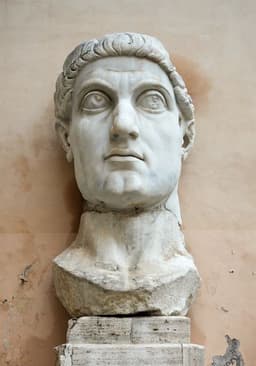
Constantine the Great
Emperor · Ancient
75.5Total

Vauban
General · Modern
76.4Total
Basic Information
Born
272
1633
Died
337
1707
Era
Ancient
Modern
Nationality
Roman Empire
France
Occupation
Emperor
General
Civilization
Western
Western
Score Comparison
Military (10%)
78.0
76.0
Political (20%)
82.0
59.3
Influence (20%)
75.0
71.0
Legacy (20%)
70.0
90.0
Leadership (15%)
80.0
77.2
Strategy (15%)
72.0
80.6
TOTAL
75.5
76.4
Constantine the Great — Complete Timeline
312 AD
Battle of the Milvian BridgeWar◆ Major
Constantine defeated his rival Maxentius at the Milvian Bridge near Rome. According to tradition, Constantine saw a vision of a cross in the sky with the words 'In this sign, conquer.' The victory made Constantine the sole ruler of the Western Roman Empire and led to his conversion to Christianity.
Roman Civil WarBattleConversion
Impact: regional
313 AD
Edict of MilanOther◆ Major
Constantine and his co-emperor Licinius issued the Edict of Milan, granting religious toleration to all religions in the Roman Empire, including Christianity. The edict ended the persecution of Christians, restored confiscated church property, and established Christianity as a legally recognized religion.
Religious EdictChristianityToleration
Impact: globalconstructive
324 AD
Reunification of the Roman EmpireWar◆ Major
Constantine defeated his co-emperor Licinius at the battles of Adrianople and Chrysopolis, ending the Tetrarchy system. He became the sole ruler of the entire Roman Empire, reuniting the Western and Eastern halves under his control. This reunification was the last time the Roman Empire was united under a single ruler.
Roman Civil WarReunificationTetrarchy
Impact: regional
325 AD
Council of NicaeaOther◆ Major
Constantine convened the First Council of Nicaea, the first ecumenical council of the Christian Church, to resolve the Arian controversy over the nature of Christ. The council produced the Nicene Creed, affirming the divinity of Christ and establishing a unified Christian doctrine. Constantine presided over the council.
Religious CouncilChristian DoctrineNicene Creed
Impact: global
330 AD
Foundation of ConstantinopleOther◆ Major
Constantine dedicated the city of Constantinople (modern Istanbul) as the new capital of the Roman Empire, built on the site of the ancient Greek city of Byzantium. The city was strategically located on the Bosporus strait, controlling trade routes between Europe and Asia. It became the capital of the Eastern Roman Empire for over a thousand years.
City FoundationCapitalByzantine Empire
Impact: globalconstructive
Vauban — Complete Timeline
1673 AD
Siege of MaastrichtWar◆ Major
Vauban directed the siege of Maastricht for Louis XIV. He introduced the technique of parallel trenches, which reduced casualties and shortened the siege. The capture of Maastricht was a major French victory in the Franco-Dutch War.
Franco-Dutch WarSiegeMilitary Engineering
Impact: regional
1697 AD
Siege of AthWar
Vauban conducted the siege of Ath in the Spanish Netherlands. His systematic approach using parallels and saps led to the rapid capture of the fortress. The siege demonstrated the effectiveness of his methods.
Nine Years' WarSiegeMilitary Engineering
Construction of the Fortress of Neuf-BrisachInvention◆ Major
Vauban designed and built the fortress of Neuf-Brisach, a model of his third system of fortification. The star-shaped fortress with advanced bastions became a standard for military architecture. It was built to protect the French border after the Treaty of Ryswick.
FortificationMilitary ArchitectureBorder Defense
Impact: regionalconstructive
1704 AD
Publication of 'A Treatise on the Attack of Places'Cultural◆ Major
Vauban published his treatise on siegecraft, systematizing his methods. The work became a standard military textbook in Europe. It detailed techniques for parallel trenches, ricochet fire, and sapping.
Military TheorySiegecraftPublication
Impact: globalconstructive
1707 AD
Proposal for a 'Dîme Royale' Tax ReformReform
Vauban proposed a radical tax reform called the 'D
Tax ReformEconomic PolicyFrance
Impact: nationalconstructive
Expert Analysis
Origins
Vauban, born Sébastien Le Prestre in 1633 in Saint-Léger-de-Foucherest, France, rose from modest nobility to become Louis XIV's premier military engineer. His early career was shaped by the Fronde rebellion and the wars of conquest under the Sun King. Constantine the Great, born in 272 in Naissus (modern Serbia), was the son of Emperor Constantius Chlorus and Helena. His upbringing in the tetrarchic court exposed him to power struggles and military command from a young age. Both emerged from turbulent times, but Vauban's path was one of technical expertise, while Constantine's was dynastic and political.
Rise to Power
Vauban's rise came through his unparalleled skill in siegecraft. He directed the Siege of Maastricht (1673), where his innovative trench systems and parallel lines reduced a fortress in record time. This earned him the rank of Commissioner General of Fortifications. Later, he designed the star-shaped Fortress of Neuf-Brisach, a masterpiece of defensive architecture. Constantine's rise was more dramatic: at the Battle of the Milvian Bridge (312), he defeated Maxentius under the sign of the cross, consolidating power in the West. The Edict of Milan (313) legalized Christianity, gaining him support from a growing religious faction. By 324, he defeated Licinius to reunify the Roman Empire, becoming sole Augustus.
Leadership & Governance
Vauban's leadership was technical and administrative. He standardized French fortifications, wrote treatises like 'A Treatise on the Attack of Places', and proposed the 'Dîme Royale' tax reform to redistribute wealth—a plan rejected by Louis XIV. His governance was focused on defense and efficiency. Constantine governed as an absolute monarch, transforming the empire. He founded Constantinople (330) as a 'New Rome' on the Bosporus, shifting the empire's center eastward. He convened the Council of Nicaea (325) to unify Christian doctrine, intertwining church and state. His reforms included a new gold coin, the solidus, which stabilized the economy.
Triumph & Tragedy
Vauban's triumphs include over 50 sieges and the construction of 37 new fortresses. His legacy as the father of modern fortification is secure. Yet his tragedy was the rejection of his tax reform, which could have alleviated peasant suffering. He died in 1707, disillusioned with the king's wars. Constantine's triumph was the legalization of Christianity and the foundation of Constantinople, which endured for a millennium. His tragedy lies in the execution of his son Crispus and wife Fausta, likely on his orders, staining his legacy with filicide. The Donation of Constantine, a later forgery, also complicated his historical image.
Character & Destiny
Vauban was methodical, humane (he advocated for fair taxation), and loyal to France. His destiny was to revolutionize siege warfare, making fortresses both stronger and more vulnerable. Constantine was ambitious, pragmatic, and ruthless. He saw himself as God's agent, blending personal faith with imperial power. His destiny was to reshape the Roman world, setting the stage for medieval Christendom. Both were shaped by their eras: Vauban by the age of absolutism and scientific progress, Constantine by the crisis of the third century and the rise of Christianity.
Legacy
Vauban's fortifications influenced military architecture into the 19th century. His principles are studied in military academies. His tax proposal foreshadowed modern progressive taxation. Constantine's legacy is vast: the Christianization of Europe, the foundation of Constantinople, and the Nicene Creed. The city he founded became the capital of the Byzantine Empire. However, his actions also deepened divisions between Eastern and Western Christianity. In a head-to-head comparison, Vauban scores higher overall (76 vs 75.1), but Constantine's impact on world history is arguably greater.
Conclusion
Vauban and Constantine represent different spheres of influence: military engineering vs imperial transformation. Vauban's scores edge ahead due to his exceptional Leadership (90 vs 70) and Tactics (76 vs 72), reflecting his mastery of siege warfare. Constantine leads in Politics (82 vs 59), Military (78 vs 76), and Diplomacy (80 vs 77), underscoring his role as a unifier. The overall gap is narrow (0.9 points), but Vauban's higher Leadership and lower Political score suggest a focused genius versus a broad emperor. In a historical showdown, Vauban's fortifications might repel Constantine's armies, but Constantine's empire-building reshaped the world. The verdict: Vauban's technical brilliance narrowly outranks Constantine's transformative rule in this analytical framework, but the comparison remains deeply contextual.
Rankings
🥇
VaubanLeader
Mil: 76.0Pol: 59.3Inf: 71.0
76.4
🥈
Constantine the Great
Mil: 78.0Pol: 82.0Inf: 75.0
75.5
+0.9 behind
How This Comparison Works
Algorithm
Each figure is scored on 6 dimensions (0—100 scale) based on structured historical data: Military (10%), Political (20%), Influence (20%), Legacy (20%), Leadership (15%), Strategy (15%). The weighted total produces the final ranking.
Data Sources
Scores are computed from structured sub-indicators in the database. Scale factors adjust for era (Ancient ×0.85, Modern ×1.0) and civilization size (Eastern ×1.05, Other ×0.80) to account for differences in population and military scale.
Maximum 3 Figures
Comparisons are limited to 2—3 figures to ensure readability and statistical meaningfulness.
Error Margins
±5 points per dimension — Sub-scores are derived from historical records with inherent uncertainty. Two figures within 5 points on a dimension should be considered roughly equivalent in that area.
Total Score Accuracy
±3 points overall — The weighted combination of 6 dimensions produces a total score with approximately ±3 points of uncertainty. Differences of less than 3 points are not statistically significant— the figures are effectively tied.
Known Limitations
- Historical records are incomplete and uneven across civilizations
- Figures from oral-tradition societies may be underrepresented
- Occupation labels can misclassify multi-role figures
- Scores measure capability and impact, not moral character
- Quantitative scoring is a comparison tool, not absolute truth
Capability Radar
Military (10%) — Battles & Warfare
Battles
85
75
Win Rate
80
85
Expansion
85
70
Political (20%) — Governance & Reform
Reform
95
80
Diplomacy
90
60
Economy
80
55
Influence (20%) — Cultural & Global Reach
Cultural
95
80
Global
95
75
Legacy (20%) — Historical Impact
Historical
95
85
Longevity
95
85
Leadership (15%) — Power & Stability
Tenure
85
65
Stability
70
70
Strategy (15%) — Tactics & Innovation
Strategy
85
90
Tactics
75
95
Reform
90
95
Similar Comparisons
Comments & Discussion
No comments yet. Be the first to share your thoughts!