Loading...
Constantine the Great vs Julius Caesar
Julius Caesar leads by 7.3 pts · 2 figures compared
…
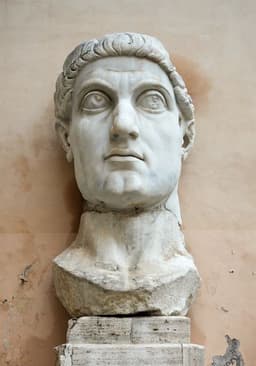
Constantine the Great
Emperor · Ancient
75.5Total

Julius Caesar
General · Ancient
82.8Total
Basic Information
Born
272
-100
Died
337
-44
Era
Ancient
Ancient
Nationality
Roman Empire
Roman Republic
Occupation
Emperor
General
Civilization
Western
Western
Score Comparison
Military (10%)
78.0
88.0
Political (20%)
82.0
78.0
Influence (20%)
75.0
85.0
Legacy (20%)
70.0
82.0
Leadership (15%)
80.0
80.0
Strategy (15%)
72.0
85.0
TOTAL
75.5
82.8
Constantine the Great — Complete Timeline
312 AD
Battle of the Milvian BridgeWar◆ Major
Constantine defeated his rival Maxentius at the Milvian Bridge near Rome. According to tradition, Constantine saw a vision of a cross in the sky with the words 'In this sign, conquer.' The victory made Constantine the sole ruler of the Western Roman Empire and led to his conversion to Christianity.
Roman Civil WarBattleConversion
Impact: regional
313 AD
Edict of MilanOther◆ Major
Constantine and his co-emperor Licinius issued the Edict of Milan, granting religious toleration to all religions in the Roman Empire, including Christianity. The edict ended the persecution of Christians, restored confiscated church property, and established Christianity as a legally recognized religion.
Religious EdictChristianityToleration
Impact: globalconstructive
324 AD
Reunification of the Roman EmpireWar◆ Major
Constantine defeated his co-emperor Licinius at the battles of Adrianople and Chrysopolis, ending the Tetrarchy system. He became the sole ruler of the entire Roman Empire, reuniting the Western and Eastern halves under his control. This reunification was the last time the Roman Empire was united under a single ruler.
Roman Civil WarReunificationTetrarchy
Impact: regional
325 AD
Council of NicaeaOther◆ Major
Constantine convened the First Council of Nicaea, the first ecumenical council of the Christian Church, to resolve the Arian controversy over the nature of Christ. The council produced the Nicene Creed, affirming the divinity of Christ and establishing a unified Christian doctrine. Constantine presided over the council.
Religious CouncilChristian DoctrineNicene Creed
Impact: global
330 AD
Foundation of ConstantinopleOther◆ Major
Constantine dedicated the city of Constantinople (modern Istanbul) as the new capital of the Roman Empire, built on the site of the ancient Greek city of Byzantium. The city was strategically located on the Bosporus strait, controlling trade routes between Europe and Asia. It became the capital of the Eastern Roman Empire for over a thousand years.
City FoundationCapitalByzantine Empire
Impact: globalconstructive
Julius Caesar — Complete Timeline
58 BC
Gallic WarsWar◆ Major
Caesar, as proconsul of Gaul, launched a series of campaigns that conquered all of Gaul (modern France, Belgium, and parts of Switzerland). He fought numerous battles, including against the Helvetii, the Belgae, and the Gallic chieftain Vercingetorix. The wars brought immense wealth and a loyal army to Caesar.
Gallic WarsConquestRoman Expansion
Impact: regional
49 BC
Crossing the RubiconPolitical Action◆ Major
Caesar led Legio XIII across the Rubicon River into Italy, defying the Roman Senate's order to disband his army. This act triggered a civil war against Pompey and the Optimates, ultimately leading to Caesar's dictatorship and the end of the Roman Republic.
Roman Civil WarEnd of RepublicPower Struggle
Impact: global
48 BC
Battle of PharsalusWar◆ Major
Caesar's outnumbered army defeated the larger forces of Pompey the Great at Pharsalus in Greece. Caesar's tactical use of a reserve line to counter Pompey's cavalry charge proved decisive. Pompey fled to Egypt, where he was assassinated, leaving Caesar as the undisputed master of the Roman world.
Roman Civil WarBattleDecisive Victory
Impact: regional
44 BC
Appointment as Dictator for LifePolitical Action◆ Major
The Roman Senate appointed Caesar dictator perpetuo (dictator for life), granting him unprecedented personal power. This move concentrated military, legislative, and judicial authority in one person, effectively ending the Roman Republic's traditional system of checks and balances and alarming many senators.
DictatorshipEnd of RepublicPower Consolidation
Impact: regionaldestructive
Assassination on the Ides of MarchPolitical Action◆ Major
A group of Roman senators, led by Marcus Junius Brutus and Gaius Cassius Longinus, stabbed Caesar to death at a meeting of the Senate in the Theatre of Pompey. The assassination was intended to restore the Republic, but instead triggered another civil war that led to the rise of the Roman Empire.
AssassinationRoman PoliticsEnd of Republic
Impact: globaldestructive
Expert Analysis
Origins
Julius Caesar (100–44 BCE) was born into a patrician family with modest political influence. His early life was marked by military service and a shrewd climb through Roman political ranks, leveraging alliances like the First Triumvirate. Constantine the Great (272–337 CE) was born in Naissus to a Roman army officer, Constantius Chlorus, and Helena. His rise was rooted in the tetrarchy system, where he maneuvered through civil wars after his father's death. Both emerged from turbulent backgrounds, but Caesar's path was more self-made, while Constantine benefited from dynastic connections.
Rise to Power
Caesar's rise was dramatic: he conquered Gaul (58–50 BCE), amassing wealth and a loyal army, then crossed the Rubicon in 49 BCE, igniting a civil war. He defeated Pompey at Pharsalus (48 BCE) and became dictator, eventually for life. Constantine's ascent came after the Battle of the Milvian Bridge (312 CE), where he claimed a vision of the cross and defeated Maxentius. He later reunified the empire under his sole rule by defeating Licinius (324 CE). Caesar's rise was more rebellious and risky; Constantine's was framed as divine mission.
Leadership & Governance
Caesar centralized power, reformed the calendar (Julian calendar), granted citizenship to provincials, and initiated public works. His rule was efficient but autocratic, alienating the Senate. Constantine legalized Christianity (Edict of Milan, 313 CE), convened the Council of Nicaea (325 CE), and moved the capital to Constantinople (330 CE). He restructured the military and bureaucracy, but his reign saw increased state control and economic strain. Both were reformers, but Caesar's changes were more immediate and secular, while Constantine's had long-term religious impact.
Triumph & Tragedy
Caesar's greatest triumph was conquering Gaul and defeating his rivals, but his tragedy was assassination on the Ides of March (44 BCE) by senators fearing his monarchy. Constantine's triumph was founding Constantinople and unifying the empire under Christianity; his tragedy is less personal but includes the execution of his son Crispus and wife Fausta (possibly due to intrigue). Caesar's fall was dramatic and public; Constantine's death was natural, but his legacy was marred by familial bloodshed.
Character & Destiny
Caesar was ambitious, charismatic, and ruthless—a master of propaganda and military strategy. His destiny seemed to be reshaping Rome, but his hubris led to his fall. Constantine was pragmatic, religiously visionary, and politically astute. He believed his destiny was divinely ordained. Both were decisive leaders, but Caesar's personal brilliance contrasts with Constantine's institutional legacy.
Legacy
Caesar's legacy includes his military reforms, the Julian calendar, and his role in ending the Republic, paving the way for the Empire. His name became synonymous with imperial rule (Kaiser, Tsar). Constantine's legacy is the Christianization of Rome, the foundation of Constantinople (later Istanbul), and the Nicene Creed. His impact on religion and geopolitics lasted millennia. While Caesar's influence is more immediate and political, Constantine's is broader and longer-lasting in cultural and religious terms.
Conclusion
Julius Caesar scores higher overall (M=88, P=78, I=85, L=82, D=80, S=85, T=83) compared to Constantine (M=78, P=82, I=75, L=70, D=80, S=72, T=76), with a gap of 7.3. Caesar excels in military might, influence, and tactical genius, while Constantine leads in political impact and legacy. However, Caesar's higher scores reflect his transformative personal agency and dramatic narrative. In a direct comparison, Caesar's military and leadership prowess outweigh Constantine's political and religious contributions, making him the more impactful figure in terms of sheer historical force. Constantine's legacy is more institutional, but Caesar's actions directly catalyzed the end of the Republic and the birth of the Empire.
Rankings
🥇
Julius CaesarLeader
Mil: 88.0Pol: 78.0Inf: 85.0
82.8
🥈
Constantine the Great
Mil: 78.0Pol: 82.0Inf: 75.0
75.5
+7.3 behind
How This Comparison Works
Algorithm
Each figure is scored on 6 dimensions (0—100 scale) based on structured historical data: Military (10%), Political (20%), Influence (20%), Legacy (20%), Leadership (15%), Strategy (15%). The weighted total produces the final ranking.
Data Sources
Scores are computed from structured sub-indicators in the database. Scale factors adjust for era (Ancient ×0.85, Modern ×1.0) and civilization size (Eastern ×1.05, Other ×0.80) to account for differences in population and military scale.
Maximum 3 Figures
Comparisons are limited to 2—3 figures to ensure readability and statistical meaningfulness.
Error Margins
±5 points per dimension — Sub-scores are derived from historical records with inherent uncertainty. Two figures within 5 points on a dimension should be considered roughly equivalent in that area.
Total Score Accuracy
±3 points overall — The weighted combination of 6 dimensions produces a total score with approximately ±3 points of uncertainty. Differences of less than 3 points are not statistically significant— the figures are effectively tied.
Known Limitations
- Historical records are incomplete and uneven across civilizations
- Figures from oral-tradition societies may be underrepresented
- Occupation labels can misclassify multi-role figures
- Scores measure capability and impact, not moral character
- Quantitative scoring is a comparison tool, not absolute truth
Capability Radar
Military (10%) — Battles & Warfare
Battles
85
95
Win Rate
80
92
Expansion
85
97
Political (20%) — Governance & Reform
Reform
95
90
Diplomacy
90
85
Economy
80
82
Influence (20%) — Cultural & Global Reach
Cultural
95
88
Global
95
94
Legacy (20%) — Historical Impact
Historical
95
95
Longevity
95
96
Leadership (15%) — Power & Stability
Tenure
85
75
Stability
70
60
Strategy (15%) — Tactics & Innovation
Strategy
85
94
Tactics
75
96
Reform
90
88
Similar Comparisons
Comments & Discussion
No comments yet. Be the first to share your thoughts!