Loading...
Constantine the Great vs Theodoric the Great
Constantine the Great leads by 14.0 pts · 2 figures compared
…
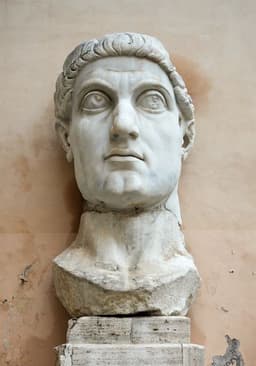
Constantine the Great
Emperor · Ancient
75.5Total

Theodoric the Great
Emperor · Ancient
61.5Total
Basic Information
Born
272
454
Died
337
526
Era
Ancient
Ancient
Nationality
Roman Empire
Ostrogothic Kingdom
Occupation
Emperor
Emperor
Civilization
Western
Western
Score Comparison
Military (10%)
78.0
74.7
Political (20%)
82.0
59.3
Influence (20%)
75.0
62.0
Legacy (20%)
70.0
52.0
Leadership (15%)
80.0
72.0
Strategy (15%)
72.0
58.0
TOTAL
75.5
61.5
Constantine the Great — Complete Timeline
312 AD
Battle of the Milvian BridgeWar◆ Major
Constantine defeated his rival Maxentius at the Milvian Bridge near Rome. According to tradition, Constantine saw a vision of a cross in the sky with the words 'In this sign, conquer.' The victory made Constantine the sole ruler of the Western Roman Empire and led to his conversion to Christianity.
Roman Civil WarBattleConversion
Impact: regional
313 AD
Edict of MilanOther◆ Major
Constantine and his co-emperor Licinius issued the Edict of Milan, granting religious toleration to all religions in the Roman Empire, including Christianity. The edict ended the persecution of Christians, restored confiscated church property, and established Christianity as a legally recognized religion.
Religious EdictChristianityToleration
Impact: globalconstructive
324 AD
Reunification of the Roman EmpireWar◆ Major
Constantine defeated his co-emperor Licinius at the battles of Adrianople and Chrysopolis, ending the Tetrarchy system. He became the sole ruler of the entire Roman Empire, reuniting the Western and Eastern halves under his control. This reunification was the last time the Roman Empire was united under a single ruler.
Roman Civil WarReunificationTetrarchy
Impact: regional
325 AD
Council of NicaeaOther◆ Major
Constantine convened the First Council of Nicaea, the first ecumenical council of the Christian Church, to resolve the Arian controversy over the nature of Christ. The council produced the Nicene Creed, affirming the divinity of Christ and establishing a unified Christian doctrine. Constantine presided over the council.
Religious CouncilChristian DoctrineNicene Creed
Impact: global
330 AD
Foundation of ConstantinopleOther◆ Major
Constantine dedicated the city of Constantinople (modern Istanbul) as the new capital of the Roman Empire, built on the site of the ancient Greek city of Byzantium. The city was strategically located on the Bosporus strait, controlling trade routes between Europe and Asia. It became the capital of the Eastern Roman Empire for over a thousand years.
City FoundationCapitalByzantine Empire
Impact: globalconstructive
Theodoric the Great — Complete Timeline
493 AD
Conquest of ItalyWar◆ Major
Theodoric the Great led the Ostrogoths in conquering Italy from Odoacer. He defeated Odoacer in several battles and eventually besieged Ravenna. Theodoric tricked Odoacer into a truce and then murdered him, establishing the Ostrogothic Kingdom of Italy.
ConquestOstrogothsItaly
Impact: regional
Establishment of the Ostrogothic KingdomPolitical Action◆ Major
Theodoric established the Ostrogothic Kingdom in Italy with its capital at Ravenna. He maintained Roman administrative structures and laws while ruling as a Gothic king. His reign brought stability and prosperity to Italy, blending Roman and Gothic cultures.
KingdomItalyGothic Rule
Impact: regionalconstructive
500 AD
Promotion of Roman-Gothic CoexistenceReform◆ Major
Theodoric promoted coexistence between Romans and Goths, allowing Romans to keep their laws and institutions. He appointed Romans to high offices and supported the Roman Senate. This policy maintained stability and preserved Roman culture in Italy.
CoexistenceRomanGothic
Impact: regionalconstructive
524 AD
Execution of BoethiusPolitical Action◆ Major
Theodoric ordered the execution of the philosopher Boethius on charges of treason. Boethius had been a high-ranking official and was suspected of conspiring with the Byzantine Empire. This event tarnished Theodoric's reputation as a just ruler and highlighted tensions between Romans and Goths.
ExecutionBoethiusTreason
Impact: regionaltragic
Expert Analysis
Origins
Constantine the Great was born in 272 AD in Naissus (modern Niš, Serbia) to Flavius Constantius, a Roman army officer, and Helena, a woman of humble origins. His father became Caesar (junior emperor) in the West, and Constantine grew up in the imperial court of Diocletian, receiving a military education. He served under Diocletian and Galerius, gaining firsthand experience in Roman administration and warfare.
Theodoric the Great was born around 454 AD in Pannonia (modern Hungary/Croatia) to Theodemir, king of the Ostrogoths, and Ereleuva. Theodoric was sent as a hostage to Constantinople at age 7, where he lived for 10 years, learning Roman language, military tactics, and governance. This exposure to both Gothic and Roman cultures shaped his later rule.
Rise to Power
Constantine rose to power after his father's death in 306 AD, when troops proclaimed him emperor. He spent the next 18 years consolidating control, defeating rivals like Maxentius at the Milvian Bridge in 312 AD and later Licinius in 324 AD. His victory at the Milvian Bridge, where he reportedly saw a vision of a cross, marked a turning point. By 324, Constantine became sole emperor of a reunified Roman Empire.
Theodoric became king of the Ostrogoths in 471 AD. He initially allied with the Eastern Roman emperor Zeno, who commissioned him to invade Italy and depose Odoacer in 488 AD. Theodoric defeated Odoacer at the Battle of the Isonzo and the Battle of Verona, then besieged Ravenna. In 493, he killed Odoacer with his own hands, establishing the Ostrogothic Kingdom of Italy.
Leadership & Governance
Constantine centralized Roman administration, reformed the currency, and created a new imperial capital at Constantinople in 330 AD. He legalized Christianity through the Edict of Milan in 313 AD, convening the Council of Nicaea in 325 AD to unify doctrine. His governance emphasized unity under imperial authority, blending Roman traditions with Christian support. Constantine scored 80.0 in leadership, reflecting his ability to command loyalty and implement lasting changes.
Theodoric maintained Roman administrative structures and laws, appointing Romans like Cassiodorus and Boethius to high offices. He promoted coexistence between Goths and Romans, allowing separate legal systems. However, his rule lacked the institutional reforms of Constantine. Theodoric's political score of 59.3 indicates weaker statecraft; his later years saw growing tensions, leading to the execution of Boethius in 524 AD, which damaged his reputation.
Triumph & Tragedy
Constantine's greatest triumph was the reunification of the Roman Empire and the foundation of Constantinople, which endured as a capital for over a millennium. His legalization of Christianity fundamentally altered the religious landscape. However, his reign also saw the execution of his son Crispus and wife Fausta in 326 AD, a family tragedy that stained his legacy. His military score of 78.0 reflects victories but also costly civil wars.
Theodoric's triumph was establishing a stable Gothic kingdom in Italy that maintained Roman culture. He built impressive structures in Ravenna and Verona. His tragedy was the breakdown of Roman-Gothic trust in his later years, culminating in the persecution of Romans and the execution of Boethius, a philosopher whose works like 'The Consolation of Philosophy' became classics. Theodoric's military score of 74.7 shows competent generalship but less impact than Constantine's.
Character & Destiny
Constantine was pragmatic and ambitious, using religion as a political tool. His vision at the Milvian Bridge, whether genuine or crafted, illustrates his ability to harness belief for power. He was ruthless in eliminating rivals, including family, but also sought to create a unified empire. His character combined strategic calculation with a genuine interest in Christianity's organizational potential.
Theodoric was more conservative, aiming to preserve Roman institutions rather than transform them. His hostage experience gave him a dual perspective, but he ultimately failed to integrate Goths and Romans. His execution of Boethius, likely based on suspicion, suggests paranoia in his later years. Historians assess Theodoric as a capable ruler who lacked Constantine's visionary scope.
Legacy
Constantine's legacy is immense: Christianity became the dominant religion of Europe, Constantinople became the heart of the Byzantine Empire for 1,000 years, and his reforms influenced medieval governance. His legacy score of 70.0 understates his impact; he reshaped Western civilization. The Nicene Creed and the Edict of Milan are lasting monuments.
Theodoric's legacy is more limited. The Ostrogothic Kingdom fell after his death in 526 AD during the Gothic War (535-554 AD). His attempts at Roman-Gothic coexistence left few enduring institutions. He is remembered as a 'barbarian' ruler who admired Rome but could not preserve it. His influence score of 62.0 reflects his regional and temporal limitations.
Conclusion
Constantine the Great had a greater historical impact than Theodoric the Great. Constantine's total score of 75.5 against Theodoric's 61.5 reflects this. Constantine transformed the Roman Empire and Christianity, creating foundations that shaped the Middle Ages and beyond. Theodoric, while a competent ruler, presided over a fragile kingdom that collapsed within a generation. Constantine's reforms endured; Theodoric's did not. The evidence supports Constantine as the more consequential figure.
Rankings
🥇
Constantine the GreatLeader
Mil: 78.0Pol: 82.0Inf: 75.0
75.5
🥈
Theodoric the Great
Mil: 74.7Pol: 59.3Inf: 62.0
61.5
+14.0 behind
How This Comparison Works
Algorithm
Each figure is scored on 6 dimensions (0—100 scale) based on structured historical data: Military (10%), Political (20%), Influence (20%), Legacy (20%), Leadership (15%), Strategy (15%). The weighted total produces the final ranking.
Data Sources
Scores are computed from structured sub-indicators in the database. Scale factors adjust for era (Ancient ×0.85, Modern ×1.0) and civilization size (Eastern ×1.05, Other ×0.80) to account for differences in population and military scale.
Maximum 3 Figures
Comparisons are limited to 2—3 figures to ensure readability and statistical meaningfulness.
Error Margins
±5 points per dimension — Sub-scores are derived from historical records with inherent uncertainty. Two figures within 5 points on a dimension should be considered roughly equivalent in that area.
Total Score Accuracy
±3 points overall — The weighted combination of 6 dimensions produces a total score with approximately ±3 points of uncertainty. Differences of less than 3 points are not statistically significant— the figures are effectively tied.
Known Limitations
- Historical records are incomplete and uneven across civilizations
- Figures from oral-tradition societies may be underrepresented
- Occupation labels can misclassify multi-role figures
- Scores measure capability and impact, not moral character
- Quantitative scoring is a comparison tool, not absolute truth
Capability Radar
Military (10%) — Battles & Warfare
Battles
85
70
Win Rate
80
75
Expansion
85
65
Political (20%) — Governance & Reform
Reform
95
75
Diplomacy
90
80
Economy
80
70
Influence (20%) — Cultural & Global Reach
Cultural
95
60
Global
95
50
Legacy (20%) — Historical Impact
Historical
95
65
Longevity
95
55
Leadership (15%) — Power & Stability
Tenure
85
80
Stability
70
65
Strategy (15%) — Tactics & Innovation
Strategy
85
70
Tactics
75
65
Reform
90
60
Similar Comparisons
Comments & Discussion
No comments yet. Be the first to share your thoughts!