Loading...
Constantine the Great vs Napoleon Bonaparte
Constantine the Great leads by 4.6 pts · 2 figures compared
…
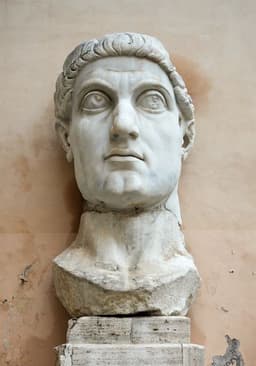
Constantine the Great
Emperor · Ancient
75.5Total

Napoleon Bonaparte
General · Modern
70.9Total
Basic Information
Born
272
1769
Died
337
1821
Era
Ancient
Modern
Nationality
Roman Empire
France
Occupation
Emperor
General
Civilization
Western
Western
Score Comparison
Military (10%)
78.0
94.0
Political (20%)
82.0
72.0
Influence (20%)
75.0
40.0
Legacy (20%)
70.0
80.0
Leadership (15%)
80.0
78.0
Strategy (15%)
72.0
90.0
TOTAL
75.5
70.9
Constantine the Great — Complete Timeline
312 AD
Battle of the Milvian BridgeWar◆ Major
Constantine defeated his rival Maxentius at the Milvian Bridge near Rome. According to tradition, Constantine saw a vision of a cross in the sky with the words 'In this sign, conquer.' The victory made Constantine the sole ruler of the Western Roman Empire and led to his conversion to Christianity.
Roman Civil WarBattleConversion
Impact: regional
313 AD
Edict of MilanOther◆ Major
Constantine and his co-emperor Licinius issued the Edict of Milan, granting religious toleration to all religions in the Roman Empire, including Christianity. The edict ended the persecution of Christians, restored confiscated church property, and established Christianity as a legally recognized religion.
Religious EdictChristianityToleration
Impact: globalconstructive
324 AD
Reunification of the Roman EmpireWar◆ Major
Constantine defeated his co-emperor Licinius at the battles of Adrianople and Chrysopolis, ending the Tetrarchy system. He became the sole ruler of the entire Roman Empire, reuniting the Western and Eastern halves under his control. This reunification was the last time the Roman Empire was united under a single ruler.
Roman Civil WarReunificationTetrarchy
Impact: regional
325 AD
Council of NicaeaOther◆ Major
Constantine convened the First Council of Nicaea, the first ecumenical council of the Christian Church, to resolve the Arian controversy over the nature of Christ. The council produced the Nicene Creed, affirming the divinity of Christ and establishing a unified Christian doctrine. Constantine presided over the council.
Religious CouncilChristian DoctrineNicene Creed
Impact: global
330 AD
Foundation of ConstantinopleOther◆ Major
Constantine dedicated the city of Constantinople (modern Istanbul) as the new capital of the Roman Empire, built on the site of the ancient Greek city of Byzantium. The city was strategically located on the Bosporus strait, controlling trade routes between Europe and Asia. It became the capital of the Eastern Roman Empire for over a thousand years.
City FoundationCapitalByzantine Empire
Impact: globalconstructive
Napoleon Bonaparte — Complete Timeline
1799 AD
Coup of 18 BrumaireOther◆ Major
Napoleon Bonaparte, with support from his brother Lucien and key political figures, overthrew the Directory in a bloodless coup. He established the Consulate with himself as First Consul, effectively becoming the ruler of France. This event ended the French Revolution's most unstable period.
French RevolutionCoupRise to Power
Impact: regional
1804 AD
Promulgation of the Napoleonic CodeOther◆ Major
Napoleon enacted the Civil Code of the French, known as the Napoleonic Code, a comprehensive set of laws that replaced the fragmented feudal legal systems. The code established legal equality, protected property rights, and secularized law. It became the basis for legal systems in many European and world countries.
Legal ReformNapoleonic CodeCivil Law
Impact: globalconstructive
1805 AD
Battle of AusterlitzWar◆ Major
Napoleon's Grande Arm
Napoleonic WarsBattleDecisive Victory
Impact: global
1812 AD
Invasion of RussiaWar◆ Major
Napoleon led the Grande Arm
Napoleonic WarsInvasionDisaster
Impact: globaldestructive
1815 AD
Battle of WaterlooWar◆ Major
Napoleon's French army was defeated by the combined forces of the Duke of Wellington's Anglo-Allied army and Gebhard Leberecht von Bl
Napoleonic WarsBattleFinal Defeat
Impact: globaldestructive
Expert Analysis
constantine-the-great-vs-napoleon-bonaparte
# The Emperor and the General: Constantine and Napoleon, Two Architects of Western Destiny
On a cold December morning in 1804, Napoleon Bonaparte placed a crown upon his own head in Notre-Dame Cathedral, signaling to the world that his authority came from no pope, no king, but from his own will alone. Thirteen centuries earlier, in the summer of 312, another ambitious commander marched toward Rome, and on the eve of battle at the Milvian Bridge, he reportedly saw a cross of light in the sky with the words “In this sign, conquer.” Constantine the Great and Napoleon Bonaparte—two men who reshaped the Western world, yet whose paths, personalities, and destinies could hardly have been more different. One built an empire that would endure for a thousand years; the other built one that collapsed in a single generation. Why?
Origins
Constantine was born in 272 in Naissus, modern-day Serbia, to a Roman army officer who would later become Emperor Constantius Chlorus. His mother, Helena, was a woman of humble birth—traditionally said to be a stable maid. This mixed heritage gave Constantine a foot in two worlds: the brutal, meritocratic world of the Roman military and the fading aristocratic traditions of the old empire. He grew up in the court of Emperor Diocletian, watching a system of four emperors—the Tetrarchy—try to hold a sprawling realm together. He learned early that power was a thing to be seized, not inherited.
Napoleon, born in 1769 on the island of Corsica, came from a minor Italian noble family that had recently submitted to French rule. His father, Carlo Bonaparte, was a shrewd lawyer who navigated the shifting allegiances of Corsican politics. Young Napoleon was sent to military school in mainland France, where he was mocked for his Corsican accent and small stature. He devoured books on military history and the Enlightenment philosophers—Rousseau, Voltaire, Montesquieu. Where Constantine learned the art of command in camps and on battlefields, Napoleon learned it in classrooms and libraries. One was shaped by the discipline of Rome, the other by the ambition of the French Revolution.
Rise to Power
Constantine’s rise was a family drama written in blood. When his father died in 306 at York, the troops immediately proclaimed Constantine emperor—a risky move in a system designed to prevent dynastic succession. For the next six years, he maneuvered among rival emperors, forming alliances and breaking them. The decisive moment came in 312, when he marched on Rome to face Maxentius. The vision of the cross—whether genuine vision, political calculation, or both—gave Constantine a divine mandate that no rival could match. He defeated Maxentius at the Milvian Bridge and entered Rome as its master.
Napoleon’s rise was a revolution’s chaos crystallized into ambition. In 1793, at age twenty-four, he drove the British out of Toulon with a brilliant artillery plan. Two years later, he saved the revolutionary government by firing grapeshot into a Parisian mob—the “whiff of grapeshot” that made his name. Then came Italy: in 1796, he led a poorly supplied army across the Alps and smashed the Austrians in a campaign of breathtaking speed. He was not yet thirty, and he was already the most famous man in France. In 1799, he staged a coup and made himself First Consul. By 1804, he was emperor.
Leadership & Governance
Constantine ruled as a Roman emperor, but he understood that the empire could not survive on force alone. He legalized Christianity in 313 with the Edict of Milan, not because he was necessarily a devout convert, but because he saw that the old pagan gods could no longer bind a fractured empire together. Christianity offered a universal faith for a universal empire. He convened the Council of Nicaea in 325 to settle doctrinal disputes, inserting the state into the church’s business—a precedent that would shape Europe for centuries. He also reformed the currency, strengthened the borders, and founded a new capital: Constantinople, a “New Rome” on the Bosporus, strategically placed where Europe meets Asia.
Napoleon, too, understood the power of institutions. His Napoleonic Code—a comprehensive system of civil law—abolished feudalism, protected property rights, and established equality before the law. It was, in many ways, the Enlightenment made into legislation. He also centralized education, created the Bank of France, and built roads and canals. But his governance was inseparable from his wars. He was a military genius—his scores of 94 in military and 93 in strategy reflect a mind that could read a battlefield like a chessboard. Austerlitz in 1805 was his masterpiece: he lured the Austrians and Russians into a trap and crushed them. Yet he could never stop conquering. He once said, “Power is my mistress. I have worked too hard at her conquest to allow anyone to take her from me.”
Triumph & Tragedy
Constantine’s greatest triumph was the Council of Nicaea, where he presided over bishops from across the empire and forged a unified Christian doctrine. His greatest tragedy was perhaps his family: he executed his eldest son, Crispus, and his wife, Fausta, in a series of murky events that still puzzle historians. He died in 337, on his way to fight the Persians, having been baptized only on his deathbed. He left an empire transformed but still fragile.
Napoleon’s triumph was his empire at its height in 1810, when he controlled most of Europe from Spain to Poland. His tragedy was the invasion of Russia in 1812. He marched 600,000 men into the vastness of the east; fewer than 100,000 came back. The disaster broke his aura of invincibility. Exiled to Elba in 1814, he escaped, raised another army, and met his final defeat at Waterloo in 1815. He died in 1821 on Saint Helena, a British prisoner, writing memoirs that would shape his legend.
Character & Destiny
Constantine was calculating, patient, and deeply pragmatic. He saw that the future belonged to the Christians, and he bet on them. He was ruthless when necessary—he executed his own son—but he built for permanence. His personality was that of a builder, not a conqueror.
Napoleon was restless, brilliant, and insatiable. He once wrote, “Glory is fleeting, but obscurity is forever.” He could not stop. Every victory demanded another. His personality was that of a gambler who kept doubling down. He scored 80 in leadership against Constantine’s 85, and 75 in politics against Constantine’s 85—reflecting a man who could win battles but could not govern peace.
Legacy
Constantine’s legacy is the Christianization of Europe, the foundation of Constantinople, and the fusion of church and state that would dominate the Middle Ages. His total score of 79.0 understates his influence: without him, the history of Christianity—and of Europe—would be unrecognizable.
Napoleon’s legacy is the modern state: the legal code, the centralized administration, the idea of careers open to talent. His total score of 82.4 reflects his military brilliance and lasting influence. But his empire died with him. He once said, “There are only two forces in the world: the sword and the spirit. In the long run, the sword will always be conquered by the spirit.” Constantine understood that; Napoleon did not.
Conclusion
Standing at the ends of their lives, both men could look back on worlds they had remade. Constantine, dying in his palace at Nicomedia, had built a capital that would stand for a millennium. Napoleon, dying on a remote island in the South Atlantic, had built a legend that would never fade. One founded an empire that outlasted him; the other founded a myth that outshone his defeat. The difference between them is the difference between the builder and the conqueror—the man who plants a tree and the man who sets a fire. Both change the landscape, but only one leaves something that can grow.
Rankings
🥇
Constantine the GreatLeader
Mil: 78.0Pol: 82.0Inf: 75.0
75.5
🥈
Napoleon Bonaparte
Mil: 94.0Pol: 72.0Inf: 40.0
70.9
+4.6 behind
How This Comparison Works
Algorithm
Each figure is scored on 6 dimensions (0—100 scale) based on structured historical data: Military (10%), Political (20%), Influence (20%), Legacy (20%), Leadership (15%), Strategy (15%). The weighted total produces the final ranking.
Data Sources
Scores are computed from structured sub-indicators in the database. Scale factors adjust for era (Ancient ×0.85, Modern ×1.0) and civilization size (Eastern ×1.05, Other ×0.80) to account for differences in population and military scale.
Maximum 3 Figures
Comparisons are limited to 2—3 figures to ensure readability and statistical meaningfulness.
Error Margins
±5 points per dimension — Sub-scores are derived from historical records with inherent uncertainty. Two figures within 5 points on a dimension should be considered roughly equivalent in that area.
Total Score Accuracy
±3 points overall — The weighted combination of 6 dimensions produces a total score with approximately ±3 points of uncertainty. Differences of less than 3 points are not statistically significant— the figures are effectively tied.
Known Limitations
- Historical records are incomplete and uneven across civilizations
- Figures from oral-tradition societies may be underrepresented
- Occupation labels can misclassify multi-role figures
- Scores measure capability and impact, not moral character
- Quantitative scoring is a comparison tool, not absolute truth
Capability Radar
Military (10%) — Battles & Warfare
Battles
85
95
Win Rate
80
90
Expansion
85
95
Political (20%) — Governance & Reform
Reform
95
95
Diplomacy
90
80
Economy
80
85
Influence (20%) — Cultural & Global Reach
Cultural
95
85
Global
95
90
Legacy (20%) — Historical Impact
Historical
95
95
Longevity
95
90
Leadership (15%) — Power & Stability
Tenure
85
85
Stability
70
70
Strategy (15%) — Tactics & Innovation
Strategy
85
95
Tactics
75
98
Reform
90
92
Similar Comparisons
Comments & Discussion
No comments yet. Be the first to share your thoughts!