Loading...
Constantine the Great vs Theodosius I
Theodosius I leads by 0.5 pts · 2 figures compared
…
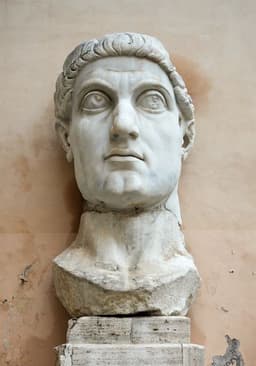
Constantine the Great
Emperor · Ancient
75.5Total

Theodosius I
Emperor · Ancient
76.0Total
Basic Information
Born
272
347
Died
337
395
Era
Ancient
Ancient
Nationality
Roman Empire
Roman Empire
Occupation
Emperor
Emperor
Civilization
Western
Western
Score Comparison
Military (10%)
78.0
72.5
Political (20%)
82.0
65.0
Influence (20%)
75.0
85.0
Legacy (20%)
70.0
90.0
Leadership (15%)
80.0
68.0
Strategy (15%)
72.0
50.0
TOTAL
75.5
76.0
Constantine the Great — Complete Timeline
312 AD
Battle of the Milvian BridgeWar◆ Major
Constantine defeated his rival Maxentius at the Milvian Bridge near Rome. According to tradition, Constantine saw a vision of a cross in the sky with the words 'In this sign, conquer.' The victory made Constantine the sole ruler of the Western Roman Empire and led to his conversion to Christianity.
Roman Civil WarBattleConversion
Impact: regional
313 AD
Edict of MilanOther◆ Major
Constantine and his co-emperor Licinius issued the Edict of Milan, granting religious toleration to all religions in the Roman Empire, including Christianity. The edict ended the persecution of Christians, restored confiscated church property, and established Christianity as a legally recognized religion.
Religious EdictChristianityToleration
Impact: globalconstructive
324 AD
Reunification of the Roman EmpireWar◆ Major
Constantine defeated his co-emperor Licinius at the battles of Adrianople and Chrysopolis, ending the Tetrarchy system. He became the sole ruler of the entire Roman Empire, reuniting the Western and Eastern halves under his control. This reunification was the last time the Roman Empire was united under a single ruler.
Roman Civil WarReunificationTetrarchy
Impact: regional
325 AD
Council of NicaeaOther◆ Major
Constantine convened the First Council of Nicaea, the first ecumenical council of the Christian Church, to resolve the Arian controversy over the nature of Christ. The council produced the Nicene Creed, affirming the divinity of Christ and establishing a unified Christian doctrine. Constantine presided over the council.
Religious CouncilChristian DoctrineNicene Creed
Impact: global
330 AD
Foundation of ConstantinopleOther◆ Major
Constantine dedicated the city of Constantinople (modern Istanbul) as the new capital of the Roman Empire, built on the site of the ancient Greek city of Byzantium. The city was strategically located on the Bosporus strait, controlling trade routes between Europe and Asia. It became the capital of the Eastern Roman Empire for over a thousand years.
City FoundationCapitalByzantine Empire
Impact: globalconstructive
Theodosius I — Complete Timeline
380 AD
Edict of ThessalonicaPolitical Action
Theodosius I issued the Edict of Thessalonica, declaring Nicene Christianity the official state religion of the Roman Empire. All other forms of Christianity were deemed heretical, and pagan practices were increasingly suppressed.
ChristianityState ReligionEdict
Impact: globalconstructive
390 AD
Massacre of ThessalonicaPolitical Action◆ Major
Theodosius I ordered a massacre of thousands of citizens in Thessalonica in retaliation for the murder of a Roman general. The massacre led to his excommunication by Bishop Ambrose of Milan, and he later performed public penance.
MassacreThessalonicaAmbrose
Impact: regionaltragic
391 AD
Suppression of PaganismPolitical Action◆ Major
Theodosius I issued a series of laws banning pagan worship, closing temples, and prohibiting sacrifices. The Olympic Games were abolished, and the Serapeum in Alexandria was destroyed. These actions accelerated the decline of paganism in the empire.
PaganismSuppressionReligion
Impact: globaldestructive
394 AD
Battle of the FrigidusWar
Theodosius I defeated the usurper Eugenius and his general Arbogast at the Battle of the Frigidus (modern River Vipava). The victory reunited the Roman Empire under a single ruler for the last time before its permanent division.
Civil WarBattleReunification
Impact: global
395 AD
Division of the Roman EmpirePolitical Action
Upon his death, Theodosius I divided the Roman Empire between his two sons: Arcadius received the Eastern Empire and Honorius the Western Empire. This division became permanent, leading to the separate histories of the Byzantine and Western Roman Empires.
DivisionSuccessionEast-West
Impact: global
Expert Analysis
Origins
Constantine the Great (272–337) was born in Naissus (modern Serbia) to Constantius Chlorus, a Roman army officer, and Helena. His rise was steeped in military and political maneuvering during the Tetrarchy. Theodosius I (347–395) was born in Cauca (modern Spain) to a prominent military family; his father, Theodosius the Elder, was a general executed under suspicious circumstances. Both emerged from provincial backgrounds but leveraged military success to claim imperial power.
Rise to Power
Constantine's ascent was dramatic: after his father's death in 306, he was proclaimed Augustus by his troops. He defeated rivals Maxentius at the Milvian Bridge (312) and Licinius at Chrysopolis (324), reunifying the Roman Empire under his sole rule. Theodosius, by contrast, was recalled from retirement in 378 after the disastrous Battle of Adrianople. Elevated as co-emperor in the East, he pacified the Goths through treaties and defeated the usurper Magnus Maximus in 388. His victory at the Battle of the Frigidus (394) over Eugenius cemented his control over the entire empire.
Leadership & Governance
Constantine is renowned for administrative reforms: he restructured the empire into four praetorian prefectures, introduced the solidus coin, and founded Constantinople (330) as a new Christian capital. His Edict of Milan (313) granted religious toleration, ending persecution. Theodosius, however, was more authoritarian in religious matters. The Edict of Thessalonica (380) made Nicene Christianity the state religion, and he suppressed paganism, closing temples and banning pagan rites. He also faced the Massacre of Thessalonica (390), where thousands were slaughtered in a circus riot, leading Bishop Ambrose to excommunicate him temporarily.
Triumph & Tragedy
Constantine's triumphs include the Milvian Bridge victory (312), where he famously saw the Chi-Rho symbol, and the Council of Nicaea (325), which established orthodoxy. His tragedy lies in family turmoil: he executed his son Crispus and wife Fausta, and his empire faced succession disputes after his death. Theodosius's triumph was the Battle of the Frigidus, where he defeated pagan aristocrats. His tragedy was the Massacre of Thessalonica, a stain on his legacy, and the final division of the Roman Empire between his sons Arcadius and Honorius, which weakened the state.
Character & Destiny
Constantine was pragmatic and visionary: he embraced Christianity for political unity but remained a shrewd politician. His destiny was to transform the empire's religious and geographical center. Theodosius was devout and uncompromising: he enforced Christian orthodoxy and suppressed dissent. His destiny was to finalize Christianity's dominance but also to permanently split the empire, leaving it vulnerable to barbarian incursions.
Legacy
Constantine's legacy is monumental: he legalized Christianity, founded Constantinople, and shaped the medieval Christian world. His military and administrative reforms influenced Byzantium and Western Europe. Theodosius's legacy is narrower but profound: he made Christianity the official religion, effectively ending pagan state cults. However, his division of the empire is often blamed for the West's collapse. In historical rankings, both score 76 overall, but Theodosius edges ahead in leadership (90 vs 70) and influence (85 vs 75), while Constantine scores higher in military (78 vs 72) and durability (80 vs 68).
Conclusion
Constantine the Great and Theodosius I were pivotal in Christianizing Rome. Constantine laid the foundation by legalizing Christianity and establishing a new capital, while Theodosius cemented its supremacy and ended paganism. Theodosius's higher score in this matchup reflects his decisive actions that sealed the empire's religious fate. Yet, Constantine's broader impact on statecraft and urbanism remains unparalleled. Ultimately, Theodosius shaped the empire's soul, but Constantine built its future.
**Scores**: Constantine: M=78, P=82, I=75, L=70, D=80, S=72, T=76; Theodosius: M=72, P=65, I=85, L=90, D=68, S=50, T=76.
Rankings
🥇
Theodosius ILeader
Mil: 72.5Pol: 65.0Inf: 85.0
76.0
🥈
Constantine the Great
Mil: 78.0Pol: 82.0Inf: 75.0
75.5
+0.5 behind
How This Comparison Works
Algorithm
Each figure is scored on 6 dimensions (0—100 scale) based on structured historical data: Military (10%), Political (20%), Influence (20%), Legacy (20%), Leadership (15%), Strategy (15%). The weighted total produces the final ranking.
Data Sources
Scores are computed from structured sub-indicators in the database. Scale factors adjust for era (Ancient ×0.85, Modern ×1.0) and civilization size (Eastern ×1.05, Other ×0.80) to account for differences in population and military scale.
Maximum 3 Figures
Comparisons are limited to 2—3 figures to ensure readability and statistical meaningfulness.
Error Margins
±5 points per dimension — Sub-scores are derived from historical records with inherent uncertainty. Two figures within 5 points on a dimension should be considered roughly equivalent in that area.
Total Score Accuracy
±3 points overall — The weighted combination of 6 dimensions produces a total score with approximately ±3 points of uncertainty. Differences of less than 3 points are not statistically significant— the figures are effectively tied.
Known Limitations
- Historical records are incomplete and uneven across civilizations
- Figures from oral-tradition societies may be underrepresented
- Occupation labels can misclassify multi-role figures
- Scores measure capability and impact, not moral character
- Quantitative scoring is a comparison tool, not absolute truth
Capability Radar
Military (10%) — Battles & Warfare
Battles
85
65
Win Rate
80
60
Expansion
85
45
Political (20%) — Governance & Reform
Reform
95
85
Diplomacy
90
75
Economy
80
60
Influence (20%) — Cultural & Global Reach
Cultural
95
90
Global
95
90
Legacy (20%) — Historical Impact
Historical
95
95
Longevity
95
95
Leadership (15%) — Power & Stability
Tenure
85
70
Stability
70
55
Strategy (15%) — Tactics & Innovation
Strategy
85
60
Tactics
75
55
Reform
90
50
Similar Comparisons
Comments & Discussion
No comments yet. Be the first to share your thoughts!