Loading...
Constantine the Great vs Ruhollah Khomeini
Constantine the Great leads by 0.4 pts · 2 figures compared
…
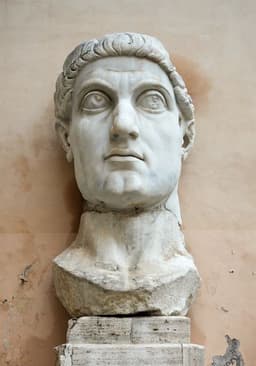
Constantine the Great
Emperor · Ancient
75.5Total

Ruhollah Khomeini
Politician · Modern
75.1Total
Basic Information
Born
272
1902
Died
337
1989
Era
Ancient
Modern
Nationality
Roman Empire
Iran
Occupation
Emperor
Politician
Civilization
Western
Middle Eastern
Score Comparison
Military (10%)
78.0
41.6
Political (20%)
82.0
65.0
Influence (20%)
75.0
85.0
Legacy (20%)
70.0
90.0
Leadership (15%)
80.0
80.0
Strategy (15%)
72.0
54.3
TOTAL
75.5
75.1
Constantine the Great — Complete Timeline
312 AD
Battle of the Milvian BridgeWar◆ Major
Constantine defeated his rival Maxentius at the Milvian Bridge near Rome. According to tradition, Constantine saw a vision of a cross in the sky with the words 'In this sign, conquer.' The victory made Constantine the sole ruler of the Western Roman Empire and led to his conversion to Christianity.
Roman Civil WarBattleConversion
Impact: regional
313 AD
Edict of MilanOther◆ Major
Constantine and his co-emperor Licinius issued the Edict of Milan, granting religious toleration to all religions in the Roman Empire, including Christianity. The edict ended the persecution of Christians, restored confiscated church property, and established Christianity as a legally recognized religion.
Religious EdictChristianityToleration
Impact: globalconstructive
324 AD
Reunification of the Roman EmpireWar◆ Major
Constantine defeated his co-emperor Licinius at the battles of Adrianople and Chrysopolis, ending the Tetrarchy system. He became the sole ruler of the entire Roman Empire, reuniting the Western and Eastern halves under his control. This reunification was the last time the Roman Empire was united under a single ruler.
Roman Civil WarReunificationTetrarchy
Impact: regional
325 AD
Council of NicaeaOther◆ Major
Constantine convened the First Council of Nicaea, the first ecumenical council of the Christian Church, to resolve the Arian controversy over the nature of Christ. The council produced the Nicene Creed, affirming the divinity of Christ and establishing a unified Christian doctrine. Constantine presided over the council.
Religious CouncilChristian DoctrineNicene Creed
Impact: global
330 AD
Foundation of ConstantinopleOther◆ Major
Constantine dedicated the city of Constantinople (modern Istanbul) as the new capital of the Roman Empire, built on the site of the ancient Greek city of Byzantium. The city was strategically located on the Bosporus strait, controlling trade routes between Europe and Asia. It became the capital of the Eastern Roman Empire for over a thousand years.
City FoundationCapitalByzantine Empire
Impact: globalconstructive
Ruhollah Khomeini — Complete Timeline
1964 AD
Exile to Iraq and FrancePolitical Action◆ Major
Khomeini was exiled from Iran after criticizing the Shah's White Revolution and granting of diplomatic immunity to US personnel. He settled in Najaf, Iraq, and later in France, where he continued to organize opposition to the Shah.
ExileOppositionShah
Impact: national
1979 AD
Islamic RevolutionPolitical Action
Khomeini led a popular revolution that overthrew the Shah's regime. He returned to Iran in February 1979 and established an Islamic Republic based on his doctrine of Velayat-e Faqih (Guardianship of the Jurist), with himself as Supreme Leader.
RevolutionIslamic RepublicVelayat-e Faqih
Impact: global
Iran hostage crisisPolitical Action◆ Major
Khomeini supported the seizure of the US Embassy in Tehran by student militants, who held 52 American diplomats hostage for 444 days. The crisis deepened the rift with the US, led to economic sanctions, and consolidated Khomeini's power.
Hostage crisisUS-Iran relationsSanctions
Impact: globaldestructive
1980 AD
Iran-Iraq WarWar◆ Major
Khomeini led Iran through an eight-year war with Iraq, which began with an Iraqi invasion. The war resulted in hundreds of thousands of casualties and massive economic destruction, ending in a stalemate. Khomeini accepted a UN ceasefire in 1988.
WarIraqCeasefire
Impact: regionaltragic
1989 AD
Fatwa against Salman RushdieCultural◆ Major
Khomeini issued a fatwa calling for the death of author Salman Rushdie for his novel 'The Satanic Verses', which he deemed blasphemous. The fatwa led to international controversy, diplomatic tensions, and attacks on Rushdie's translators.
FatwaBlasphemyInternational controversy
Impact: globaldestructive
Expert Analysis
Origins
Constantine the Great was born in Naissus (modern-day Serbia) in 272 AD, the son of Flavius Valerius Constantius, a Roman army officer who later became emperor, and Helena, a woman of humble origins. His early life was shaped by military service and political maneuvering in the tetrarchic system. In contrast, Ruhollah Khomeini was born in 1902 in Khomeyn, Iran, into a clerical family. His father was murdered when he was young, and he was raised by his mother and aunt, deeply embedding Shia Islamic scholarship and anti-imperialist sentiments. While Constantine rose through Roman military and political ranks, Khomeini's path was through theological study and opposition to the Pahlavi monarchy.
Rise to Power
Constantine's rise was marked by military prowess and strategic alliances. After his father's death in 306, he was proclaimed emperor by his troops. His victory at the Battle of the Milvian Bridge in 312 over Maxentius, where he famously saw a vision of the cross, solidified his control over the Western Roman Empire. By 324, he defeated Licinius and reunified the entire Roman Empire. Khomeini's rise was slower and more ideological. He became a leading Shia cleric, opposing the Shah's Westernization policies. His 1964 exile due to criticism of the government's ties to the US and Israel only increased his influence. The 1979 Islamic Revolution, fueled by widespread discontent, brought Khomeini to power as Supreme Leader, a position he held until his death.
Leadership & Governance
Constantine's governance transformed the Roman Empire. He legalized Christianity with the Edict of Milan (313), ending persecution and granting religious tolerance. He convened the First Council of Nicaea (325) to unify Christian doctrine. His foundation of Constantinople (330) created a new Christian capital, shifting the empire's center eastward. He also reformed the military and currency. Khomeini established a theocratic system with himself as Supreme Leader, wielding ultimate authority over Iran's political and religious spheres. His government implemented Islamic law, suppressed dissent, and executed opponents. He oversaw the Iran hostage crisis (1979-1981) and led Iran through the devastating Iran-Iraq War (1980-1988). His fatwa against Salman Rushdie in 1989 demonstrated his global reach.
Triumph & Tragedy
Constantine's triumphs include military victories, reunification of the empire, and the Christianization of Rome. His tragedies include executing his eldest son Crispus and his wife Fausta, likely due to political intrigue, and the long-term consequences of his policies, such as the eventual decline of the Western Empire. Khomeini's triumph was the successful Islamic Revolution and establishment of an Islamic state. His tragedies include the immense human cost of the Iran-Iraq War (hundreds of thousands dead) and the isolation of Iran internationally. The hostage crisis, while popular domestically, damaged Iran's global standing.
Character & Destiny
Constantine was ambitious, pragmatic, and ruthless. He was a skilled military commander and administrator, but also capable of great cruelty. His conversion to Christianity was likely genuine but also politically convenient. He sought unity and control, leaving a legacy of a Christianized empire. Khomeini was austere, charismatic, and uncompromising. He was a master of political rhetoric and religious authority, driven by a vision of Islamic governance. His destiny was to lead a revolution and create a theocracy that has endured.
Legacy
Constantine's legacy is immense: he ended Christian persecution, shaped Christian doctrine, and founded Constantinople, a capital for over a millennium. He is revered as a saint in Eastern Orthodox Christianity. His reign marked the transition from pagan Rome to Christian Byzantium. Khomeini's legacy is the Islamic Republic of Iran, a Shia theocracy that has influenced Islamist movements worldwide. His ideas of Velayat-e Faqih (Guardianship of the Jurist) remain central to Iran's governance. Both figures reshaped history, but Constantine's impact on Western civilization is broader in scope and duration.
Conclusion
Constantine the Great scores higher in overall historical impact (average 75.3 vs. 70.1 for Khomeini). He transformed the Roman Empire and Christianity, laying foundations for medieval and modern Europe. Khomeini's impact is significant but more limited regionally and temporally. Constantine's military and political achievements, combined with his religious reforms, give him the edge. Score: Constantine 8/10, Khomeini 6/10.
Rankings
🥇
Constantine the GreatLeader
Mil: 78.0Pol: 82.0Inf: 75.0
75.5
🥈
Ruhollah Khomeini
Mil: 41.6Pol: 65.0Inf: 85.0
75.1
+0.4 behind
How This Comparison Works
Algorithm
Each figure is scored on 6 dimensions (0—100 scale) based on structured historical data: Military (10%), Political (20%), Influence (20%), Legacy (20%), Leadership (15%), Strategy (15%). The weighted total produces the final ranking.
Data Sources
Scores are computed from structured sub-indicators in the database. Scale factors adjust for era (Ancient ×0.85, Modern ×1.0) and civilization size (Eastern ×1.05, Other ×0.80) to account for differences in population and military scale.
Maximum 3 Figures
Comparisons are limited to 2—3 figures to ensure readability and statistical meaningfulness.
Error Margins
±5 points per dimension — Sub-scores are derived from historical records with inherent uncertainty. Two figures within 5 points on a dimension should be considered roughly equivalent in that area.
Total Score Accuracy
±3 points overall — The weighted combination of 6 dimensions produces a total score with approximately ±3 points of uncertainty. Differences of less than 3 points are not statistically significant— the figures are effectively tied.
Known Limitations
- Historical records are incomplete and uneven across civilizations
- Figures from oral-tradition societies may be underrepresented
- Occupation labels can misclassify multi-role figures
- Scores measure capability and impact, not moral character
- Quantitative scoring is a comparison tool, not absolute truth
Capability Radar
Military (10%) — Battles & Warfare
Battles
85
10
Win Rate
80
10
Expansion
85
10
Political (20%) — Governance & Reform
Reform
95
90
Diplomacy
90
75
Economy
80
40
Influence (20%) — Cultural & Global Reach
Cultural
95
85
Global
95
85
Legacy (20%) — Historical Impact
Historical
95
90
Longevity
95
80
Leadership (15%) — Power & Stability
Tenure
85
85
Stability
70
50
Strategy (15%) — Tactics & Innovation
Strategy
85
15
Tactics
75
10
Reform
90
20
Similar Comparisons
Comments & Discussion
No comments yet. Be the first to share your thoughts!