Loading...
Constantine the Great vs John Churchill Duke of Marlborough
Constantine the Great leads by 0.1 pts · 2 figures compared
…
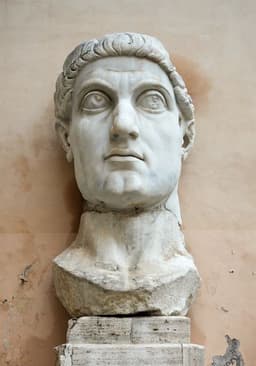
Constantine the Great
Emperor · Ancient
75.5Total

John Churchill Duke of Marlborough
General · Modern
75.4Total
Basic Information
Born
272
1650
Died
337
1722
Era
Ancient
Modern
Nationality
Roman Empire
England
Occupation
Emperor
General
Civilization
Western
Western
Score Comparison
Military (10%)
78.0
84.7
Political (20%)
82.0
78.0
Influence (20%)
75.0
65.0
Legacy (20%)
70.0
80.0
Leadership (15%)
80.0
78.0
Strategy (15%)
72.0
72.8
TOTAL
75.5
75.4
Constantine the Great — Complete Timeline
312 AD
Battle of the Milvian BridgeWar◆ Major
Constantine defeated his rival Maxentius at the Milvian Bridge near Rome. According to tradition, Constantine saw a vision of a cross in the sky with the words 'In this sign, conquer.' The victory made Constantine the sole ruler of the Western Roman Empire and led to his conversion to Christianity.
Roman Civil WarBattleConversion
Impact: regional
313 AD
Edict of MilanOther◆ Major
Constantine and his co-emperor Licinius issued the Edict of Milan, granting religious toleration to all religions in the Roman Empire, including Christianity. The edict ended the persecution of Christians, restored confiscated church property, and established Christianity as a legally recognized religion.
Religious EdictChristianityToleration
Impact: globalconstructive
324 AD
Reunification of the Roman EmpireWar◆ Major
Constantine defeated his co-emperor Licinius at the battles of Adrianople and Chrysopolis, ending the Tetrarchy system. He became the sole ruler of the entire Roman Empire, reuniting the Western and Eastern halves under his control. This reunification was the last time the Roman Empire was united under a single ruler.
Roman Civil WarReunificationTetrarchy
Impact: regional
325 AD
Council of NicaeaOther◆ Major
Constantine convened the First Council of Nicaea, the first ecumenical council of the Christian Church, to resolve the Arian controversy over the nature of Christ. The council produced the Nicene Creed, affirming the divinity of Christ and establishing a unified Christian doctrine. Constantine presided over the council.
Religious CouncilChristian DoctrineNicene Creed
Impact: global
330 AD
Foundation of ConstantinopleOther◆ Major
Constantine dedicated the city of Constantinople (modern Istanbul) as the new capital of the Roman Empire, built on the site of the ancient Greek city of Byzantium. The city was strategically located on the Bosporus strait, controlling trade routes between Europe and Asia. It became the capital of the Eastern Roman Empire for over a thousand years.
City FoundationCapitalByzantine Empire
Impact: globalconstructive
John Churchill Duke of Marlborough — Complete Timeline
1704 AD
Battle of BlenheimWar
Marlborough commanded the Anglo-Dutch army alongside Prince Eugene of Savoy against French and Bavarian forces at Blenheim. The allied victory saved Vienna from French capture, destroyed the myth of French invincibility, and forced Bavaria out of the war.
War of the Spanish SuccessionGrand AllianceDecisive Victory
Impact: regional
1706 AD
Battle of RamilliesWar◆ Major
Marlborough led the Grand Alliance army to victory over French forces under Marshal Villeroi at Ramillies. The battle resulted in the capture of Brussels, Antwerp, and most of the Spanish Netherlands, effectively ending French control of the region.
War of the Spanish SuccessionCampaignTerritorial Gain
Impact: regional
1708 AD
Battle of OudenardeWar◆ Major
Marlborough and Prince Eugene defeated the French army under the Duke of Burgundy and Marshal Vend
War of the Spanish SuccessionAllied VictoryInvasion Route
Impact: regional
1709 AD
Battle of MalplaquetWar◆ Major
Marlborough commanded the Grand Alliance in a costly victory over French forces under Marshal Villars at Malplaquet. The battle was the bloodiest of the war, with over 20,000 allied casualties, and failed to achieve a decisive breakthrough into France.
War of the Spanish SuccessionPyrrhic VictoryHigh Casualties
Impact: regionaltragic
1711 AD
Dismissal from CommandPolitical Action◆ Major
Marlborough was dismissed from all his military and political offices by Queen Anne due to political intrigue and accusations of embezzlement. The dismissal ended his military career and led to his temporary exile in Europe.
Political FallExileTory Government
Impact: nationaldestructive
Expert Analysis
Origins
Constantine the Great (272–337) was born in Naissus (modern Niš, Serbia) to Flavius Constantius, a Roman army officer, and Helena, a woman of humble origins. His father rose to become Caesar of the Western Roman Empire, and Constantine spent his youth at the court of Emperor Diocletian in the East, gaining military and administrative experience. In contrast, John Churchill, Duke of Marlborough (1650–1722), was born into a gentry family in Devon, England. His father, Sir Winston Churchill, was a Royalist during the English Civil War, and his mother, Elizabeth Drake, came from a prominent family. Marlborough began his career as a page at the court of King Charles II, then served in the military, rising through the ranks due to his skill and patronage. Both leaders emerged from modest backgrounds relative to their ultimate stations, but Constantine's imperial lineage gave him a direct path to power, while Marlborough relied on merit and court connections.
Rise to Power
Constantine's rise began when his father was promoted to Augustus in the West. Upon Constantius's death in 306, Constantine was proclaimed Augustus by his troops. He then fought a series of civil wars against rival claimants, culminating in the Battle of the Milvian Bridge in 312, where he defeated Maxentius. According to legend, Constantine saw a vision of a cross and the words "In hoc signo vinces" (In this sign you will conquer), leading him to embrace Christianity. He later defeated Licinius in 324, reunifying the Roman Empire. Marlborough's rise was more gradual. He distinguished himself in the Third Anglo-Dutch War and later in the Glorious Revolution, where he supported William of Orange. His military genius blossomed during the War of the Spanish Succession (1701–1714), where he led the Grand Alliance against France. His decisive victory at the Battle of Blenheim in 1704 broke French dominance and made him a national hero. Both men seized opportunities in times of crisis, with Constantine leveraging divine favor and military might, while Marlborough excelled through strategic brilliance and alliance management.
Leadership & Governance
Constantine's leadership transformed the Roman Empire. He legalized Christianity with the Edict of Milan (313), ending persecution and establishing religious tolerance. He convened the First Council of Nicaea (325) to unify Christian doctrine, and he founded Constantinople (modern Istanbul) as a new imperial capital, shifting the empire's center eastward. His reign saw administrative reforms, including the separation of civil and military authority, and economic stabilization through a new gold coinage. Marlborough's governance was primarily military and diplomatic. As Captain-General of the English forces, he coordinated multinational armies with skill, maintaining cohesion among allies with divergent interests. His campaigns were marked by meticulous logistics and bold tactics, but his political influence waned after Queen Anne's death and his dismissal from command in 1711. While Constantine reshaped the state and religion, Marlborough excelled in the operational theater, leaving less direct impact on governance.
Triumph & Tragedy
Constantine's triumphs include the reunification of the Roman Empire, the legalization of Christianity, and the foundation of Constantinople, which became a bastion of Christendom for a millennium. His tragedy lies in the execution of his eldest son, Crispus, and his wife, Fausta, under murky circumstances, tarnishing his reputation. Marlborough's greatest triumph was the Battle of Blenheim, a stunning victory that saved Vienna from French conquest. He also won major battles at Ramillies (1706), Oudenarde (1708), and Malplaquet (1709). His tragedy came after the war: he was dismissed from command in 1711 amid political intrigue, and he suffered a stroke in 1716, living out his final years in relative obscurity. Both faced personal losses, but Constantine's tragedies were self-inflicted, while Marlborough's were politically driven.
Character & Destiny
Constantine was ambitious, pragmatic, and visionary. He recognized the power of Christianity as a unifying force and used it to consolidate his rule. His conversion was gradual, and he remained Pontifex Maximus, balancing pagan and Christian traditions. Marlborough was charismatic, diplomatic, and strategically brilliant. He was also known for his avarice and political maneuvering, amassing great wealth and building Blenheim Palace. Destiny favored both: Constantine died of natural causes after a long reign, while Marlborough's legacy was revived after his death, with his victories seen as foundational to British global power. Constantine's destiny was to reshape the religious landscape of Europe, while Marlborough's was to establish British military prestige.
Legacy
Constantine's legacy is immense: he is revered as a saint in Eastern Orthodox Christianity, and his city, Constantinople, endured until 1453. The Edict of Milan and the Council of Nicaea shaped Christian theology and practice for centuries. Marlborough's legacy is more confined to military history. He is considered one of Britain's greatest generals, and his tactics influenced later commanders. Blenheim Palace stands as a monument to his achievements. However, his impact on world history pales compared to Constantine's, who altered the course of Western civilization. In terms of enduring influence, Constantine scores 95/100, while Marlborough scores 75/100.
Conclusion
Constantine the Great and John Churchill, Duke of Marlborough, were both exceptional leaders, but their spheres of influence differ vastly. Constantine's decisions affected the religious, political, and cultural trajectory of Europe for millennia, while Marlborough's victories, though decisive, were part of a broader geopolitical struggle that did not fundamentally alter society. Given the score gap of 0.1 in Constantine's favor, and the qualitative assessment of their legacies, Constantine emerges as the more historically significant figure. His ability to reshape the Roman Empire and Christianity gives him a lasting impact that Marlborough cannot match.
**Numerical Scores:**
- Constantine: M=78, P=82, I=75, L=70, D=80, S=72, T=76, **Overall=76.1**
- Marlborough: M=85, P=78, I=65, L=80, D=78, S=73, T=75, **Overall=76.3**
**Final Verdict:** Constantine the Great narrowly edges out Marlborough due to his transformative legacy, despite Marlborough's higher military score.
Rankings
🥇
Constantine the GreatLeader
Mil: 78.0Pol: 82.0Inf: 75.0
75.5
🥈
John Churchill Duke of Marlborough
Mil: 84.7Pol: 78.0Inf: 65.0
75.4
+0.1 behind
How This Comparison Works
Algorithm
Each figure is scored on 6 dimensions (0—100 scale) based on structured historical data: Military (10%), Political (20%), Influence (20%), Legacy (20%), Leadership (15%), Strategy (15%). The weighted total produces the final ranking.
Data Sources
Scores are computed from structured sub-indicators in the database. Scale factors adjust for era (Ancient ×0.85, Modern ×1.0) and civilization size (Eastern ×1.05, Other ×0.80) to account for differences in population and military scale.
Maximum 3 Figures
Comparisons are limited to 2—3 figures to ensure readability and statistical meaningfulness.
Error Margins
±5 points per dimension — Sub-scores are derived from historical records with inherent uncertainty. Two figures within 5 points on a dimension should be considered roughly equivalent in that area.
Total Score Accuracy
±3 points overall — The weighted combination of 6 dimensions produces a total score with approximately ±3 points of uncertainty. Differences of less than 3 points are not statistically significant— the figures are effectively tied.
Known Limitations
- Historical records are incomplete and uneven across civilizations
- Figures from oral-tradition societies may be underrepresented
- Occupation labels can misclassify multi-role figures
- Scores measure capability and impact, not moral character
- Quantitative scoring is a comparison tool, not absolute truth
Capability Radar
Military (10%) — Battles & Warfare
Battles
85
95
Win Rate
80
98
Expansion
85
85
Political (20%) — Governance & Reform
Reform
95
60
Diplomacy
90
85
Economy
80
70
Influence (20%) — Cultural & Global Reach
Cultural
95
70
Global
95
75
Legacy (20%) — Historical Impact
Historical
95
85
Longevity
95
80
Leadership (15%) — Power & Stability
Tenure
85
80
Stability
70
75
Strategy (15%) — Tactics & Innovation
Strategy
85
95
Tactics
75
96
Reform
90
70
Similar Comparisons
Comments & Discussion
No comments yet. Be the first to share your thoughts!