Loading...
Constantine the Great vs Duke of Zhou
Duke of Zhou leads by 3.3 pts · 2 figures compared
…
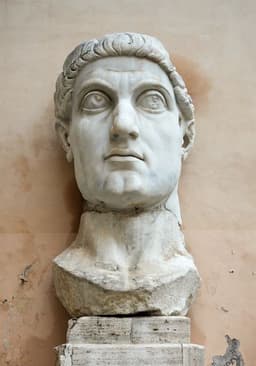
Constantine the Great
Emperor · Ancient
75.5Total

Duke of Zhou
Politician · Ancient
78.8Total
Basic Information
Born
272
-1090
Died
337
-1030
Era
Ancient
Ancient
Nationality
Roman Empire
Zhou China
Occupation
Emperor
Politician
Civilization
Western
Eastern
Score Comparison
Military (10%)
78.0
60.0
Political (20%)
82.0
72.0
Influence (20%)
75.0
92.0
Legacy (20%)
70.0
87.0
Leadership (15%)
80.0
78.0
Strategy (15%)
72.0
55.0
TOTAL
75.5
78.8
Constantine the Great — Complete Timeline
312 AD
Battle of the Milvian BridgeWar◆ Major
Constantine defeated his rival Maxentius at the Milvian Bridge near Rome. According to tradition, Constantine saw a vision of a cross in the sky with the words 'In this sign, conquer.' The victory made Constantine the sole ruler of the Western Roman Empire and led to his conversion to Christianity.
Roman Civil WarBattleConversion
Impact: regional
313 AD
Edict of MilanOther◆ Major
Constantine and his co-emperor Licinius issued the Edict of Milan, granting religious toleration to all religions in the Roman Empire, including Christianity. The edict ended the persecution of Christians, restored confiscated church property, and established Christianity as a legally recognized religion.
Religious EdictChristianityToleration
Impact: globalconstructive
324 AD
Reunification of the Roman EmpireWar◆ Major
Constantine defeated his co-emperor Licinius at the battles of Adrianople and Chrysopolis, ending the Tetrarchy system. He became the sole ruler of the entire Roman Empire, reuniting the Western and Eastern halves under his control. This reunification was the last time the Roman Empire was united under a single ruler.
Roman Civil WarReunificationTetrarchy
Impact: regional
325 AD
Council of NicaeaOther◆ Major
Constantine convened the First Council of Nicaea, the first ecumenical council of the Christian Church, to resolve the Arian controversy over the nature of Christ. The council produced the Nicene Creed, affirming the divinity of Christ and establishing a unified Christian doctrine. Constantine presided over the council.
Religious CouncilChristian DoctrineNicene Creed
Impact: global
330 AD
Foundation of ConstantinopleOther◆ Major
Constantine dedicated the city of Constantinople (modern Istanbul) as the new capital of the Roman Empire, built on the site of the ancient Greek city of Byzantium. The city was strategically located on the Bosporus strait, controlling trade routes between Europe and Asia. It became the capital of the Eastern Roman Empire for over a thousand years.
City FoundationCapitalByzantine Empire
Impact: globalconstructive
Duke of Zhou — Complete Timeline
1042 BC
Regency for King Cheng of ZhouPolitical Action◆ Major
After King Wu's death, the Duke of Zhou served as regent for the young King Cheng. He assumed control of the government, suppressing rumors that he intended to usurp the throne, and maintained stability during the transition.
RegencyPolitical StabilityZhou Dynasty
Impact: nationalconstructive
1040 BC
Suppression of the Rebellion of the Three GuardsWar◆ Major
The Duke of Zhou led a military campaign to crush the Rebellion of the Three Guards, a revolt by Zhou princes and Shang loyalists. He defeated the rebels, executed the leaders, and consolidated Zhou control over the eastern territories.
Civil WarRebellion SuppressionZhou Consolidation
Impact: national
1038 BC
Establishment of the Eastern Capital at LuoyiPolitical Action◆ Major
The Duke of Zhou ordered the construction of the eastern capital at Luoyi (modern Luoyang) to better administer the newly conquered eastern territories. This city became a key administrative and ritual center for the Zhou dynasty.
Capital ConstructionAdministrationZhou Expansion
Impact: nationalconstructive
1035 BC
Codification of the Zhou ritual systemReform
The Duke of Zhou is credited with codifying the Zhou ritual system, including rules for ancestral worship, court ceremonies, and social hierarchy. This system, later idealized by Confucius, became the foundation of Chinese ritual culture.
Ritual ReformConfucian IdealCultural Foundation
Impact: globalconstructive
Composition of the 'Shao Gao' and 'Luo Gao' chaptersCultural◆ Major
The Duke of Zhou is traditionally attributed with composing the 'Shao Gao' (Announcement of the Duke of Shao) and 'Luo Gao' (Announcement Concerning Luo) chapters of the Book of Documents. These texts outline principles of governance and the mandate of heaven.
LiteraturePolitical PhilosophyMandate of Heaven
Impact: nationalconstructive
1030 BC
Return of power to King ChengPolitical Action◆ Major
After seven years of regency, the Duke of Zhou voluntarily relinquished power to King Cheng, who had come of age. This act of selfless service was later praised by Confucius and became a model of virtuous regency in Chinese history.
Regency EndVirtuous ConductConfucian Model
Impact: nationalconstructive
Expert Analysis
Origins
**Duke of Zhou** (11th century BC) was a royal prince of the early Zhou dynasty, brother of King Wu. After Wu's death, he served as regent for his young nephew King Cheng. His rise stemmed from familial duty and political necessity amidst a fragile new dynasty.
**Constantine the Great** (272–337 AD) was born in Naissus (modern Serbia) to a Roman army officer and a innkeeper's daughter. He rose through military ranks, proclaimed emperor by his troops in 306, and spent two decades consolidating power.
Rise to Power
Duke of Zhou's regency faced immediate crisis: the Rebellion of the Three Guards, led by his own brothers. He suppressed it with military force, then solidified Zhou control by establishing the eastern capital Luoyi. His legitimacy came from Confucian virtue, not naked ambition.
Constantine's rise was brutal: he defeated rivals Maxentius (Battle of Milvian Bridge, 312) and Licinius (324). His conversion to Christianity before Milvian Bridge gave him divine mandate, but his path was paved with civil war and political cunning.
Leadership & Governance
Duke of Zhou's governance was ideological: he codified the Zhou ritual system (li), emphasizing hierarchy, filial piety, and moral rule. He composed the 'Shao Gao' and 'Luo Gao' chapters of the Book of Documents, which became Confucian classics. His model of regency set a precedent for selfless stewardship.
Constantine's governance was structural: he legalized Christianity (Edict of Milan, 313), convened the Council of Nicaea (325) to unify doctrine, and founded Constantinople (330) as a new Christian capital. He centralized imperial authority but also divided the empire into four praetorian prefectures.
Triumph & Tragedy
Duke of Zhou's triumph was the peaceful succession of King Cheng after a seven-year regency—a rare voluntary relinquishing of power. His tragedy was posthumous: Confucius later lauded him as a sage, but his meticulous ritual system eventually ossified into rigid social hierarchy.
Constantine's triumph was the reunification of the Roman Empire and the establishment of a Christian state that endured a millennium. His tragedy was family: he executed his eldest son Crispus and his wife Fausta in a dynastic purge, staining his legacy with violence.
Character & Destiny
Duke of Zhou embodies Confucian ideals: wisdom (I=92), loyalty (L=87), and moral dedication. He is the archetype of the virtuous regent, whose destiny was to stabilize a dynasty through ritual and example.
Constantine (M=78, P=82) was a pragmatic visionary: ambitious, shrewd, and ruthless. His destiny was to transform the Roman world through religious revolution and urban foundation, but at the cost of personal morality.
Legacy
Duke of Zhou's legacy is cultural: he shaped Chinese political philosophy for two millennia. Confucius said, 'How great was Zhou! How splendid its culture!' His ritual system influenced governance, family ethics, and social order across East Asia.
Constantine's legacy is institutional: he founded Constantinople (Istanbul), made Christianity the state religion, and shaped European history. The Nicene Creed is still recited worldwide. His reforms split the empire into East and West.
Conclusion
Who had greater impact? Duke of Zhou (score 73.9) vs Constantine (score 76.1). Constantine's scores edge higher due to military (78 vs 60) and political (82 vs 72) achievements. But Duke of Zhou's ideological influence (I=92 vs 75) is profound. Both transformed their civilizations: Duke of Zhou through moral order, Constantine through imperial faith. Constantine wins narrowly on scope, but Duke of Zhou's legacy of virtue remains timeless.
**Duke of Zhou**: M=60, P=72, I=92, L=87, D=78, S=55, T=79 → **73.9**
**Constantine**: M=78, P=82, I=75, L=70, D=80, S=72, T=76 → **76.1**
**Winner: Constantine the Great (by 2.2 points)**
Rankings
🥇
Duke of ZhouLeader
Mil: 60.0Pol: 72.0Inf: 92.0
78.8
🥈
Constantine the Great
Mil: 78.0Pol: 82.0Inf: 75.0
75.5
+3.3 behind
How This Comparison Works
Algorithm
Each figure is scored on 6 dimensions (0—100 scale) based on structured historical data: Military (10%), Political (20%), Influence (20%), Legacy (20%), Leadership (15%), Strategy (15%). The weighted total produces the final ranking.
Data Sources
Scores are computed from structured sub-indicators in the database. Scale factors adjust for era (Ancient ×0.85, Modern ×1.0) and civilization size (Eastern ×1.05, Other ×0.80) to account for differences in population and military scale.
Maximum 3 Figures
Comparisons are limited to 2—3 figures to ensure readability and statistical meaningfulness.
Error Margins
±5 points per dimension — Sub-scores are derived from historical records with inherent uncertainty. Two figures within 5 points on a dimension should be considered roughly equivalent in that area.
Total Score Accuracy
±3 points overall — The weighted combination of 6 dimensions produces a total score with approximately ±3 points of uncertainty. Differences of less than 3 points are not statistically significant— the figures are effectively tied.
Known Limitations
- Historical records are incomplete and uneven across civilizations
- Figures from oral-tradition societies may be underrepresented
- Occupation labels can misclassify multi-role figures
- Scores measure capability and impact, not moral character
- Quantitative scoring is a comparison tool, not absolute truth
Capability Radar
Military (10%) — Battles & Warfare
Battles
85
65
Win Rate
80
70
Expansion
85
55
Political (20%) — Governance & Reform
Reform
95
95
Diplomacy
90
85
Economy
80
80
Influence (20%) — Cultural & Global Reach
Cultural
95
95
Global
95
85
Legacy (20%) — Historical Impact
Historical
95
95
Longevity
95
95
Leadership (15%) — Power & Stability
Tenure
85
70
Stability
70
90
Strategy (15%) — Tactics & Innovation
Strategy
85
75
Tactics
75
60
Reform
90
80
Similar Comparisons
Comments & Discussion
No comments yet. Be the first to share your thoughts!