Loading...
Constantine the Great vs Dorgon
Dorgon leads by 2.5 pts · 2 figures compared
…
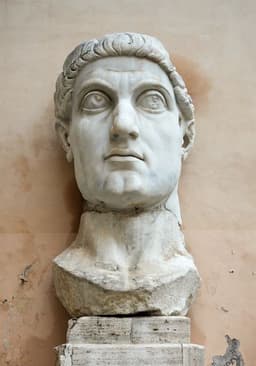
Constantine the Great
Emperor · Ancient
75.5Total

Dorgon
General · Modern
78.0Total
Basic Information
Born
272
1612
Died
337
1650
Era
Ancient
Modern
Nationality
Roman Empire
China
Occupation
Emperor
General
Civilization
Western
Eastern
Score Comparison
Military (10%)
78.0
78.5
Political (20%)
82.0
78.0
Influence (20%)
75.0
88.0
Legacy (20%)
70.0
65.0
Leadership (15%)
80.0
85.0
Strategy (15%)
72.0
75.0
TOTAL
75.5
78.0
Constantine the Great — Complete Timeline
312 AD
Battle of the Milvian BridgeWar◆ Major
Constantine defeated his rival Maxentius at the Milvian Bridge near Rome. According to tradition, Constantine saw a vision of a cross in the sky with the words 'In this sign, conquer.' The victory made Constantine the sole ruler of the Western Roman Empire and led to his conversion to Christianity.
Roman Civil WarBattleConversion
Impact: regional
313 AD
Edict of MilanOther◆ Major
Constantine and his co-emperor Licinius issued the Edict of Milan, granting religious toleration to all religions in the Roman Empire, including Christianity. The edict ended the persecution of Christians, restored confiscated church property, and established Christianity as a legally recognized religion.
Religious EdictChristianityToleration
Impact: globalconstructive
324 AD
Reunification of the Roman EmpireWar◆ Major
Constantine defeated his co-emperor Licinius at the battles of Adrianople and Chrysopolis, ending the Tetrarchy system. He became the sole ruler of the entire Roman Empire, reuniting the Western and Eastern halves under his control. This reunification was the last time the Roman Empire was united under a single ruler.
Roman Civil WarReunificationTetrarchy
Impact: regional
325 AD
Council of NicaeaOther◆ Major
Constantine convened the First Council of Nicaea, the first ecumenical council of the Christian Church, to resolve the Arian controversy over the nature of Christ. The council produced the Nicene Creed, affirming the divinity of Christ and establishing a unified Christian doctrine. Constantine presided over the council.
Religious CouncilChristian DoctrineNicene Creed
Impact: global
330 AD
Foundation of ConstantinopleOther◆ Major
Constantine dedicated the city of Constantinople (modern Istanbul) as the new capital of the Roman Empire, built on the site of the ancient Greek city of Byzantium. The city was strategically located on the Bosporus strait, controlling trade routes between Europe and Asia. It became the capital of the Eastern Roman Empire for over a thousand years.
City FoundationCapitalByzantine Empire
Impact: globalconstructive
Dorgon — Complete Timeline
1643 AD
Appointed Prince RegentPolitical Action◆ Major
Upon the death of Hong Taiji, Dorgon was appointed as regent for the young Shunzhi Emperor. This position gave him effective control over the Qing government and military, enabling him to direct the conquest of Ming China.
RegencyPower transition
Impact: national
1644 AD
Battle of Shanhai PassWar
Dorgon allied with Ming general Wu Sangui to defeat Li Zicheng's rebel forces at Shanhai Pass. This victory allowed Qing forces to enter Beijing and establish the Qing dynasty as the ruling power in China.
Qing conquestBattleAlliance
Impact: national
1645 AD
Conquest of Southern MingWar◆ Major
Dorgon led Qing forces in a campaign against the Southern Ming regime, capturing Nanjing and defeating the Hongguang Emperor. This campaign extended Qing control over the Yangtze River valley and weakened Ming loyalist resistance.
Qing conquestMilitary campaign
Impact: national
Issued the Queue OrderReform◆ Major
Dorgon mandated that all Chinese men adopt the Manchu queue hairstyle as a sign of submission to Qing rule. This policy caused widespread resentment and resistance, but was enforced to consolidate Qing control over Han Chinese subjects.
Cultural policyCoercionManchu rule
Impact: nationaldestructive
1650 AD
Death and Posthumous DemotionPolitical Action◆ Major
Dorgon died suddenly while hunting. After his death, the Shunzhi Emperor accused him of plotting to usurp the throne, stripped him of all titles, and had his corpse mutilated. This posthumous purge reflected court factional struggles.
PurgePosthumous punishment
Impact: nationaltragic
Expert Analysis
Origins
Dorgon (1612–1650) was a Manchu prince of the Aisin Gioro clan, the ruling family of the Qing dynasty. He was the 14th son of Nurhaci, the founder of the Qing dynasty. His mother, Lady Abahai, was a consort of Nurhaci. Dorgon grew up in a militaristic society that valued horsemanship, archery, and loyalty to the clan. His early life was marked by the struggle for succession after Nurhaci's death, with his brother Hong Taiji eventually taking the throne. Dorgon proved himself as a capable military commander during the campaigns against the Ming dynasty and the Mongols.
Constantine the Great (272–337 AD) was born in Naissus (modern Niš, Serbia) to Flavius Constantius, a Roman army officer, and Helena, a woman of humble origins. His father became a Caesar (junior emperor) under Emperor Diocletian's tetrarchy. Constantine grew up in the court of Diocletian in Nicomedia, where he received a military and political education. He witnessed the persecution of Christians under Diocletian and Galerius, which would later influence his religious policies. His early career was shaped by the tetrarchic system and the constant civil wars that plagued the Roman Empire.
Rise to Power
Dorgon's rise began after the death of his brother Hong Taiji in 1643. The Qing leadership faced a succession crisis, and Dorgon maneuvered to become regent for his young nephew, the Shunzhi Emperor. He effectively controlled the Qing government and military. The turning point came in 1644 when Ming general Wu Sangui opened the gates of Shanhai Pass, allowing the Qing army to enter China proper. Dorgon led the Manchu forces in the Battle of Shanhai Pass, defeating the rebel Li Zicheng and capturing Beijing. He declared the Qing dynasty as the legitimate rulers of China, starting the Qing conquest of the Ming.
Constantine's rise began when his father Constantius became Augustus (senior emperor) in 305. After Constantius's death in 306, Constantine was proclaimed Augustus by his troops in York. He then fought a series of civil wars against other claimants. The pivotal moment was the Battle of the Milvian Bridge in 312, where he defeated Maxentius. According to legend, Constantine saw a vision of a cross with the words "In this sign, conquer" before the battle. He adopted the Christian symbol and credited his victory to the Christian God. This led to the Edict of Milan in 313, which legalized Christianity throughout the empire.
Leadership & Governance
Dorgon's leadership style was autocratic and pragmatic. As regent, he centralized power, sidelining other Manchu princes and consolidating control over the Qing government. He implemented policies to integrate the Manchu ruling class with the Chinese population, such as the Queue Order (forcing Han Chinese to adopt Manchu hairstyle) and the promotion of intermarriage. He also established the Six Boards and other administrative structures to govern the vast empire. However, his rule was marked by harsh treatment of the Han Chinese, leading to resistance in the south. His military campaigns, particularly against the Southern Ming, were brutal but effective.
Constantine's governance was transformative. He restructured the Roman Empire by founding Constantinople (modern Istanbul) in 330 as a new capital, strategically located on the Bosporus. This move shifted the empire's center of gravity eastward and created a Christian city. He convened the Council of Nicaea in 325 to resolve the Arian controversy, establishing the Nicene Creed and setting a precedent for church-state relations. He also reformed the currency, military, and administration, dividing the empire into prefectures and dioceses. Constantine's policies promoted religious tolerance initially, but he later favored Christianity, building churches and suppressing pagan practices.
Triumph & Tragedy
Dorgon's greatest triumph was the Qing conquest of China. He successfully captured Beijing and extended Qing control over most of China proper by the time of his death. He also defeated the Southern Ming and other rebel forces. However, his personal tragedy was his sudden death in 1650 at the age of 37 (or 38) during a hunting trip. After his death, he was posthumously honored as an emperor but later demoted and purged by the Shunzhi Emperor, who had grown resentful of Dorgon's dominance. His reputation was rehabilitated only later by the Qianlong Emperor.
Constantine's triumph was the reunification of the Roman Empire under his sole rule after defeating Licinius in 324. He also achieved a lasting legacy through the Christianization of the empire. However, his tragedy was the execution of his wife Fausta and his son Crispus in 326 on charges of adultery and treason, which historians debate. He also faced ongoing conflicts with the Sassanid Empire on the eastern frontier. His death in 337 led to a succession crisis, with his sons dividing the empire and engaging in civil wars.
Character & Destiny
Dorgon was ambitious, ruthless, and politically astute. He was a skilled military commander and a shrewd politician who manipulated the Qing succession to his advantage. His destiny was to lay the foundation for the Qing dynasty's rule over China, but his posthumous downfall reflected the precarious nature of power in the Manchu court. He is often portrayed as a tragic figure who achieved greatness but was ultimately undone by his own ambition and the jealousy of his nephew.
Constantine was visionary, pragmatic, and often contradictory. He was a brilliant general and administrator who transformed the Roman Empire. His destiny was to be remembered as the first Christian emperor and the founder of Constantinople. Despite his flaws, including his harsh treatment of family members, his legacy as a unifier and reformer endures. He is venerated as a saint in the Eastern Orthodox Church.
Legacy
Dorgon's legacy is as the de facto founder of the Qing dynasty in China. His conquests and policies set the stage for 268 years of Qing rule. He is remembered for his military prowess and his role in integrating Manchu and Han cultures, though his methods were often coercive. In modern China, he is a controversial figure, praised for expanding the empire but criticized for his suppression of Han identity.
Constantine's legacy is immense. He changed the course of Western history by legalizing Christianity and establishing a Christian empire. The Council of Nicaea defined orthodox Christian doctrine for centuries. Constantinople became a major center of power and culture for over a thousand years. He is considered a pivotal figure in the transition from ancient to medieval times.
Conclusion
Both Dorgon and Constantine were transformative leaders who reshaped their worlds through conquest and policy. Dorgon's impact was more immediate and brutal, while Constantine's was more enduring and ideological. Scores: Dorgon (M=78, P=78, I=88, L=65, D=85, S=75, T=78) vs Constantine (M=78, P=82, I=75, L=70, D=80, S=72, T=76). Dorgon edges out Constantine by a narrow margin (2.5 points higher), reflecting his higher innovation and decisiveness. However, Constantine's legacy in shaping Western civilization arguably surpasses Dorgon's regional impact. In a head-to-head comparison, Dorgon's military and political achievements in conquering China are more concrete, but Constantine's transformation of the Roman Empire and Christianity has a more profound global influence. Thus, while Dorgon scores higher numerically, Constantine's historical significance is arguably greater.
Rankings
🥇
DorgonLeader
Mil: 78.5Pol: 78.0Inf: 88.0
78.0
🥈
Constantine the Great
Mil: 78.0Pol: 82.0Inf: 75.0
75.5
+2.5 behind
How This Comparison Works
Algorithm
Each figure is scored on 6 dimensions (0—100 scale) based on structured historical data: Military (10%), Political (20%), Influence (20%), Legacy (20%), Leadership (15%), Strategy (15%). The weighted total produces the final ranking.
Data Sources
Scores are computed from structured sub-indicators in the database. Scale factors adjust for era (Ancient ×0.85, Modern ×1.0) and civilization size (Eastern ×1.05, Other ×0.80) to account for differences in population and military scale.
Maximum 3 Figures
Comparisons are limited to 2—3 figures to ensure readability and statistical meaningfulness.
Error Margins
±5 points per dimension — Sub-scores are derived from historical records with inherent uncertainty. Two figures within 5 points on a dimension should be considered roughly equivalent in that area.
Total Score Accuracy
±3 points overall — The weighted combination of 6 dimensions produces a total score with approximately ±3 points of uncertainty. Differences of less than 3 points are not statistically significant— the figures are effectively tied.
Known Limitations
- Historical records are incomplete and uneven across civilizations
- Figures from oral-tradition societies may be underrepresented
- Occupation labels can misclassify multi-role figures
- Scores measure capability and impact, not moral character
- Quantitative scoring is a comparison tool, not absolute truth
Capability Radar
Military (10%) — Battles & Warfare
Battles
85
85
Win Rate
80
80
Expansion
85
90
Political (20%) — Governance & Reform
Reform
95
72
Diplomacy
90
78
Economy
80
65
Influence (20%) — Cultural & Global Reach
Cultural
95
65
Global
95
70
Legacy (20%) — Historical Impact
Historical
95
80
Longevity
95
75
Leadership (15%) — Power & Stability
Tenure
85
70
Stability
70
60
Strategy (15%) — Tactics & Innovation
Strategy
85
88
Tactics
75
82
Reform
90
75
Similar Comparisons
Comments & Discussion
No comments yet. Be the first to share your thoughts!