Loading...
Chen Tang vs Xiang Yu
Xiang Yu leads by 3.9 pts · 2 figures compared
…

Chen Tang
General · Ancient
48.4Total
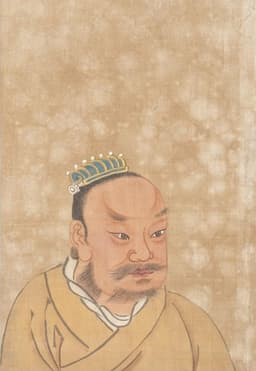
Xiang Yu
General · Ancient
52.3Total
Basic Information
Born
-70
-232
Died
-15
-202
Era
Ancient
Ancient
Nationality
China
China
Occupation
General
General
Civilization
Eastern
Eastern
Score Comparison
Military (10%)
50.0
77.5
Political (20%)
35.0
35.0
Influence (20%)
51.0
61.0
Legacy (20%)
43.3
52.0
Leadership (15%)
57.1
30.0
Strategy (15%)
60.0
65.4
TOTAL
48.4
52.3
Chen Tang — Complete Timeline
36 BC
Battle of ZhizhiWar◆ Major
Chen Tang, as a Han officer, led a punitive expedition against the Xiongnu chieftain Zhizhi Chanyu at his fortress near the Talas River. Despite being outnumbered, Chen Tang's forces stormed the fortress and killed Zhizhi, securing the Han frontier and demonstrating Han military reach into Central Asia.
Han-Xiongnu WarPunitive ExpeditionCentral Asia
Impact: regional
Famous Declaration on OffendersPolitical Action
After the Battle of Zhizhi, Chen Tang reportedly declared that offenders against the Han must be punished no matter how far away they were. This statement became a famous Han policy principle, emphasizing the empire's reach and resolve in dealing with threats.
PolicyDiplomacyHan Empire
Impact: national
Xiang Yu — Complete Timeline
207 BC
Battle of JuluWar◆ Major
Xiang Yu led a rebel army against the Qin dynasty at Julu. After ordering his troops to destroy their cooking vessels and boats, they defeated a larger Qin force, breaking the siege and establishing Xiang Yu as the leading rebel commander.
Qin rebellionBattleTurning point
Impact: regional
206 BC
Feast at Hong GatePolitical Action◆ Major
Xiang Yu hosted a banquet for Liu Bang at Hong Gate. During the feast, Xiang Yu's advisor Fan Zeng attempted to have Liu Bang assassinated, but Xiang Yu hesitated. Liu Bang escaped, and the rivalry between the two leaders intensified.
Political intrigueRivalryChu-Han Contention
Impact: regional
202 BC
Battle of GaixiaWar◆ Major
Liu Bang's Han forces surrounded Xiang Yu's army at Gaixia. After a night of psychological warfare with Han soldiers singing Chu songs, Xiang Yu's troops lost morale. Xiang Yu broke out but was cornered, leading to his suicide.
Chu-Han ContentionBattleDefeat
Impact: regionaltragic
Expert Analysis
Origins
Chen Tang (c. 1st century BCE) was a Han dynasty officer from a modest background, likely born in the 40s BCE. Little is known of his early life, but he rose through the ranks of the Han military bureaucracy. His formative experience was serving in the Western Regions, where he gained firsthand knowledge of the Xiongnu threat. Xiang Yu (232–202 BCE) was born into the noble Chu military family. His father was a general, and Xiang Yu was trained in martial arts and military strategy from youth. He was known for his immense physical strength and ambition, which drove him to seek the overthrow of the Qin dynasty after its unification.
Rise to Power
Chen Tang's rise was gradual and bureaucratic. He served as a military officer in the Western Regions, where he demonstrated initiative. In 36 BCE, while serving as acting protector-general, he took the bold step of launching a punitive expedition against Zhizhi Chanyu without explicit imperial approval. This risky move paid off with a decisive victory. Xiang Yu's rise was meteoric. In 209 BCE, he joined his uncle Xiang Liang in rebellion against Qin. After Xiang Liang's death, Xiang Yu took command. In 207 BCE, at the Battle of Julu, he ordered his troops to destroy their cooking vessels and boats, signaling a fight to the death. This psychological tactic led to a crushing victory over Qin forces, making him the de facto leader of the anti-Qin coalition.
Leadership & Governance
Chen Tang exemplified Han imperial confidence and legalism. He believed in the principle that offenders must be punished regardless of distance, a doctrine that justified aggressive frontier expansion. His leadership was characterized by boldness and a willingness to act without orders, but he also faced legal repercussions for his unauthorized campaign, showing the limits of his political acumen. Xiang Yu was a charismatic but flawed leader. He led by personal example, often fighting at the front. However, he was politically inept: he alienated allies, failed to secure loyalty, and mismanaged the distribution of territories after the fall of Qin. His leadership score of 30.0 reflects his inability to build a stable coalition, contrasting with Chen Tang's 57.1.
Triumph & Tragedy
Chen Tang's greatest triumph was the Battle of Zhizhi (36 BCE), where he captured and executed the Xiongnu chieftain Zhizhi Chanyu, ending a major threat to Han dominance in Central Asia. His famous declaration that offenders must be punished however far they flee became a symbol of Han power. However, his tragedy lay in his subsequent treatment: he was initially rewarded but later demoted and exiled due to political infighting, dying in obscurity. Xiang Yu's triumph was the Battle of Julu (207 BCE), where his daring tactics shattered Qin's main army. He also won the Battle of Pengcheng (205 BCE) against Liu Bang. His tragedy was his downfall at the Battle of Gaixia (202 BCE), where his army was surrounded and destroyed. He committed suicide after breaking out, rather than face capture. His failure to kill Liu Bang at the Feast at Hong Gate (206 BCE) is seen as a critical mistake.
Character & Destiny
Chen Tang was a risk-taker and a pragmatist. His decision to attack Zhizhi without orders showed his independent streak, but it also made him vulnerable to political enemies. His character reflects the tension between personal initiative and bureaucratic control in the Han system. Xiang Yu was proud, impulsive, and honor-bound. He valued personal glory over political calculation. His refusal to assassinate Liu Bang at the Feast at Hong Gate was a chivalrous act that cost him his empire. His character led to his isolation: he killed his advisor Fan Zeng due to suspicion, and his cruelty (e.g., massacring surrendered Qin soldiers) turned potential allies against him. Historians note that Xiang Yu's military brilliance (score 77.5) was undermined by his political naivety (score 35.0).
Legacy
Chen Tang's legacy is his articulation of the doctrine of preemptive punishment, which influenced Han and later Chinese frontier policy. His victory at Zhizhi extended Han influence to the Talas River, and his famous quote is still referenced in Chinese foreign policy rhetoric. However, his personal fate—exiled and forgotten—dimmed his immediate legacy. Xiang Yu's legacy is more complex. He is remembered as a tragic hero in Chinese culture, celebrated for his military prowess and romanticized in poetry and opera. His failure is a cautionary tale about the importance of political skill. Historically, his defeat paved the way for the Han dynasty's long rule. His military tactics, such as the 'burning boats' at Julu, are studied in military academies. In terms of influence scores, Xiang Yu scores 61.0 vs Chen Tang's 51.0.
Conclusion
Xiang Yu had a greater immediate impact on Chinese history. His military campaigns directly led to the fall of the Qin dynasty, and his rivalry with Liu Bang shaped the founding of the Han dynasty. Chen Tang's expedition, while significant, was a single campaign that did not alter the dynastic cycle. Xiang Yu's total score of 52.3 surpasses Chen Tang's 48.4. However, Chen Tang's strategic vision (score 60.0 vs Xiang Yu's 65.4) and leadership (57.1 vs 30.0) show that he was more effective as a commander within a stable system. Ultimately, Xiang Yu's higher military score (77.5 vs 50.0) and influence (61.0 vs 51.0) reflect his larger role in shaping Chinese history, even if his personal failure prevented him from founding a dynasty.
Rankings
🥇
Xiang YuLeader
Mil: 77.5Pol: 35.0Inf: 61.0
52.3
🥈
Chen Tang
Mil: 50.0Pol: 35.0Inf: 51.0
48.4
+3.9 behind
How This Comparison Works
Algorithm
Each figure is scored on 6 dimensions (0—100 scale) based on structured historical data: Military (10%), Political (20%), Influence (20%), Legacy (20%), Leadership (15%), Strategy (15%). The weighted total produces the final ranking.
Data Sources
Scores are computed from structured sub-indicators in the database. Scale factors adjust for era (Ancient ×0.85, Modern ×1.0) and civilization size (Eastern ×1.05, Other ×0.80) to account for differences in population and military scale.
Maximum 3 Figures
Comparisons are limited to 2—3 figures to ensure readability and statistical meaningfulness.
Error Margins
±5 points per dimension — Sub-scores are derived from historical records with inherent uncertainty. Two figures within 5 points on a dimension should be considered roughly equivalent in that area.
Total Score Accuracy
±3 points overall — The weighted combination of 6 dimensions produces a total score with approximately ±3 points of uncertainty. Differences of less than 3 points are not statistically significant— the figures are effectively tied.
Known Limitations
- Historical records are incomplete and uneven across civilizations
- Figures from oral-tradition societies may be underrepresented
- Occupation labels can misclassify multi-role figures
- Scores measure capability and impact, not moral character
- Quantitative scoring is a comparison tool, not absolute truth
Capability Radar
Military (10%) — Battles & Warfare
Battles
30
85
Win Rate
35
75
Expansion
25
80
Political (20%) — Governance & Reform
Reform
10
10
Diplomacy
25
30
Economy
10
15
Influence (20%) — Cultural & Global Reach
Cultural
25
70
Global
20
55
Legacy (20%) — Historical Impact
Historical
40
75
Longevity
30
70
Leadership (15%) — Power & Stability
Tenure
20
40
Stability
15
20
Strategy (15%) — Tactics & Innovation
Strategy
35
70
Tactics
40
90
Reform
10
20
Similar Comparisons
Comments & Discussion
No comments yet. Be the first to share your thoughts!