Loading...
Jia Fu vs Xiang Yu
Xiang Yu leads by 4.2 pts · 2 figures compared
…

Jia Fu
General · Ancient
48.1Total
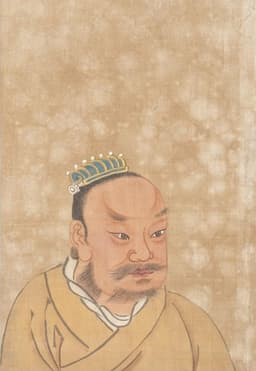
Xiang Yu
General · Ancient
52.3Total
Basic Information
Born
-10
-232
Died
55
-202
Era
Ancient
Ancient
Nationality
China
China
Occupation
General
General
Civilization
Eastern
Eastern
Score Comparison
Military (10%)
55.0
77.5
Political (20%)
35.0
35.0
Influence (20%)
46.3
61.0
Legacy (20%)
38.3
52.0
Leadership (15%)
68.0
30.0
Strategy (15%)
60.0
65.4
TOTAL
48.1
52.3
Jia Fu — Complete Timeline
23 AD
Battle of KunyangWar◆ Major
Jia Fu fought under Liu Xiu (later Emperor Guangwu) at the Battle of Kunyang, a decisive engagement where a smaller Han force defeated the numerically superior Xin dynasty army. Jia Fu's valor in this battle contributed to the restoration of the Han dynasty.
Eastern HanBattleRestoration
Impact: nationalconstructive
27 AD
Suppression of the Chimei RebellionWar◆ Major
Jia Fu played a key role in the Eastern Han campaign against the Chimei (Red Eyebrows) rebels. He led forces in several engagements, helping to defeat the rebel army and consolidate Emperor Guangwu's control over the empire.
Eastern HanRebellionCampaign
Impact: nationalconstructive
Xiang Yu — Complete Timeline
207 BC
Battle of JuluWar◆ Major
Xiang Yu led a rebel army against the Qin dynasty at Julu. After ordering his troops to destroy their cooking vessels and boats, they defeated a larger Qin force, breaking the siege and establishing Xiang Yu as the leading rebel commander.
Qin rebellionBattleTurning point
Impact: regional
206 BC
Feast at Hong GatePolitical Action◆ Major
Xiang Yu hosted a banquet for Liu Bang at Hong Gate. During the feast, Xiang Yu's advisor Fan Zeng attempted to have Liu Bang assassinated, but Xiang Yu hesitated. Liu Bang escaped, and the rivalry between the two leaders intensified.
Political intrigueRivalryChu-Han Contention
Impact: regional
202 BC
Battle of GaixiaWar◆ Major
Liu Bang's Han forces surrounded Xiang Yu's army at Gaixia. After a night of psychological warfare with Han soldiers singing Chu songs, Xiang Yu's troops lost morale. Xiang Yu broke out but was cornered, leading to his suicide.
Chu-Han ContentionBattleDefeat
Impact: regionaltragic
Expert Analysis
Origins
Jia Fu was born around 9 CE in Nanyang Commandery (modern Henan) during the late Xin dynasty. His family were local gentry, and he was known for his physical strength and courage from a young age. He initially served as a county official but joined the rebellion led by Liu Xiu (later Emperor Guangwu) in 22 CE, becoming one of his key military commanders.
Xiang Yu was born in 232 BCE in Xiaxiang (modern Jiangsu) into the noble family of the Chu state. His father died early, and he was raised by his uncle Xiang Liang. Xiang Yu was educated in calligraphy and swordsmanship but found them unfulfilling; he preferred the art of war. He famously declared he would learn enough to "command ten thousand men." His family background and Chu heritage fueled his desire to overthrow the Qin dynasty.
Rise to Power
Jia Fu rose to prominence during the civil wars following Wang Mang's fall. His first major achievement came at the Battle of Kunyang in 23 CE, where he fought under Liu Xiu. The Han forces, vastly outnumbered by Xin troops, launched a surprise attack. Jia Fu's valor in the battle, including leading a charge, helped secure a decisive victory. Liu Xiu recognized his bravery and appointed him as a general. Jia Fu later participated in campaigns against various rebel groups, including the Chimei (Red Eyebrows) in 27 CE, where he commanded troops effectively.
Xiang Yu's rise began with the assassination of the Qin governor of Kuaiji in 209 BCE, orchestrated by his uncle Xiang Liang. They raised an army and joined the rebellion against Qin. Xiang Yu's pivotal moment came at the Battle of Julu in 207 BCE. He led a coalition of rebel forces against the main Qin army led by Zhang Han. By ordering his troops to destroy their cooking vessels and boats (symbolizing no retreat), he motivated them to a fierce assault, resulting in a crushing victory. This battle made Xiang Yu the de facto leader of the anti-Qin forces. He then marched on the Qin capital, Xianyang, and executed the last Qin emperor.
Leadership & Governance
Jia Fu operated as a loyal general under Emperor Guangwu. His leadership style was direct and courageous; he led from the front and inspired his troops through personal example. He was not involved in high-level governance, instead focusing on military execution. His score in leadership is 68.0, reflecting his competence in command but lack of broader administrative role.
Xiang Yu, in contrast, was a supreme commander who also attempted to govern. After the fall of Qin, he divided the empire into eighteen kingdoms, naming himself "Hegemon-King of Western Chu." However, his governance was marked by favoritism towards Chu nobles and harsh punishments. He failed to consolidate support, alienating potential allies like Liu Bang. His political score is 35.0, indicating poor statecraft. His leadership style was autocratic and impulsive; he often relied on brute force rather than diplomacy.
Triumph & Tragedy
Jia Fu's greatest triumph was his role in the Battle of Kunyang, where his bravery contributed to a victory that allowed Liu Xiu to establish the Eastern Han. He also succeeded in suppressing the Chimei rebellion, helping stabilize the new dynasty. However, his later life is obscure; he retired from military service and died around 55 CE. His tragedy is that his achievements are overshadowed by more famous generals of the era, and his scores (total 48.1) reflect limited long-term impact.
Xiang Yu's triumph was the Battle of Julu, a masterpiece of military strategy where he defeated a larger Qin army. His score in military is 77.5, the highest among his attributes. His tragedy was his defeat at the Battle of Gaixia in 202 BCE. Surrounded by Liu Bang's forces, his army was demoralized by the singing of Chu songs (a psychological tactic). He broke out with only 28 cavalry, fought to the end, and committed suicide at the Wu River. His failure to adapt politically and his arrogance led to his downfall, despite his military brilliance.
Character & Destiny
Jia Fu was characterized by loyalty and courage. He never sought personal power, remaining a steadfast supporter of Liu Xiu. His destiny was to be a capable but secondary figure, his name known mainly to historians. He scored 60.0 in strategy, showing solid tactical ability but not genius.
Xiang Yu was proud, impulsive, and generous to his troops but cruel to enemies. He was known for his physical strength and personal prowess in battle. However, his character flaws—arrogance, lack of strategic patience, and inability to delegate—sealed his fate. Historians like Sima Qian portrayed him as a tragic hero whose military genius was undone by political naivety. His strategy score of 65.4 is high, but his leadership score of 30.0 reflects his inability to inspire loyalty beyond his immediate circle.
Legacy
Jia Fu's legacy is limited to his role in the founding of the Eastern Han. He is remembered in Chinese history as a minor general, with his deeds recorded in the Book of the Later Han. His total influence score is 46.3, indicating modest impact.
Xiang Yu's legacy is immense. He is a cultural icon in China, symbolizing tragic heroism. His story is told in operas, films, and literature. The idiom "ambush on all sides" originates from his defeat at Gaixia. Despite losing, his military tactics are studied. His influence score is 61.0, and legacy score is 52.0, both higher than Jia Fu's. However, his political failures meant his dynasty did not endure.
Conclusion
Xiang Yu had greater impact than Jia Fu. While Jia Fu was a competent general in a successful dynasty, Xiang Yu's military achievements at Julu were on a larger scale, and his story has resonated for millennia. Xiang Yu's total score (52.3) edges Jia Fu's (48.1) by 4.2 points. His military brilliance and tragic narrative make him a more significant historical figure, despite his ultimate failure. Jia Fu, though valorous, remains a footnote in the rise of the Eastern Han, whereas Xiang Yu shaped the transition from Qin to Han and became a legend.
Rankings
🥇
Xiang YuLeader
Mil: 77.5Pol: 35.0Inf: 61.0
52.3
🥈
Jia Fu
Mil: 55.0Pol: 35.0Inf: 46.3
48.1
+4.2 behind
How This Comparison Works
Algorithm
Each figure is scored on 6 dimensions (0—100 scale) based on structured historical data: Military (10%), Political (20%), Influence (20%), Legacy (20%), Leadership (15%), Strategy (15%). The weighted total produces the final ranking.
Data Sources
Scores are computed from structured sub-indicators in the database. Scale factors adjust for era (Ancient ×0.85, Modern ×1.0) and civilization size (Eastern ×1.05, Other ×0.80) to account for differences in population and military scale.
Maximum 3 Figures
Comparisons are limited to 2—3 figures to ensure readability and statistical meaningfulness.
Error Margins
±5 points per dimension — Sub-scores are derived from historical records with inherent uncertainty. Two figures within 5 points on a dimension should be considered roughly equivalent in that area.
Total Score Accuracy
±3 points overall — The weighted combination of 6 dimensions produces a total score with approximately ±3 points of uncertainty. Differences of less than 3 points are not statistically significant— the figures are effectively tied.
Known Limitations
- Historical records are incomplete and uneven across civilizations
- Figures from oral-tradition societies may be underrepresented
- Occupation labels can misclassify multi-role figures
- Scores measure capability and impact, not moral character
- Quantitative scoring is a comparison tool, not absolute truth
Capability Radar
Military (10%) — Battles & Warfare
Battles
40
85
Win Rate
45
75
Expansion
20
80
Political (20%) — Governance & Reform
Reform
5
10
Diplomacy
10
30
Economy
5
15
Influence (20%) — Cultural & Global Reach
Cultural
20
70
Global
5
55
Legacy (20%) — Historical Impact
Historical
25
75
Longevity
15
70
Leadership (15%) — Power & Stability
Tenure
15
40
Stability
10
20
Strategy (15%) — Tactics & Innovation
Strategy
35
70
Tactics
50
90
Reform
10
20
Similar Comparisons
Comments & Discussion
No comments yet. Be the first to share your thoughts!