Loading...
Che Guevara vs Napoleon Bonaparte
Napoleon Bonaparte leads by 29.4 pts · 2 figures compared
…
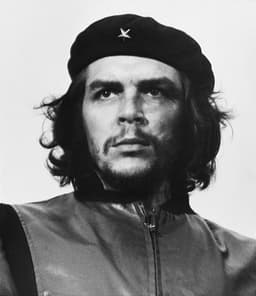
Che Guevara
Revolutionary · Modern
41.5Total

Napoleon Bonaparte
General · Modern
70.9Total
Basic Information
Born
1928
1769
Died
—
1821
Era
Modern
Modern
Nationality
Argentina
France
Occupation
Revolutionary
General
Civilization
Western
Western
Score Comparison
Military (10%)
35.0
94.0
Political (20%)
25.0
72.0
Influence (20%)
55.0
40.0
Legacy (20%)
50.0
80.0
Leadership (15%)
30.0
78.0
Strategy (15%)
35.0
90.0
TOTAL
41.5
70.9
Che Guevara — Complete Timeline
1956 AD
Participation in the Cuban RevolutionWar
Guevara joined Fidel Castro's 26th of July Movement, landing in Cuba aboard the Granma. He became a key guerrilla commander, leading troops in the Battle of Santa Clara, which helped overthrow Fulgencio Batista's regime.
Cuban RevolutionGuerrilla WarfareCastro
Impact: regional
1961 AD
Appointment as Minister of IndustriesPolitical Action◆ Major
Guevara was appointed Minister of Industries in Cuba, where he implemented radical economic policies, including nationalization and central planning. His efforts to diversify the economy and reduce dependence on sugar largely failed.
Economic PolicyNationalizationCuba
Impact: national
1965 AD
Guerrilla Campaign in the CongoWar◆ Major
Guevara led a small Cuban force to support the Simba rebellion in the Democratic Republic of the Congo. The campaign was unsuccessful due to poor logistics, lack of local support, and superior opposition forces, leading to his withdrawal.
CongoGuerrillaFailed Revolution
Impact: regionaldestructive
1967 AD
Capture and Execution in BoliviaPolitical Action
Guevara was captured by Bolivian forces, trained and advised by the CIA, while leading a guerrilla insurgency. He was executed the next day in La Higuera. His death turned him into a global icon of revolutionary struggle.
ExecutionBoliviaMartyrdom
Impact: globaltragic
Napoleon Bonaparte — Complete Timeline
1799 AD
Coup of 18 BrumaireOther◆ Major
Napoleon Bonaparte, with support from his brother Lucien and key political figures, overthrew the Directory in a bloodless coup. He established the Consulate with himself as First Consul, effectively becoming the ruler of France. This event ended the French Revolution's most unstable period.
French RevolutionCoupRise to Power
Impact: regional
1804 AD
Promulgation of the Napoleonic CodeOther◆ Major
Napoleon enacted the Civil Code of the French, known as the Napoleonic Code, a comprehensive set of laws that replaced the fragmented feudal legal systems. The code established legal equality, protected property rights, and secularized law. It became the basis for legal systems in many European and world countries.
Legal ReformNapoleonic CodeCivil Law
Impact: globalconstructive
1805 AD
Battle of AusterlitzWar◆ Major
Napoleon's Grande Arm
Napoleonic WarsBattleDecisive Victory
Impact: global
1812 AD
Invasion of RussiaWar◆ Major
Napoleon led the Grande Arm
Napoleonic WarsInvasionDisaster
Impact: globaldestructive
1815 AD
Battle of WaterlooWar◆ Major
Napoleon's French army was defeated by the combined forces of the Duke of Wellington's Anglo-Allied army and Gebhard Leberecht von Bl
Napoleonic WarsBattleFinal Defeat
Impact: globaldestructive
Expert Analysis
che-guevara-vs-napoleon-bonaparte
# The Emperor and the Revolutionary
On a cold December morning in 1805, Napoleon Bonaparte stood on the fields of Austerlitz, watching his Grand Army crush the combined forces of Russia and Austria. A century and a half later, in the jungles of Bolivia, Ernesto "Che" Guevara lay wounded and exhausted, surrounded by soldiers who would soon execute him. One died in a palace, the other in a mud hut. Both sought to reshape the world, yet their paths diverged so completely that they seem to belong to different species of ambition. What drove these two men—one a builder of empires, the other a martyr of revolution—to such opposite fates?
Origins
Napoleon was born in 1769 on the island of Corsica, a place that had only recently become French. His family was minor nobility, struggling and proud. He spoke Italian before French, and throughout his life carried the chip of an outsider on his shoulder. The French Revolution, which erupted when he was twenty, shattered the old order and opened doors that would have remained closed under the monarchy. A young artillery officer of modest birth could rise on talent alone.
Che Guevara, born in 1928 in Argentina, came from a different kind of privilege. His family was middle-class, educated, and politically aware. But where Napoleon breathed the air of a revolution that had already happened, Che grew up in a world of Cold War tensions, American hegemony, and Latin America's grinding poverty. His asthma, which plagued him from childhood, gave him a sense of fragility that he spent his life trying to overcome. He trained as a doctor, not a soldier, and his first journey across South America on a motorcycle opened his eyes to the continent's suffering.
Rise to Power
Napoleon's ascent was swift and spectacular. In 1793, at the siege of Toulon, he devised the plan that recaptured the port from British forces. He was promoted to brigadier general at twenty-four. By 1796, he commanded the French army in Italy, where his lightning campaigns stunned Europe. His political genius matched his military talent: when he returned from Egypt in 1799, he seized power in a coup d'état, becoming First Consul. In 1804, he crowned himself Emperor. Every step was calculated, every risk measured.
Che's rise was more accidental and far more brutal. In 1954, he met Fidel Castro in Mexico City, and found his purpose. In 1956, they set sail for Cuba aboard the Granma, a rickety yacht that nearly sank before they landed. Of the eighty-two men who started, only a handful survived the first ambush. Che was among them. He became a guerrilla commander not through training but through survival, learning warfare in the mountains of the Sierra Maestra. When Castro's forces triumphed in 1959, Che was suddenly a minister, a diplomat, a symbol—roles for which his background had not prepared him.
Leadership & Governance
Napoleon was a master of organization. His Napoleonic Code, implemented in 1804, standardized French law, abolished feudal privileges, and established merit-based advancement. He built roads, founded schools, created a central bank. His military genius was systematic: he moved armies faster than his enemies, struck at their weakest points, and exploited victory without mercy. At Austerlitz in 1805, he lured the Allies into attacking his deliberately weakened right flank, then crushed their center. His score of 94 for military prowess reflects this tactical brilliance.
Che was a guerrilla, not a statesman. As Minister of Industries in Cuba from 1961, he tried to industrialize the economy through central planning, moral incentives, and voluntary labor. The results were disastrous: production fell, workers grew disillusioned, and the economy stagnated. His military score of 34.7 reflects his limitations on the conventional battlefield. He was effective in small-scale jungle warfare, but his strategies often failed when faced with better-equipped, more disciplined opponents. Where Napoleon built institutions, Che burned them down and tried to build anew from ashes.
Triumph & Tragedy
Napoleon's greatest triumph was Austerlitz, where he defeated a larger coalition army and forced the dissolution of the Holy Roman Empire. His greatest tragedy came in 1812, when he invaded Russia. The campaign was a catastrophe: of the 600,000 men who crossed into Russia, fewer than 100,000 returned. His final defeat at Waterloo in 1815 was a masterpiece of misjudgment—he delayed his attack, split his forces, and underestimated the Prussian arrival. He died in exile on Saint Helena in 1821, a prisoner of the British.
Che's triumph was the Cuban Revolution itself, a stunning victory of a small guerrilla force against a corrupt dictatorship. His tragedy unfolded in Bolivia in 1967. He had left Cuba to spread revolution to the Congo, which failed, and then to Bolivia, where he was betrayed, captured, and executed. His last words, according to his captors, were: "I know you have come to kill me. Shoot, coward, you are only going to kill a man." He was 39.
Character & Destiny
Napoleon was a pragmatist who believed in power as its own justification. "I am not a man, but a thing," he once said. "I have a mission to fulfill, and I shall carry it out." He was ruthless, brilliant, and ultimately consumed by his own ambition. His downfall came not from external enemies but from his inability to stop—to consolidate, to rest, to accept limits.
Che was an idealist who believed in revolution as a moral imperative. "The true revolutionary is guided by great feelings of love," he wrote. He was sincere, self-sacrificing, and utterly impractical. His downfall came from his refusal to compromise, to adapt, to recognize that the world would not bend to his will. He died as he lived: a romantic, not a realist.
Legacy
Napoleon's legacy is everywhere: in the legal codes of Europe, the boundaries of nations, the very idea of the modern state. He is remembered as a conqueror and a reformer, a tyrant and a genius. His score of 78 for legacy reflects this complexity.
Che's legacy is more symbolic than practical. His image—the beret, the stare, the iconic photograph by Alberto Korda—has become a global icon of rebellion, sold on T-shirts and posters. His writings on guerrilla warfare are studied by revolutionaries and counterinsurgents alike. But his actual achievements were limited: the Cuban Revolution succeeded despite his economic policies, and his campaigns in Africa and Bolivia failed. His score of 70 for legacy captures his strange immortality—not as a builder, but as a symbol.
Conclusion
Napoleon and Che Guevara represent two poles of revolutionary ambition: the emperor who built an empire and the martyr who died for a dream. Napoleon changed the world through power, organization, and force. Che changed it through sacrifice, symbol, and myth. One ended his life in a palace, the other in a dirt-floor schoolhouse. Yet both understood that history belongs to those who act, not those who wait. Their stories remind us that the same fire that forges empires can also consume those who try to build them—and that sometimes, the most powerful legacy is not what you achieve, but what you inspire others to believe is possible.
Rankings
🥇
Napoleon BonaparteLeader
Mil: 94.0Pol: 72.0Inf: 40.0
70.9
🥈
Che Guevara
Mil: 35.0Pol: 25.0Inf: 55.0
41.5
+29.4 behind
How This Comparison Works
Algorithm
Each figure is scored on 6 dimensions (0—100 scale) based on structured historical data: Military (10%), Political (20%), Influence (20%), Legacy (20%), Leadership (15%), Strategy (15%). The weighted total produces the final ranking.
Data Sources
Scores are computed from structured sub-indicators in the database. Scale factors adjust for era (Ancient ×0.85, Modern ×1.0) and civilization size (Eastern ×1.05, Other ×0.80) to account for differences in population and military scale.
Maximum 3 Figures
Comparisons are limited to 2—3 figures to ensure readability and statistical meaningfulness.
Error Margins
±5 points per dimension — Sub-scores are derived from historical records with inherent uncertainty. Two figures within 5 points on a dimension should be considered roughly equivalent in that area.
Total Score Accuracy
±3 points overall — The weighted combination of 6 dimensions produces a total score with approximately ±3 points of uncertainty. Differences of less than 3 points are not statistically significant— the figures are effectively tied.
Known Limitations
- Historical records are incomplete and uneven across civilizations
- Figures from oral-tradition societies may be underrepresented
- Occupation labels can misclassify multi-role figures
- Scores measure capability and impact, not moral character
- Quantitative scoring is a comparison tool, not absolute truth
Capability Radar
Military (10%) — Battles & Warfare
Battles
35
95
Win Rate
40
90
Expansion
25
95
Political (20%) — Governance & Reform
Reform
35
95
Diplomacy
20
80
Economy
15
85
Influence (20%) — Cultural & Global Reach
Cultural
75
85
Global
70
90
Legacy (20%) — Historical Impact
Historical
70
95
Longevity
65
90
Leadership (15%) — Power & Stability
Tenure
30
85
Stability
10
70
Strategy (15%) — Tactics & Innovation
Strategy
45
95
Tactics
55
98
Reform
30
92
Similar Comparisons
Comments & Discussion
No comments yet. Be the first to share your thoughts!