Loading...
Che Guevara vs Julius Caesar
Julius Caesar leads by 41.3 pts · 2 figures compared
…
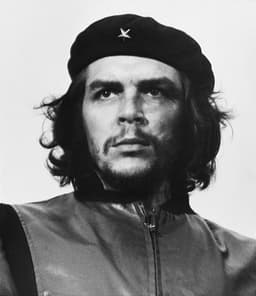
Che Guevara
Revolutionary · Modern
41.5Total

Julius Caesar
General · Ancient
82.8Total
Basic Information
Born
1928
-100
Died
—
-44
Era
Modern
Ancient
Nationality
Argentina
Roman Republic
Occupation
Revolutionary
General
Civilization
Western
Western
Score Comparison
Military (10%)
35.0
88.0
Political (20%)
25.0
78.0
Influence (20%)
55.0
85.0
Legacy (20%)
50.0
82.0
Leadership (15%)
30.0
80.0
Strategy (15%)
35.0
85.0
TOTAL
41.5
82.8
Che Guevara — Complete Timeline
1956 AD
Participation in the Cuban RevolutionWar
Guevara joined Fidel Castro's 26th of July Movement, landing in Cuba aboard the Granma. He became a key guerrilla commander, leading troops in the Battle of Santa Clara, which helped overthrow Fulgencio Batista's regime.
Cuban RevolutionGuerrilla WarfareCastro
Impact: regional
1961 AD
Appointment as Minister of IndustriesPolitical Action◆ Major
Guevara was appointed Minister of Industries in Cuba, where he implemented radical economic policies, including nationalization and central planning. His efforts to diversify the economy and reduce dependence on sugar largely failed.
Economic PolicyNationalizationCuba
Impact: national
1965 AD
Guerrilla Campaign in the CongoWar◆ Major
Guevara led a small Cuban force to support the Simba rebellion in the Democratic Republic of the Congo. The campaign was unsuccessful due to poor logistics, lack of local support, and superior opposition forces, leading to his withdrawal.
CongoGuerrillaFailed Revolution
Impact: regionaldestructive
1967 AD
Capture and Execution in BoliviaPolitical Action
Guevara was captured by Bolivian forces, trained and advised by the CIA, while leading a guerrilla insurgency. He was executed the next day in La Higuera. His death turned him into a global icon of revolutionary struggle.
ExecutionBoliviaMartyrdom
Impact: globaltragic
Julius Caesar — Complete Timeline
58 BC
Gallic WarsWar◆ Major
Caesar, as proconsul of Gaul, launched a series of campaigns that conquered all of Gaul (modern France, Belgium, and parts of Switzerland). He fought numerous battles, including against the Helvetii, the Belgae, and the Gallic chieftain Vercingetorix. The wars brought immense wealth and a loyal army to Caesar.
Gallic WarsConquestRoman Expansion
Impact: regional
49 BC
Crossing the RubiconPolitical Action◆ Major
Caesar led Legio XIII across the Rubicon River into Italy, defying the Roman Senate's order to disband his army. This act triggered a civil war against Pompey and the Optimates, ultimately leading to Caesar's dictatorship and the end of the Roman Republic.
Roman Civil WarEnd of RepublicPower Struggle
Impact: global
48 BC
Battle of PharsalusWar◆ Major
Caesar's outnumbered army defeated the larger forces of Pompey the Great at Pharsalus in Greece. Caesar's tactical use of a reserve line to counter Pompey's cavalry charge proved decisive. Pompey fled to Egypt, where he was assassinated, leaving Caesar as the undisputed master of the Roman world.
Roman Civil WarBattleDecisive Victory
Impact: regional
44 BC
Appointment as Dictator for LifePolitical Action◆ Major
The Roman Senate appointed Caesar dictator perpetuo (dictator for life), granting him unprecedented personal power. This move concentrated military, legislative, and judicial authority in one person, effectively ending the Roman Republic's traditional system of checks and balances and alarming many senators.
DictatorshipEnd of RepublicPower Consolidation
Impact: regionaldestructive
Assassination on the Ides of MarchPolitical Action◆ Major
A group of Roman senators, led by Marcus Junius Brutus and Gaius Cassius Longinus, stabbed Caesar to death at a meeting of the Senate in the Theatre of Pompey. The assassination was intended to restore the Republic, but instead triggered another civil war that led to the rise of the Roman Empire.
AssassinationRoman PoliticsEnd of Republic
Impact: globaldestructive
Expert Analysis
che-guevara-vs-julius-caesar
# The General and the Guerrilla: Two Paths to Revolution
On a January morning in 49 BCE, Julius Caesar stood at the banks of the Rubicon River, a small stream that marked the boundary between his provincial command and Rome itself. To cross with his army was to declare war on the Republic. He paused, then uttered a phrase that would echo through millennia: "The die is cast." Two thousand years later, in the jungles of Bolivia, another man faced his own Rubicon. Ernesto "Che" Guevara, wounded and surrounded, reportedly told his captors, "Shoot, coward, you are only going to kill a man." Both men sought to remake the world through violence and will. Yet one became the father of an empire, the other a martyr for a cause that never came. What separates a Caesar from a Che? The answer lies not in the purity of their dreams, but in the brutal arithmetic of history—timing, strategy, and the cold logic of power.
Origins
Caesar was born into the chaos of the late Roman Republic, a world of civil wars, senatorial corruption, and a patrician class that hoarded glory like gold. His family, the Julii, claimed descent from the goddess Venus, but they were politically marginal. Caesar learned early that in Rome, status was earned through debt, daring, and military command. He fled the dictator Sulla's proscriptions as a young man, served in Asia Minor, and was captured by pirates—whom he promised to crucify, then did, after raising the ransom himself. This was a man who understood that power flowed from the point of a sword.
Che Guevara was born in 1928 in Rosario, Argentina, into a middle-class family with leftist sympathies. He studied medicine, but his soul belonged to the road. Two motorcycle journeys across Latin America exposed him to the continent's open wounds: exploited miners, landless peasants, and the iron grip of American-backed dictatorships. Where Caesar saw a Republic to conquer, Guevara saw a system to destroy. His origin was not patrician ambition but existential rage—a doctor who grew sick of the world's diseases and decided to burn down the hospital.
Rise to Power
Caesar's ascent was a masterpiece of calculated patience. He climbed the Roman political ladder—quaestor, aedile, praetor—spending fortunes on games and bribes to buy popularity. In 60 BCE, he formed the First Triumvirate with Pompey and Crassus, an alliance that gave him command of Gaul. Over eight years, from 58 to 50 BCE, he conquered a territory larger than Italy itself, wrote his own propaganda in the *Commentaries*, and built an army that loved him more than Rome. When the Senate ordered him to disband, he crossed the Rubicon instead. In four years of civil war, he defeated Pompey, crushed his enemies, and made himself dictator for life.
Guevara's rise was faster, more accidental, and far less strategic. In 1956, he joined Fidel Castro's 26th of July Movement, landing in Cuba aboard the leaky yacht *Granma*. Most of the rebels were killed or captured. Guevara survived, became a commander, and proved himself in the Sierra Maestra mountains—not through tactical brilliance, but through sheer endurance and ideological fervor. He was a man who could march for days without food and shoot deserters without hesitation. After the revolution's victory in 1959, he became a celebrity, then Minister of Industries. But he was never a Caesar. He had no patience for bureaucracy, no talent for coalition-building, and no desire to rule. He wanted to ignite a global fire.
Leadership & Governance
Caesar governed as a reformer and a realist. He granted citizenship to Gauls, reformed the calendar, initiated public works, and centralized the tax system. He was ruthless—his campaigns in Gaul killed perhaps a million people—but he understood that power required legitimacy. He pardoned his enemies, elevated talented men from the provinces, and packed the Senate with his supporters. His military genius lay in speed and logistics: he built bridges across the Rhine in ten days, besieged Alesia with double fortifications, and won at Pharsalus against superior numbers. He was a politician who commanded armies, not a soldier who stumbled into politics.
Guevara's leadership was ideological and improvisational. As Minister of Industries, he abolished money, nationalized factories, and pushed Cuba toward a Soviet-style command economy that produced shortages and inefficiency. He was brilliant in the field—his column in the Cuban Revolution was the most disciplined—but his guerrilla campaigns in the Congo in 1965 and Bolivia in 1967 were disasters. He failed to win local support, underestimated the terrain, and refused to adapt his tactics. Where Caesar studied his enemies, Guevara lectured them. He had a strategy for the world, but no plan for the village.
Triumph & Tragedy
Caesar's greatest moment was his triumph: the conquest of Gaul, the defeat of Pompey, and the title of dictator perpetuus. His tragedy was the Ides of March, 44 BCE, when sixty senators stabbed him to death in the Pompeian Theatre. He had centralized power but failed to build a system to sustain it. His assassins thought they were saving the Republic; instead, they unleashed another civil war that ended with Augustus as emperor.
Guevara's triumph was symbolic: the Cuban Revolution, the poster child for anti-imperialism, and the iconic photograph by Alberto Korda that made his face a logo for rebellion. His tragedy was his death in a Bolivian schoolhouse on October 9, 1967, executed by a Bolivian sergeant under CIA supervision. He had led a guerrilla force of fewer than fifty men, most of whom were dead or captured. He died not as a conqueror, but as a fugitive.
Character & Destiny
Caesar was a gambler who calculated the odds. He was vain, ambitious, and promiscuous, but also merciful, generous, and disciplined. He wrote his own history, controlled his own narrative, and understood that perception was power. His character drove him to take risks—crossing the Rubicon, pardoning Brutus—that ultimately killed him. But he died knowing he had changed the world.
Guevara was a romantic who rejected calculation. He was austere, dogmatic, and self-destructive. He turned down high office to die in a jungle. His character drove him to abandon his family, his health, and his life for a vision of humanity that never arrived. He was a man who could not compromise because he believed history was on his side. It was not.
Legacy
Caesar's legacy is the Roman Empire, the Latin language, the Western calendar, and a title—*Caesar*—that became synonymous with emperor for two thousand years. He is remembered as a genius and a tyrant, a founder and a destroyer. His name still means power.
Guevara's legacy is a T-shirt. His image adorns dorm rooms and protest marches, but his ideas—armed revolution, anti-imperialism, the "New Man"—failed everywhere they were tried. Bolivia, the Congo, Cuba itself: none became the utopia he envisioned. He is remembered as a martyr and a failure, an icon and a cautionary tale.
Conclusion
What separates Caesar from Che is not courage or conviction—both had those in abundance. It is the difference between a man who built an empire and a man who built a symbol. Caesar understood that power requires institutions, alliances, and the willingness to compromise. Guevara believed that purity of purpose was enough. One died at the height of his power, the other at the nadir of his ambition. In the end, history rewards those who win, not those who inspire. The die is cast—but only Caesar knew how to read the dice.
Rankings
🥇
Julius CaesarLeader
Mil: 88.0Pol: 78.0Inf: 85.0
82.8
🥈
Che Guevara
Mil: 35.0Pol: 25.0Inf: 55.0
41.5
+41.3 behind
How This Comparison Works
Algorithm
Each figure is scored on 6 dimensions (0—100 scale) based on structured historical data: Military (10%), Political (20%), Influence (20%), Legacy (20%), Leadership (15%), Strategy (15%). The weighted total produces the final ranking.
Data Sources
Scores are computed from structured sub-indicators in the database. Scale factors adjust for era (Ancient ×0.85, Modern ×1.0) and civilization size (Eastern ×1.05, Other ×0.80) to account for differences in population and military scale.
Maximum 3 Figures
Comparisons are limited to 2—3 figures to ensure readability and statistical meaningfulness.
Error Margins
±5 points per dimension — Sub-scores are derived from historical records with inherent uncertainty. Two figures within 5 points on a dimension should be considered roughly equivalent in that area.
Total Score Accuracy
±3 points overall — The weighted combination of 6 dimensions produces a total score with approximately ±3 points of uncertainty. Differences of less than 3 points are not statistically significant— the figures are effectively tied.
Known Limitations
- Historical records are incomplete and uneven across civilizations
- Figures from oral-tradition societies may be underrepresented
- Occupation labels can misclassify multi-role figures
- Scores measure capability and impact, not moral character
- Quantitative scoring is a comparison tool, not absolute truth
Capability Radar
Military (10%) — Battles & Warfare
Battles
35
95
Win Rate
40
92
Expansion
25
97
Political (20%) — Governance & Reform
Reform
35
90
Diplomacy
20
85
Economy
15
82
Influence (20%) — Cultural & Global Reach
Cultural
75
88
Global
70
94
Legacy (20%) — Historical Impact
Historical
70
95
Longevity
65
96
Leadership (15%) — Power & Stability
Tenure
30
75
Stability
10
60
Strategy (15%) — Tactics & Innovation
Strategy
45
94
Tactics
55
96
Reform
30
88
Similar Comparisons
Comments & Discussion
No comments yet. Be the first to share your thoughts!