Loading...
Charles VII of France vs Li Yuan
Li Yuan leads by 12.0 pts · 2 figures compared
…
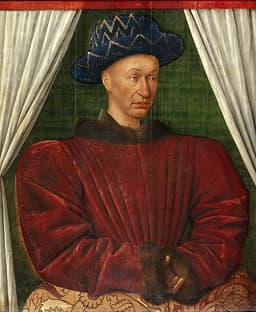
Charles VII of France
Emperor · Medieval
61.7Total

Li Yuan
Emperor · Medieval
73.7Total
Basic Information
Born
1403
566
Died
1461
635
Era
Medieval
Medieval
Nationality
France
China
Occupation
Emperor
Emperor
Civilization
Western
Eastern
Score Comparison
Military (10%)
67.5
78.0
Political (20%)
70.0
70.0
Influence (20%)
56.7
80.0
Legacy (20%)
55.0
71.4
Leadership (15%)
66.0
72.0
Strategy (15%)
66.3
67.2
TOTAL
61.7
73.7
Charles VII of France — Complete Timeline
1429 AD
Siege of OrléansWar◆ Major
Joan of Arc, acting under Charles VII's authority, led French forces to lift the English siege of Orl
Hundred Years' WarSiegeJoan of Arc
Impact: regional
Coronation at ReimsPolitical Action
Charles VII was crowned King of France at Reims Cathedral, a traditional site for French coronations, following the military successes of Joan of Arc. This coronation legitimized his claim against the English-backed Henry VI and boosted French morale.
CoronationHundred Years' WarJoan of Arc
Impact: nationalconstructive
1435 AD
Treaty of ArrasPolitical Action◆ Major
Charles VII signed the Treaty of Arras with Philip the Good of Burgundy, ending the Burgundian alliance with England. This diplomatic victory isolated the English and paved the way for French reconquest of English-held territories.
TreatyBurgundyDiplomacy
Impact: regionalconstructive
1438 AD
Pragmatic Sanction of BourgesReform◆ Major
Charles VII issued the Pragmatic Sanction of Bourges, asserting the authority of the French crown over the Catholic Church in France. It limited papal interference in ecclesiastical appointments and revenues, strengthening royal control.
Church ReformRoyal AuthorityGallicanism
Impact: nationalconstructive
1453 AD
Battle of CastillonWar
French forces under Charles VII's command defeated the English at Castillon, the final battle of the Hundred Years' War. The English lost Gascony, ending their territorial presence in France except for Calais.
Hundred Years' WarBattleEnd of War
Impact: regional
Li Yuan — Complete Timeline
618 AD
Founded the Tang dynastyPolitical Action
Li Yuan, Duke of Tang, rebelled against the Sui dynasty and captured Chang'an. He declared himself Emperor Gaozu, founding the Tang dynasty that would rule China for nearly 300 years.
Tang dynastyFoundingSui-Tang transition
Impact: globalconstructive
621 AD
Battle of Hulao PassWar◆ Major
Li Yuan's son Li Shimin defeated the rival warlord Dou Jiande at Hulao Pass. This victory eliminated a major competitor and secured Tang control over the central plains.
Tang unificationBattleLi Shimin
Impact: national
626 AD
Abdicated in favor of Li ShiminPolitical Action◆ Major
After the Xuanwu Gate Incident where Li Shimin killed his brothers, Li Yuan abdicated the throne to his son. He became Taishang Huang (retired emperor) and lived in retirement.
Tang dynastySuccessionXuanwu Gate
Impact: national
Expert Analysis
Origins
Charles VII of France was born in 1403 as the fifth son of King Charles VI and Isabeau of Bavaria. His early years were overshadowed by his father's intermittent madness and the bitter feud between the Armagnac and Burgundian factions, which plunged France into civil war. Charles was raised in a chaotic court, receiving limited formal education but gaining firsthand experience of political instability. His mother's neglect and his father's incapacity left him ill-prepared for kingship. In contrast, Li Yuan was born in 566 into the powerful Li family of the Northern Zhou dynasty. His father, Li Bing, was a general, and his mother, Duchess Dugu, came from a prominent Xianbei clan. Li Yuan received a thorough Confucian education and military training, serving as a provincial governor under the Sui dynasty. His family's prestige and his own competence gave him a solid foundation for leadership.
Rise to Power
Charles VII became dauphin in 1417 after his older brothers died, but his claim was contested. In 1420, the Treaty of Troyes disinherited him in favor of Henry V of England. Charles was seen as weak and indecisive, earning the nickname "the Dauphin who did nothing." His turning point came in 1429 when Joan of Arc, a peasant girl, convinced him to let her lead an army to relieve Orléans. After the victory, Charles was crowned at Reims in July 1429, a symbolic act that solidified his legitimacy. However, Joan's capture and execution in 1431 left Charles politically vulnerable. He later negotiated the Treaty of Arras in 1435, breaking the Burgundian-English alliance. Li Yuan's rise was more deliberate. Appointed governor of Taiyuan in 615, he initially remained loyal to the collapsing Sui dynasty. In 617, following the advice of his son Li Shimin, he rebelled, capturing the capital Chang'an by the end of the year. He declared himself Emperor Gaozu of Tang in 618, establishing a new dynasty. Li Yuan's military score of 78.0 reflects his ability to leverage his sons' talents, especially Li Shimin's victory at Hulao Pass in 621, which crushed the rival Dou Jiande.
Leadership & Governance
Charles VII focused on restoring royal authority after the Hundred Years' War. He reorganized the French army with the Compagnies d'Ordonnance (standing companies) in 1445, creating a professional force. He also issued the Pragmatic Sanction of Bourges in 1438, asserting control over the French Church and limiting papal interference. His financial reforms, including the taille tax, strengthened the crown. However, he remained cautious and often relied on advisors like Jacques Cœur. Li Yuan's governance was more transformative. As founder of the Tang dynasty, he implemented the equal-field system to distribute land fairly and the Three Departments and Six Ministries structure that became a model for Chinese bureaucracy. He also codified laws with the Tang Code, influencing later dynasties. His political score of 70.0 matches Charles's, but Li Yuan's influence score of 80.0 far exceeds Charles's 56.7. Li Yuan's leadership score of 72.0 also surpasses Charles's 66.0, reflecting his more decisive and effective rule.
Triumph & Tragedy
Charles VII's greatest triumph was ending the Hundred Years' War, culminating in the Battle of Castillon in 1453, where French artillery destroyed the English army. He reclaimed all of France except Calais. His tragedy was his failure to save Joan of Arc, whom he abandoned after her capture. He also faced the Praguerie revolt in 1440, a rebellion by nobles against his reforms. Li Yuan's triumph was founding the Tang dynasty, which became one of China's golden ages. His tragedy was the Xuanwu Gate Incident in 626, where his son Li Shimin killed his brothers and forced Li Yuan to abdicate. Li Yuan lived as a retired emperor until 635, but his legacy was overshadowed by his son's brilliance. Li Yuan's total score of 73.7 reflects a more successful reign, while Charles's 61.7 indicates a narrower impact.
Character & Destiny
Charles VII was known for his caution, indecisiveness, and suspicion. He distrusted his son, the future Louis XI, and often avoided direct conflict. His reliance on Joan of Arc and later on his mistress Agnès Sorel showed a dependence on strong personalities. His character led to a slow but steady recovery of France. Li Yuan was more pragmatic and adaptable. He recognized his son's abilities and allowed him to lead, but his decision to favor his younger son Li Jiancheng over Li Shimin led to tragedy. Li Yuan's abdication was a strategic retreat, preserving his life and dynasty. Historians note that Li Yuan's willingness to delegate was both a strength and a weakness.
Legacy
Charles VII is remembered as "the Victorious" for expelling the English, but his legacy is overshadowed by Joan of Arc. He strengthened the French monarchy, laying groundwork for absolutism. His military reforms influenced later French armies. Li Yuan's legacy is immense: the Tang dynasty lasted nearly three centuries, spreading Chinese culture across Asia. The Tang Code influenced Japan, Korea, and Vietnam. Li Yuan's administrative innovations shaped Chinese governance for centuries. His influence score of 80.0 dwarfs Charles's 56.7, and his legacy score of 71.4 exceeds Charles's 55.0.
Conclusion
Li Yuan had greater historical impact than Charles VII. His Tang dynasty redefined Chinese civilization, while Charles's achievements were largely confined to France and the Hundred Years' War. Li Yuan's scores across all categories except strategy (67.2 vs 66.3) are higher, with a total gap of 12.0 points. While Charles ended a war and stabilized France, Li Yuan founded a dynasty that shaped East Asia for generations. The data supports Li Yuan as the more significant figure.
Rankings
🥇
Li YuanLeader
Mil: 78.0Pol: 70.0Inf: 80.0
73.7
🥈
Charles VII of France
Mil: 67.5Pol: 70.0Inf: 56.7
61.7
+12.0 behind
How This Comparison Works
Algorithm
Each figure is scored on 6 dimensions (0—100 scale) based on structured historical data: Military (10%), Political (20%), Influence (20%), Legacy (20%), Leadership (15%), Strategy (15%). The weighted total produces the final ranking.
Data Sources
Scores are computed from structured sub-indicators in the database. Scale factors adjust for era (Ancient ×0.85, Modern ×1.0) and civilization size (Eastern ×1.05, Other ×0.80) to account for differences in population and military scale.
Maximum 3 Figures
Comparisons are limited to 2—3 figures to ensure readability and statistical meaningfulness.
Error Margins
±5 points per dimension — Sub-scores are derived from historical records with inherent uncertainty. Two figures within 5 points on a dimension should be considered roughly equivalent in that area.
Total Score Accuracy
±3 points overall — The weighted combination of 6 dimensions produces a total score with approximately ±3 points of uncertainty. Differences of less than 3 points are not statistically significant— the figures are effectively tied.
Known Limitations
- Historical records are incomplete and uneven across civilizations
- Figures from oral-tradition societies may be underrepresented
- Occupation labels can misclassify multi-role figures
- Scores measure capability and impact, not moral character
- Quantitative scoring is a comparison tool, not absolute truth
Capability Radar
Military (10%) — Battles & Warfare
Battles
65
75
Win Rate
70
80
Expansion
55
80
Political (20%) — Governance & Reform
Reform
85
75
Diplomacy
75
80
Economy
70
75
Influence (20%) — Cultural & Global Reach
Cultural
60
85
Global
55
85
Legacy (20%) — Historical Impact
Historical
75
90
Longevity
70
90
Leadership (15%) — Power & Stability
Tenure
70
70
Stability
65
70
Strategy (15%) — Tactics & Innovation
Strategy
75
85
Tactics
60
70
Reform
80
65
Similar Comparisons
Comments & Discussion
No comments yet. Be the first to share your thoughts!