Loading...
Edward III vs Li Yuan
Li Yuan leads by 11.4 pts · 2 figures compared
…
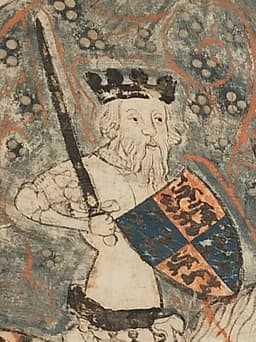
Edward III
Emperor · Medieval
62.3Total

Li Yuan
Emperor · Medieval
73.7Total
Basic Information
Born
1312
566
Died
1377
635
Era
Medieval
Medieval
Nationality
England
China
Occupation
Emperor
Emperor
Civilization
Western
Eastern
Score Comparison
Military (10%)
72.0
78.0
Political (20%)
59.3
70.0
Influence (20%)
68.0
80.0
Legacy (20%)
40.0
71.4
Leadership (15%)
80.0
72.0
Strategy (15%)
72.0
67.2
TOTAL
62.3
73.7
Edward III — Complete Timeline
1337 AD
Claimed the French ThronePolitical Action
Edward III formally claimed the French crown through his mother Isabella, daughter of Philip IV of France, rejecting the Salic law that barred female succession. This claim initiated the Hundred Years' War between England and France.
Hundred Years' WarSuccession CrisisDynastic Claim
Impact: regional
1346 AD
Battle of CrécyWar◆ Major
Edward III's English army defeated a larger French force at Cr
Hundred Years' WarBattleLongbow
Impact: regional
1347 AD
Siege of CalaisWar◆ Major
Edward III besieged the French port of Calais for nearly a year, forcing its surrender. The city became an English enclave for over two centuries, serving as a strategic base for English operations in France.
Hundred Years' WarSiegeCalais
Impact: regional
1356 AD
Battle of PoitiersWar◆ Major
Edward III's son, Edward the Black Prince, led English forces to victory at Poitiers, capturing King John II of France. This triumph followed Cr
Hundred Years' WarBattleCapture of King John
Impact: regional
1360 AD
Treaty of BrétignyPolitical Action◆ Major
Edward III signed the Treaty of Br
TreatyHundred Years' WarTerritorial Gains
Impact: regional
Li Yuan — Complete Timeline
618 AD
Founded the Tang dynastyPolitical Action
Li Yuan, Duke of Tang, rebelled against the Sui dynasty and captured Chang'an. He declared himself Emperor Gaozu, founding the Tang dynasty that would rule China for nearly 300 years.
Tang dynastyFoundingSui-Tang transition
Impact: globalconstructive
621 AD
Battle of Hulao PassWar◆ Major
Li Yuan's son Li Shimin defeated the rival warlord Dou Jiande at Hulao Pass. This victory eliminated a major competitor and secured Tang control over the central plains.
Tang unificationBattleLi Shimin
Impact: national
626 AD
Abdicated in favor of Li ShiminPolitical Action◆ Major
After the Xuanwu Gate Incident where Li Shimin killed his brothers, Li Yuan abdicated the throne to his son. He became Taishang Huang (retired emperor) and lived in retirement.
Tang dynastySuccessionXuanwu Gate
Impact: national
Expert Analysis
Origins
Edward III was born in 1312 at Windsor Castle, the son of Edward II and Isabella of France. His early life was marked by his father's weak rule and eventual deposition in 1327, when Edward III was crowned at age 14 under a regency led by his mother and her lover, Roger Mortimer. The young king grew up amidst political intrigue, witnessing the execution of his father's favorites and the eventual overthrow of Mortimer in 1330, which he orchestrated personally at age 18. His formative experience was the Scottish campaign of 1333, where he won the Battle of Halidon Hill, establishing his military reputation.
Li Yuan was born in 566 in Chang'an, to a noble family serving the Northern Zhou and Sui dynasties. His father, Li Bing, was a general, and his mother was from the powerful Dugu clan. Li Yuan rose through the ranks as a Sui official, governing the strategic Taiyuan region. His early life was shaped by the crumbling Sui dynasty, which faced widespread rebellions after the death of Emperor Yang. Li Yuan was cautious and loyal initially, but his sons, particularly Li Shimin, urged him to rebel, leading to his decision in 617 to raise an army.
Rise to Power
Edward III's rise to power began with his personal coup in 1330, when he arrested Mortimer and assumed full control. He then focused on Scotland, but his major turning point came in 1337 when he claimed the French throne through his mother, Isabella, daughter of Philip IV, rejecting Salic law. This sparked the Hundred Years' War. His early campaigns were cautious, but the Battle of Crécy in 1346, where his army used longbowmen to devastate French knights, was a decisive victory. The subsequent Siege of Calais in 1347 gave England a vital port. His son, Edward the Black Prince, further triumphed at Poitiers in 1356, capturing King John II. By 1360, the Treaty of Brétigny gave England vast territories in Aquitaine.
Li Yuan's rise was swift and strategic. In 617, he rebelled from Taiyuan, marching on Chang'an, which he captured in December. He declared himself Emperor Gaozu in 618, founding the Tang dynasty. His son Li Shimin proved a brilliant general, defeating rival warlords like Xue Rengao and Dou Jiande at the Battle of Hulao Pass in 621. Li Yuan's rule was initially secure, but the Xuanwu Gate Incident in 626, where Li Shimin killed his brothers and forced Li Yuan to abdicate, ended his active reign. Li Yuan became retired emperor and died in 635.
Leadership & Governance
Edward III governed through a mix of chivalric prestige and parliamentary cooperation. He relied on his nobility for military service and used the Order of the Garter (founded 1348) to bind them to him. His governance was focused on war finance, leading to heavy taxation and the development of Parliament as a taxing body. He was a hands-on leader, often leading armies, but his later years saw decline due to the Black Death and financial strain. His political score of 59.3 reflects mixed success in domestic stability.
Li Yuan's governance was foundational for the Tang dynasty. He adopted a centralized bureaucracy modeled on Sui institutions, but with more moderation. He issued a new legal code, reduced taxes, and promoted Confucian scholarship. His rule was brief but stable, though he ceded much military authority to Li Shimin. His political score of 70.0 indicates effective state-building, though his abdication limits his direct impact.
Triumph & Tragedy
Edward III's triumphs include the victories at Crécy (scoring 72.0 in military) and Poitiers, and the Treaty of Brétigny, which gave England its largest continental empire since the Angevin period. However, his later years saw the loss of most of these gains due to French resurgence under Charles V. The war drained England's treasury, and his succession was marred by the eventual Hundred Years' War losses. His legacy score of 40.0 reflects the ephemeral nature of his conquests.
Li Yuan's triumph was founding the Tang dynasty, which became a golden age. His military score of 78.0 reflects his successful rebellion and consolidation. However, his tragedy was the Xuanwu Gate Incident, where his sons' power struggle forced his abdication. He lost direct power, though his dynasty endured for nearly 300 years. His legacy score of 71.4 shows lasting impact.
Character & Destiny
Edward III was ambitious and chivalric, personally leading campaigns and embodying the knightly ideal. His claim to France was legally dubious but driven by a desire for glory and lands. His character was decisive but sometimes overconfident; he failed to press advantages after Crécy. His destiny was shaped by the war he started, which outlasted him and ultimately failed.
Li Yuan was cautious and pragmatic, initially reluctant to rebel. He was a capable administrator but less aggressive than his son. His destiny was to be overshadowed by Li Shimin, who is often seen as the true founder of Tang greatness. Li Yuan's abdication reflects his willingness to yield for stability, but it also diminished his personal legacy.
Legacy
Edward III's legacy is tied to the Hundred Years' War, which transformed English national identity and military tactics (longbow). He also strengthened Parliament, which later became a check on royal power. His claim to France influenced English foreign policy for centuries. However, his military gains were temporary, and his legacy score of 40.0 is moderate.
Li Yuan's legacy is immense: he founded the Tang dynasty, which saw unprecedented cultural and economic flourishing. His administrative reforms set patterns for later dynasties. The Tang era is considered China's golden age, and Li Yuan is honored as Gaozu. His legacy score of 71.4 reflects this enduring impact.
Conclusion
While Edward III was a skilled warrior and king, his achievements were ultimately reversed within a generation. Li Yuan, despite his shorter active reign, founded a dynasty that shaped China for centuries. With a TOTAL score of 73.7 against Edward's 62.3, Li Yuan had greater impact. His Tang dynasty influenced not only China but all of East Asia, while Edward's war, though famous, ended in English defeat. Li Yuan's legacy is more substantial and enduring.
Rankings
🥇
Li YuanLeader
Mil: 78.0Pol: 70.0Inf: 80.0
73.7
🥈
Edward III
Mil: 72.0Pol: 59.3Inf: 68.0
62.3
+11.4 behind
How This Comparison Works
Algorithm
Each figure is scored on 6 dimensions (0—100 scale) based on structured historical data: Military (10%), Political (20%), Influence (20%), Legacy (20%), Leadership (15%), Strategy (15%). The weighted total produces the final ranking.
Data Sources
Scores are computed from structured sub-indicators in the database. Scale factors adjust for era (Ancient ×0.85, Modern ×1.0) and civilization size (Eastern ×1.05, Other ×0.80) to account for differences in population and military scale.
Maximum 3 Figures
Comparisons are limited to 2—3 figures to ensure readability and statistical meaningfulness.
Error Margins
±5 points per dimension — Sub-scores are derived from historical records with inherent uncertainty. Two figures within 5 points on a dimension should be considered roughly equivalent in that area.
Total Score Accuracy
±3 points overall — The weighted combination of 6 dimensions produces a total score with approximately ±3 points of uncertainty. Differences of less than 3 points are not statistically significant— the figures are effectively tied.
Known Limitations
- Historical records are incomplete and uneven across civilizations
- Figures from oral-tradition societies may be underrepresented
- Occupation labels can misclassify multi-role figures
- Scores measure capability and impact, not moral character
- Quantitative scoring is a comparison tool, not absolute truth
Capability Radar
Military (10%) — Battles & Warfare
Battles
85
75
Win Rate
80
80
Expansion
85
80
Political (20%) — Governance & Reform
Reform
70
75
Diplomacy
75
80
Economy
80
75
Influence (20%) — Cultural & Global Reach
Cultural
65
85
Global
70
85
Legacy (20%) — Historical Impact
Historical
80
90
Longevity
75
90
Leadership (15%) — Power & Stability
Tenure
85
70
Stability
70
70
Strategy (15%) — Tactics & Innovation
Strategy
90
85
Tactics
85
70
Reform
75
65
Similar Comparisons
Comments & Discussion
No comments yet. Be the first to share your thoughts!