Loading...
Charles VII of France vs King Seongdeok
Charles VII of France leads by 2.8 pts · 2 figures compared
…
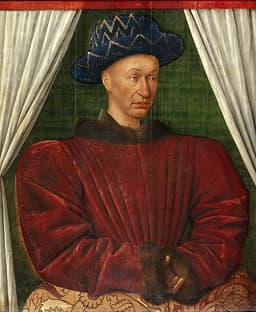
Charles VII of France
Emperor · Medieval
61.7Total

King Seongdeok
Emperor · Medieval
58.9Total
Basic Information
Born
1403
691
Died
1461
737
Era
Medieval
Medieval
Nationality
France
Korea
Occupation
Emperor
Emperor
Civilization
Western
Eastern
Score Comparison
Military (10%)
67.5
50.0
Political (20%)
70.0
68.0
Influence (20%)
56.7
62.0
Legacy (20%)
55.0
52.0
Leadership (15%)
66.0
72.0
Strategy (15%)
66.3
43.7
TOTAL
61.7
58.9
Charles VII of France — Complete Timeline
1429 AD
Siege of OrléansWar◆ Major
Joan of Arc, acting under Charles VII's authority, led French forces to lift the English siege of Orl
Hundred Years' WarSiegeJoan of Arc
Impact: regional
Coronation at ReimsPolitical Action
Charles VII was crowned King of France at Reims Cathedral, a traditional site for French coronations, following the military successes of Joan of Arc. This coronation legitimized his claim against the English-backed Henry VI and boosted French morale.
CoronationHundred Years' WarJoan of Arc
Impact: nationalconstructive
1435 AD
Treaty of ArrasPolitical Action◆ Major
Charles VII signed the Treaty of Arras with Philip the Good of Burgundy, ending the Burgundian alliance with England. This diplomatic victory isolated the English and paved the way for French reconquest of English-held territories.
TreatyBurgundyDiplomacy
Impact: regionalconstructive
1438 AD
Pragmatic Sanction of BourgesReform◆ Major
Charles VII issued the Pragmatic Sanction of Bourges, asserting the authority of the French crown over the Catholic Church in France. It limited papal interference in ecclesiastical appointments and revenues, strengthening royal control.
Church ReformRoyal AuthorityGallicanism
Impact: nationalconstructive
1453 AD
Battle of CastillonWar
French forces under Charles VII's command defeated the English at Castillon, the final battle of the Hundred Years' War. The English lost Gascony, ending their territorial presence in France except for Calais.
Hundred Years' WarBattleEnd of War
Impact: regional
King Seongdeok — Complete Timeline
702 AD
Ascended to the Throne of SillaPolitical Action◆ Major
Seongdeok became king of Unified Silla. His reign is considered a golden age of Silla culture and Buddhism.
AccessionSillaKorea
Impact: regional
720 AD
Promoted Astronomy and ScienceCultural
Seongdeok supported scientific advancements, including the construction of the Cheomseongdae astronomical observatory. This reflected the kingdom's interest in science and calendar-making.
ScienceAstronomySilla
Impact: regionalconstructive
Expert Analysis
Origins
Charles VII of France was born in 1403 to King Charles VI and Isabeau of Bavaria. His early life was marked by his father's bouts of insanity and the ongoing Hundred Years' War. He grew up in a fractured kingdom, with much of northern France under English control and the powerful Duchy of Burgundy allied with the English. His education was typical for a prince, but his legitimacy was questioned due to rumors of his mother's infidelity, casting a shadow over his claim to the throne.
King Seongdeok of Silla was born around 691 as Kim Heung-gwang, the second son of King Sinmun. He ascended the throne in 702 after the death of his older brother, King Hyoso. Silla had unified the Korean peninsula under its rule in 668, and Seongdeok inherited a stable kingdom with a flourishing Buddhist culture. His upbringing was steeped in the Confucian and Buddhist traditions of the Silla court, preparing him for a reign focused on cultural and religious patronage.
Rise to Power
Charles VII's rise was fraught with difficulty. In 1420, the Treaty of Troyes disinherited him in favor of Henry V of England, but Henry's death in 1422 left Charles as the contested heir. He controlled only a small territory south of the Loire River. His turning point came in 1429 when Joan of Arc, a peasant girl claiming divine guidance, arrived at his court. With her leadership, the French lifted the Siege of Orléans in May 1429, a major victory that reversed English momentum. Charles was crowned at Reims Cathedral in July 1429, a traditional site that legitimized his kingship. Joan's capture and execution in 1431 did not halt his advance; he continued to consolidate power.
King Seongdeok's rise was smoother as a legitimate heir. He became king in 702 without significant opposition. His reign was not marked by military conquest but by internal development. He focused on strengthening the central government and promoting Buddhism, which served as a unifying force in Unified Silla. His key allies were the Buddhist clergy and the aristocratic families who supported temple construction.
Leadership & Governance
Charles VII's leadership was pragmatic and focused on restoring royal authority. He reformed the French army, creating the first standing army (the compagnies d'ordonnance) in 1439, which reduced reliance on feudal levies. He also issued the Pragmatic Sanction of Bourges in 1438, asserting royal control over the French Church and limiting papal authority. His diplomatic skill was evident in the Treaty of Arras (1435), which reconciled with Burgundy, isolating England. His governance score of 70.0 reflects these achievements.
King Seongdeok's leadership was more cultural and religious. He commissioned Bulguksa Temple and Seokguram Grotto, masterpieces of Buddhist art and architecture. He also promoted astronomy, building the Cheomseongdae observatory in 647 (before his reign, but his support continued). His political score of 68.0 is high, but his military score of 50.0 indicates a lack of martial focus. He maintained peace through diplomacy and cultural prestige rather than force.
Triumph & Tragedy
Charles VII's greatest triumph was ending the Hundred Years' War, culminating in the Battle of Castillon in 1453, where the French artillery defeated the English, securing all English territories except Calais. His military score of 67.5 reflects his strategic use of artillery and professional army. However, his tragedy was his dependence on Joan of Arc and his failure to rescue her from execution, which tarnished his reputation. He also faced a rebellion of nobles (the Praguerie) in 1440, which he suppressed.
King Seongdeok's triumph was the cultural flourishing of Silla, symbolized by Bulguksa Temple and Seokguram Grotto, both UNESCO World Heritage sites today. His reign is considered a golden age of Silla Buddhism. His tragedy was the lack of military expansion; he did not strengthen the kingdom's defenses, leaving it vulnerable to future invasions. His overall score of 58.9 is lower than Charles VII's 61.7.
Character & Destiny
Charles VII was cautious and often indecisive, but he learned from experience. His character evolved from a timid dauphin to a determined king. He was known for his administrative reforms and patronage of the arts, but also for his paranoia and conflicts with his son, the future Louis XI. His destiny was to restore the French monarchy, setting the stage for France's emergence as a major power.
King Seongdeok was devout and visionary, focusing on cultural and religious projects. His character was less martial and more scholarly, which suited the peaceful conditions of his reign. However, his lack of military focus meant that Silla's military strength declined, leading to eventual decline after his death.
Legacy
Charles VII's legacy is as the king who won the Hundred Years' War and laid the foundations for the French Renaissance. His army reforms influenced European warfare, and his assertion of royal power strengthened the French state. He scored 55.0 in legacy, reflecting his role in ending the war.
King Seongdeok's legacy is primarily cultural. Bulguksa Temple and Seokguram Grotto remain iconic symbols of Korean Buddhist art. His support for science also left a mark, but his political legacy was limited as Silla declined in the following centuries. His legacy score is 52.0, slightly lower.
Conclusion
Charles VII had a greater impact on history. His military score of 67.5 compared to Seongdeok's 50.0, and his political score of 70.0 vs 68.0, show his superior strategic and governance skills. While Seongdeok's cultural contributions are significant, they did not alter the course of history as dramatically as Charles's end of the Hundred Years' War and the strengthening of the French state. Charles VII's total score of 61.7 versus Seongdeok's 58.9 confirms this. Therefore, Charles VII of France was the more impactful ruler.
Rankings
🥇
Charles VII of FranceLeader
Mil: 67.5Pol: 70.0Inf: 56.7
61.7
🥈
King Seongdeok
Mil: 50.0Pol: 68.0Inf: 62.0
58.9
+2.8 behind
How This Comparison Works
Algorithm
Each figure is scored on 6 dimensions (0—100 scale) based on structured historical data: Military (10%), Political (20%), Influence (20%), Legacy (20%), Leadership (15%), Strategy (15%). The weighted total produces the final ranking.
Data Sources
Scores are computed from structured sub-indicators in the database. Scale factors adjust for era (Ancient ×0.85, Modern ×1.0) and civilization size (Eastern ×1.05, Other ×0.80) to account for differences in population and military scale.
Maximum 3 Figures
Comparisons are limited to 2—3 figures to ensure readability and statistical meaningfulness.
Error Margins
±5 points per dimension — Sub-scores are derived from historical records with inherent uncertainty. Two figures within 5 points on a dimension should be considered roughly equivalent in that area.
Total Score Accuracy
±3 points overall — The weighted combination of 6 dimensions produces a total score with approximately ±3 points of uncertainty. Differences of less than 3 points are not statistically significant— the figures are effectively tied.
Known Limitations
- Historical records are incomplete and uneven across civilizations
- Figures from oral-tradition societies may be underrepresented
- Occupation labels can misclassify multi-role figures
- Scores measure capability and impact, not moral character
- Quantitative scoring is a comparison tool, not absolute truth
Capability Radar
Military (10%) — Battles & Warfare
Battles
65
20
Win Rate
70
25
Expansion
55
15
Political (20%) — Governance & Reform
Reform
85
55
Diplomacy
75
60
Economy
70
60
Influence (20%) — Cultural & Global Reach
Cultural
60
70
Global
55
40
Legacy (20%) — Historical Impact
Historical
75
65
Longevity
70
70
Leadership (15%) — Power & Stability
Tenure
70
65
Stability
65
65
Strategy (15%) — Tactics & Innovation
Strategy
75
20
Tactics
60
20
Reform
80
15
Similar Comparisons
Comments & Discussion
No comments yet. Be the first to share your thoughts!