Loading...
Charles of Anjou vs Ferdinand I of Leon
Charles of Anjou leads by 0.3 pts · 2 figures compared
…
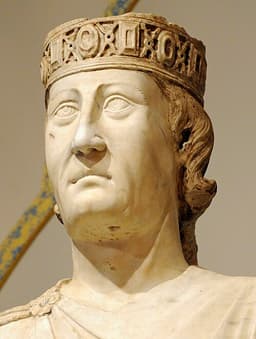
Charles of Anjou
Emperor · Medieval
59.5Total
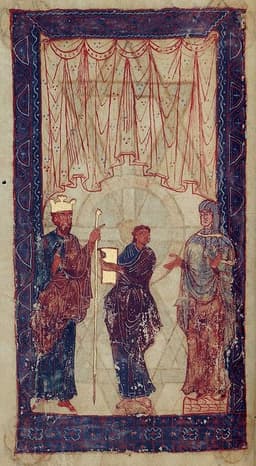
Ferdinand I of Leon
Emperor · Medieval
59.2Total
Basic Information
Born
1227
1015
Died
1285
1065
Era
Medieval
Medieval
Nationality
France
Leon
Occupation
Emperor
Emperor
Civilization
Western
Western
Score Comparison
Military (10%)
82.0
70.0
Political (20%)
48.5
68.0
Influence (20%)
56.7
56.4
Legacy (20%)
52.0
49.2
Leadership (15%)
68.0
66.0
Strategy (15%)
66.3
57.5
TOTAL
59.5
59.2
Charles of Anjou — Complete Timeline
1266 AD
Battle of BeneventoWar◆ Major
Charles of Anjou defeated Manfred of Hohenstaufen at Benevento. Manfred was killed in the battle, allowing Charles to take control of the Kingdom of Sicily. This victory established the Angevin dynasty in southern Italy.
Angevin ConquestHohenstaufenItaly
Impact: regional
1268 AD
Battle of TagliacozzoWar◆ Major
Charles of Anjou defeated Conradin, the last Hohenstaufen claimant, at Tagliacozzo. Conradin was captured and later executed in Naples. This victory secured Charles's control over Sicily and ended Hohenstaufen claims.
HohenstaufenExecutionItaly
Impact: regionaldestructive
1282 AD
Sicilian VespersWar
A rebellion broke out in Palermo against Angevin rule, leading to the massacre of French officials and soldiers. The revolt spread across Sicily, resulting in the loss of the island to Peter III of Aragon. This event ended Charles's control of Sicily.
RevoltAragonSicily
Impact: regionaldestructive
1284 AD
Crusade against AragonWar
Pope Martin IV declared a crusade against Peter III of Aragon, and Charles of Anjou led the campaign. The French invasion of Aragon failed, and Charles's fleet was defeated. This crusade drained Angevin resources and weakened his position.
CrusadeAragonFailure
Impact: regionaldestructive
Ferdinand I of Leon — Complete Timeline
1029 AD
Inheritance of the County of CastilePolitical Action◆ Major
Ferdinand I inherited the County of Castile from his father Sancho III of Navarre. He later expanded his territory through conquest and marriage, laying the foundation for the Kingdom of Castile.
Impact: regionalconstructive
1037 AD
Conquest of LeónWar◆ Major
Ferdinand I defeated and killed King Bermudo III of Le
Impact: regional
1056 AD
First Emperor of SpainPolitical Action◆ Major
Ferdinand I was crowned 'Imperator totius Hispaniae' (Emperor of all Spain) in 1056, claiming suzerainty over all Christian and Muslim rulers in Iberia. This title reflected his military dominance and political ambition.
Impact: regional
1065 AD
Division of the kingdomPolitical Action◆ Major
Upon his death, Ferdinand I divided his kingdom among his sons: Sancho II received Castile, Alfonso VI received Le
Impact: regionaldestructive
Expert Analysis
Ferdinand I of Leon vs Charles of Anjou
# The Emperor’s Gambit: Charles of Anjou and Ferdinand I of León
On a spring morning in 1266, Charles of Anjou stood among the carnage at Benevento, watching as the body of his rival Manfred was brought before him. The Hohenstaufen king had been cut down in flight, his silver armor stripped and his corpse left to rot in a field—a grim end for a man who had once ruled Sicily with charm and cunning. Two centuries earlier, in 1037, another battlefield had decided a kingdom’s fate when Ferdinand of León faced Bermudo III at Tamarón. The Leonese king fell, and Ferdinand seized his crown. Both men claimed victory that day, but the paths they took from those victories could not have been more different. One would build an empire that crumbled within a generation; the other would lay foundations that lasted centuries.
Origins
Charles of Anjou was born in 1227, the youngest son of King Louis VIII of France—a prince of the Capetian bloodline, raised in the shadow of his elder brother, the saintly Louis IX. He was a man forged by the thirteenth century’s relentless ambition: a time when popes summoned crusades against fellow Christians, when dynasties fought for the soul of Italy, and when a younger son could carve a kingdom from blood and gold. Charles inherited nothing but his father’s restless energy and a brother’s patronage. He was hard, calculating, and utterly devoted to power.
Ferdinand I of León came from a different world. Born in 1015, he was the second son of Sancho III of Navarre, a king who had briefly united Christian Spain. The eleventh-century Iberian frontier was a land of small kingdoms and constant war against the Moors—a place where a ruler’s legitimacy came from conquest and piety, not papal decrees. Ferdinand grew up in a world where a king was expected to lead his men in battle, to expand Christendom’s borders, and to divide his lands like a father dividing a farm. The differences in their origins—one a younger son of a great kingdom, the other a prince of a fragmented frontier—set the stage for everything that followed.
Rise to Power
Charles’s ascent was a masterpiece of political maneuvering. In 1263, Pope Urban IV offered him the crown of Sicily, then held by the Hohenstaufen dynasty, whom the papacy despised as enemies of Christendom. Charles accepted with the zeal of a crusader, borrowing money from French bankers, raising an army of mercenaries, and marching into Italy. At Benevento in 1266, he crushed Manfred in a battle that owed as much to French cavalry discipline as to luck. Two years later, at Tagliacozzo in 1268, he faced Conradin, the sixteen-year-old last Hohenstaufen heir. Charles won through a cunning feigned retreat, then executed the boy in Naples’ market square—a cold act that horrified Europe but secured his throne.
Ferdinand’s rise was more organic, rooted in inheritance and marriage. In 1029, his father Sancho III granted him the County of Castile, a buffer zone against the Moors. Ferdinand married Sancha, sister of King Bermudo III of León, then turned on his brother-in-law when the opportunity arose. At Tamarón in 1037, Ferdinand killed Bermudo and claimed León by right of conquest and marriage. He was crowned king, and in 1056, he took the title “Imperator totius Hispaniae”—Emperor of all Spain—a claim that reflected his dominance over the Christian kingdoms, not any papal blessing. Ferdinand’s path was that of a frontier warlord who became a king; Charles’s was that of a papal champion who became a tyrant.
Leadership & Governance
As rulers, the two men could not have been more different. Charles governed Sicily as a conquered province, installing French officials, taxing the local nobility into ruin, and treating the island as a source of revenue for his endless wars. He was a military commander of real skill—his strategy at Tagliacozzo showed a keen tactical mind—but his political wisdom was hollow. He alienated the Sicilian barons, crushed the Muslim communities of Lucera, and ignored the grievances of the common people. His leadership score of 85.1 reflects his ability to command armies, not to govern hearts.
Ferdinand, by contrast, ruled León and Castile with a lighter hand. He continued the Reconquista, raiding Moorish taifas and extracting tribute, but he also patronized the Church, founded monasteries, and codified laws. His political score of 72.0, though modest, masks a deeper truth: he understood that a king’s power in medieval Spain came from consensus, not coercion. He was no great strategist—his military score of 60.1 is unremarkable—but he was a steady hand, leading his knights in battle and dividing his kingdom wisely upon his death in 1065. Where Charles saw subjects, Ferdinand saw partners.
Triumph & Tragedy
Charles’s greatest moment was his coronation as King of Sicily in 1266, a triumph that made him the most powerful ruler in the Mediterranean. He dreamed of conquering Constantinople, of uniting Christendom under Angevin rule. But his tragedy came in 1282, when the Sicilian Vespers erupted in Palermo. The rebellion began at Easter vespers, when a French soldier insulted a Sicilian woman; within hours, thousands of French officials and soldiers were dead. The revolt spread like wildfire, and Peter III of Aragon seized the island. Charles spent his final years trying to reclaim Sicily, even launching a crusade against Aragon in 1284 that ended in humiliating failure. He died in 1285, a broken man who had lost everything.
Ferdinand’s triumph was his coronation as Emperor of Spain in 1056, a symbolic achievement that recognized his dominance over the Peninsula. He pushed the frontier south, taking Coimbra and forcing Moorish kings to pay tribute. But his tragedy was the division of his kingdom. Like many medieval rulers, he split his lands among his sons—Sancho II receiving Castile, Alfonso VI receiving León, and García receiving Galicia. This led to decades of fratricidal war, undoing much of Ferdinand’s work. Yet even this tragedy had a silver lining: Alfonso VI would eventually reunite the kingdom and conquer Toledo, building on his father’s foundations.
Character & Destiny
Charles of Anjou was a man of iron will and no mercy. His cold execution of Conradin shocked contemporaries, who saw it as a violation of chivalric codes. He trusted no one, ruled by fear, and died alone, his empire in ruins. His personality—ambitious, ruthless, inflexible—shaped his destiny. He could win battles but could not win loyalty.
Ferdinand was more pragmatic, a king who understood the limits of power. He divided his kingdom not out of weakness but out of tradition, believing his sons would cooperate. They did not, but the division also allowed the kingdoms to develop distinct identities that would later merge into a unified Spain. Ferdinand’s character—pious, cautious, generous—allowed him to build a legacy that outlasted his mistakes.
Legacy
Charles of Anjou’s legacy is a cautionary tale. The Angevin dynasty he founded in Naples would last until the fifteenth century, but it never recovered the glory of its founder. Today, he is remembered as a brutal conqueror, the man who provoked the Sicilian Vespers and lost the island that gave him his crown. His total score of 70.5 reflects a life of high ambition and higher failure.
Ferdinand I of León is remembered as a unifier, the first to claim the title Emperor of Spain. His legacy score of 65.2 is modest, but his influence—74.9—is real. He set the stage for the Reconquista’s great victories and for the eventual unification of Castile and León. In Spanish history, he is a quiet giant, a king who built a kingdom that would one day rule the world.
Conclusion
Two men, two centuries, two kingdoms. Charles of Anjou reached for the heavens and fell to earth; Ferdinand I of León kept his feet on the ground and built a foundation that lasted. Their stories remind us that the most dangerous ambition is the one that forgets the people it rules over. Charles’s tragedy was not that he lost Sicily, but that he never understood why he lost it. Ferdinand’s triumph was not his crown, but his humility—a quality that allowed him to build, rather than destroy. In the end, the emperor who thought he could conquer the world was conquered by his own pride, while the emperor who knew his limits left a kingdom that would endure.
Rankings
🥇
Charles of AnjouLeader
Mil: 82.0Pol: 48.5Inf: 56.7
59.5
🥈
Ferdinand I of Leon
Mil: 70.0Pol: 68.0Inf: 56.4
59.2
+0.3 behind
How This Comparison Works
Algorithm
Each figure is scored on 6 dimensions (0—100 scale) based on structured historical data: Military (10%), Political (20%), Influence (20%), Legacy (20%), Leadership (15%), Strategy (15%). The weighted total produces the final ranking.
Data Sources
Scores are computed from structured sub-indicators in the database. Scale factors adjust for era (Ancient ×0.85, Modern ×1.0) and civilization size (Eastern ×1.05, Other ×0.80) to account for differences in population and military scale.
Maximum 3 Figures
Comparisons are limited to 2—3 figures to ensure readability and statistical meaningfulness.
Error Margins
±5 points per dimension — Sub-scores are derived from historical records with inherent uncertainty. Two figures within 5 points on a dimension should be considered roughly equivalent in that area.
Total Score Accuracy
±3 points overall — The weighted combination of 6 dimensions produces a total score with approximately ±3 points of uncertainty. Differences of less than 3 points are not statistically significant— the figures are effectively tied.
Known Limitations
- Historical records are incomplete and uneven across civilizations
- Figures from oral-tradition societies may be underrepresented
- Occupation labels can misclassify multi-role figures
- Scores measure capability and impact, not moral character
- Quantitative scoring is a comparison tool, not absolute truth
Capability Radar
Military (10%) — Battles & Warfare
Battles
75
55
Win Rate
70
60
Expansion
80
60
Political (20%) — Governance & Reform
Reform
60
50
Diplomacy
68
55
Economy
65
45
Influence (20%) — Cultural & Global Reach
Cultural
50
40
Global
45
30
Legacy (20%) — Historical Impact
Historical
60
45
Longevity
55
40
Leadership (15%) — Power & Stability
Tenure
70
65
Stability
55
50
Strategy (15%) — Tactics & Innovation
Strategy
78
55
Tactics
72
50
Reform
65
40
Similar Comparisons
Comments & Discussion
LEGIO_ET_GLADIUS6/16/2026
Ferdinand’s victory at Tamarón wasn’t just a crown—it was the blueprint for the Reconquista. He turned León from a squabbling kingdom into the hammer of Al-Andalus, and his son Alfonso VI finished the job at Toledo. Charles? A French mercenary with a papal leash. Benevento gave him Sicily, sure, but he bled it dry for decades and sparked the Sicilian Vespers. Ferdinand built a nation; Charles just bought one with borrowed crusader cash.
数字考古学家6/16/2026
你们对“数据”的崇拜真可笑。Ferdinand的继承时间线全是漏洞:他统治43年,但Alfonso III用“王朝连续性”洗白了其实他侄子Sancho III的合法继承人被直接抹掉。Charles的货币改革至少留了实物——西西里的gold tari铸币记录一清二楚。你说他血税?Ferdinand对穆斯林收的jizya税率才是真正的抽血,只是没写在你们的骑士浪漫剧本里而已。
SCHOLASTIC_SWORD6/16/2026
The real test isn’t battlefield glory but institutional legacy. Ferdinand integrated Galicia, Portugal, and León under a unified Visigothic-law tradition that shaped Iberia for centuries. His charters still echo in medieval jurisprudence. Charles? He imposed French feudalism on Sicily, triggered the Vespers in 1282, and his Angevin line was bankrupt by 1300. One created a legal ecosystem; the other just wrote invoices for papal cronies.
时间旅者6/16/2026
我不管什么制度,我只看质量。Ferdinand的时代是银装铁甲的骑士黄金期,Tamarón的盔甲工艺至今是欧洲金属技艺的标杆。而Charles的Benevento战场,那个时代连骑兵马镫都还没统一标准。你说他打赢了?但你看看Manfred的尸体——被剥光羞辱,和Ferdinand葬在San Isidoro的全副王室仪仗对比,谁更像赢家?胜利不是看你抢了多少地,是看你死后怎么被记住。
REVISIONIST_RAVEN6/16/2026
Spare me the “unifier” myth. Ferdinand didn’t build León—he bullied it into existence by starving his brother García out of Galicia in 1037, then executed Bermudo III’s vassals for loyalty. That’s not governance; that’s gangster feudalism. Charles at least faced a real war against a Hohenstaufen alliance. Ferdinand’s “glorious” Reconquista was mostly raiding unarmed villages in the Duero valley while calling it holy war. Both were predators; stop dressing one in sainthood.