Loading...
Charles I of Anjou vs Wenceslaus IV
Charles I of Anjou leads by 18.8 pts · 2 figures compared
…
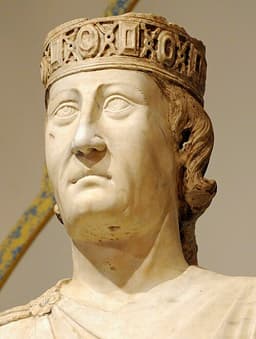
Charles I of Anjou
Emperor · Medieval
63.6Total

Wenceslaus IV
Emperor · Medieval
44.8Total
Basic Information
Born
1227
1361
Died
1285
1419
Era
Medieval
Medieval
Nationality
France
Holy Roman Empire
Occupation
Emperor
Emperor
Civilization
Western
Western
Score Comparison
Military (10%)
82.0
25.9
Political (20%)
68.0
30.8
Influence (20%)
62.0
53.3
Legacy (20%)
52.0
45.8
Leadership (15%)
67.0
58.8
Strategy (15%)
66.3
39.6
TOTAL
63.6
44.8
Charles I of Anjou — Complete Timeline
1266 AD
Conquest of the Kingdom of SicilyWar◆ Major
Charles I of Anjou defeated Manfred of Hohenstaufen at the Battle of Benevento, conquering the Kingdom of Sicily. He was crowned king in Rome with papal support, establishing Angevin rule in southern Italy.
ConquestSicilyAngevin
Impact: regional
1268 AD
Battle of TagliacozzoWar◆ Major
Charles I defeated Conradin of Hohenstaufen at the Battle of Tagliacozzo, ending Hohenstaufen claims to Sicily. Conradin was captured and later executed, solidifying Angevin control and earning Charles a reputation for ruthlessness.
BattleHohenstaufenExecution
Impact: regionaldestructive
1270 AD
Planned crusade against the Byzantine EmpirePolitical Action◆ Major
Charles I negotiated with the Pope and other powers to launch a crusade against the Byzantine Empire, aiming to restore the Latin Empire. He used Sicily as a base for naval preparations, but the plan was delayed by the Eighth Crusade.
CrusadeByzantineDiplomacy
Impact: regional
1282 AD
Sicilian VespersWar◆ Major
A popular uprising in Palermo, known as the Sicilian Vespers, expelled Angevin rule from Sicily. The revolt was supported by Peter III of Aragon, leading to a war that cost Charles control of the island and weakened his power.
RevoltSicilyAragon
Impact: regionaldestructive
1285 AD
Death and collapse of Angevin ambitionsOther◆ Major
Charles I died at Foggia, leaving his son Charles II a reduced kingdom. The loss of Sicily and the ongoing war with Aragon ended his dreams of a Mediterranean empire, and the Angevin dynasty never recovered its former power.
DeathAngevinDecline
Impact: regionaltragic
Wenceslaus IV — Complete Timeline
1394 AD
Imprisonment by the Bohemian NobilityPolitical Action
A league of Bohemian nobles, led by the House of Rosenberg, captured Wenceslaus IV and held him prisoner at Wildberg Castle. The nobles demanded greater political influence and the removal of his unpopular advisors. Wenceslaus was released after several months through the intervention of his half-brother Sigismund.
Noble RevoltImprisonmentBohemia
tragic
1400 AD
Deposition as King of the RomansPolitical Action◆ Major
The four Rhenish electors deposed Wenceslaus IV as King of the Romans, citing his incompetence, drunkenness, and failure to maintain peace in the Empire. They elected Rupert of the Palatinate as his successor. Wenceslaus refused to accept the deposition but retained the title of King of Bohemia.
DepositionImperial PoliticsElectors
Impact: regionaltragic
1412 AD
Conflict with Jan HusPolitical Action◆ Major
Wenceslaus IV supported the sale of indulgences by Pope John XXIII to fund a crusade. Jan Hus publicly condemned this practice, leading to a rift between the king and the reformer. Wenceslaus initially protected Hus but later withdrew support under pressure from the clergy.
Hussite MovementReligious ConflictIndulgences
Impact: regionaldestructive
1419 AD
Defenestration of Prague (1419)Political Action
A Hussite procession led by priest Jan
Hussite WarsDefenestrationRevolt
Impact: regionaldestructive
Expert Analysis
Origins
Charles I of Anjou (1226-1285) was the youngest son of King Louis VIII of France and Blanche of Castile. Born into the Capetian dynasty, he was granted the county of Anjou and Maine as an appanage. His upbringing in the French court instilled in him a sense of ambition and military prowess, but he lacked the direct inheritance of a crown, driving him to seek his own kingdom.
Wenceslaus IV (1361-1419) was born into the Luxembourg dynasty, the son of Holy Roman Emperor Charles IV and Anna of Świdnica. He inherited the Kingdom of Bohemia and the title of King of the Romans at a young age. His education was overseen by his father, but Wenceslaus developed a reputation for indolence and a love of hunting and drinking, contrasting with his father's capable rule.
Rise to Power
Charles I rose to power through military conquest. In 1266, Pope Clement IV offered him the Kingdom of Sicily as a papal fief, seeking to oust the Hohenstaufen dynasty. Charles defeated Manfred of Hohenstaufen at the Battle of Benevento (1266) and later crushed Conradin at Tagliacozzo (1268), securing his rule. He was crowned king in Rome with papal approval, establishing a powerful Angevin state.
Wenceslaus IV ascended to the throne of Bohemia in 1378 upon his father's death. He was already crowned King of the Romans in 1376. However, his reign was marked by conflict with the Bohemian nobility and the Catholic Church. His inability to manage the growing religious tensions, particularly the teachings of Jan Hus, led to his deposition as King of the Romans in 1400 by the Rhenish electors, who cited his incompetence.
Leadership & Governance
Charles I was an authoritarian ruler who centralized power in Sicily. He imposed heavy taxes to fund his military campaigns, including a planned crusade against the Byzantine Empire. His governance favored French officials over local Sicilians, creating resentment. He also clashed with the papacy over control of Sicily, showing his ambition but also his inflexibility.
Wenceslaus IV's leadership was weak and indecisive. He attempted to balance between the Catholic Church and the reformist Hussites but failed to satisfy either. His support for the sale of indulgences alienated Jan Hus, leading to Hus's excommunication and execution. Wenceslaus's imprisonment by Bohemian nobles in 1394 reflected his loss of authority. His political score of 30.8 and leadership score of 58.8 indicate his struggles.
Triumph & Tragedy
Charles I's greatest triumph was conquering and ruling Sicily, expanding Angevin influence across the Mediterranean. He also secured the execution of Conradin, ending Hohenstaufen claims. However, his tragedy was the Sicilian Vespers in 1282, a popular uprising that expelled Angevin rule from Sicily. Supported by Peter III of Aragon, the revolt shattered Charles's dream of a Mediterranean empire. His death in 1285 left his son a reduced kingdom.
Wenceslaus IV's achievements include his early coronation as King of the Romans and his patronage of culture, such as the construction of Karlštejn Castle. However, his reign was plagued by failure: his deposition in 1400, the rise of the Hussite movement, and the Defenestration of Prague in 1419, which sparked the Hussite Wars. His military score of 25.9 reflects his inability to suppress rebellion.
Character & Destiny
Charles I was ambitious, ruthless, and determined. His military score of 82.0 and strategy score of 66.3 show his capabilities, but his political score of 68.0 indicates his failure to secure lasting support. His harsh rule provoked rebellion, leading to his downfall. Historian Steven Runciman described him as 'a man of great ability but little wisdom.'
Wenceslaus IV was lethargic, prone to alcoholism, and indecisive. His political score of 30.8 and strategy score of 39.6 illustrate his poor governance. His inability to address the Hussite crisis allowed it to escalate into a full-scale war. His legacy is overshadowed by his father's achievements and the turmoil of his reign.
Legacy
Charles I's legacy is mixed. He established the Angevin dynasty in Naples, which lasted until the 15th century. His ambition influenced Mediterranean politics, but the Sicilian Vespers demonstrated the limits of his power. His total score of 63.6 reflects his military successes but political failures.
Wenceslaus IV's legacy is primarily tied to the Hussite Wars, which erupted after his death. His inaction contributed to the religious schism in Bohemia. He is remembered as a weak ruler, with a total score of 44.8, significantly lower than Charles I.
Conclusion
Charles I of Anjou had a greater impact than Wenceslaus IV, with a score gap of 18.8 points. Charles's military conquests shaped Mediterranean geopolitics, while Wenceslaus's reign was marked by decline and rebellion. Although both faced failures, Charles's achievements in conquering Sicily and his ambitious plans outweigh Wenceslaus's ineffective rule. Charles I's score of 63.6 versus Wenceslaus's 44.8 supports this conclusion.
Rankings
🥇
Charles I of AnjouLeader
Mil: 82.0Pol: 68.0Inf: 62.0
63.6
🥈
Wenceslaus IV
Mil: 25.9Pol: 30.8Inf: 53.3
44.8
+18.8 behind
How This Comparison Works
Algorithm
Each figure is scored on 6 dimensions (0—100 scale) based on structured historical data: Military (10%), Political (20%), Influence (20%), Legacy (20%), Leadership (15%), Strategy (15%). The weighted total produces the final ranking.
Data Sources
Scores are computed from structured sub-indicators in the database. Scale factors adjust for era (Ancient ×0.85, Modern ×1.0) and civilization size (Eastern ×1.05, Other ×0.80) to account for differences in population and military scale.
Maximum 3 Figures
Comparisons are limited to 2—3 figures to ensure readability and statistical meaningfulness.
Error Margins
±5 points per dimension — Sub-scores are derived from historical records with inherent uncertainty. Two figures within 5 points on a dimension should be considered roughly equivalent in that area.
Total Score Accuracy
±3 points overall — The weighted combination of 6 dimensions produces a total score with approximately ±3 points of uncertainty. Differences of less than 3 points are not statistically significant— the figures are effectively tied.
Known Limitations
- Historical records are incomplete and uneven across civilizations
- Figures from oral-tradition societies may be underrepresented
- Occupation labels can misclassify multi-role figures
- Scores measure capability and impact, not moral character
- Quantitative scoring is a comparison tool, not absolute truth
Capability Radar
Military (10%) — Battles & Warfare
Battles
75
20
Win Rate
70
15
Expansion
80
5
Political (20%) — Governance & Reform
Reform
55
30
Diplomacy
50
25
Economy
60
20
Influence (20%) — Cultural & Global Reach
Cultural
45
30
Global
55
20
Legacy (20%) — Historical Impact
Historical
60
40
Longevity
50
35
Leadership (15%) — Power & Stability
Tenure
60
60
Stability
30
15
Strategy (15%) — Tactics & Innovation
Strategy
78
10
Tactics
72
10
Reform
65
5
Similar Comparisons
Comments & Discussion
No comments yet. Be the first to share your thoughts!