Loading...
Charles I of Anjou vs Stephen the Great
Charles I of Anjou leads by 2.0 pts · 2 figures compared
…
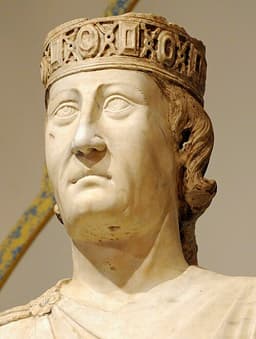
Charles I of Anjou
Emperor · Medieval
63.6Total
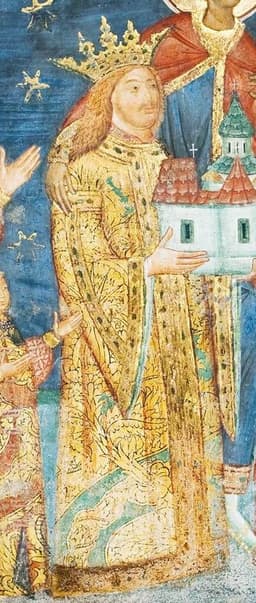
Stephen the Great
Emperor · Medieval
61.6Total
Basic Information
Born
1227
1433
Died
1285
1504
Era
Medieval
Medieval
Nationality
France
Moldavia
Occupation
Emperor
Emperor
Civilization
Western
Western
Score Comparison
Military (10%)
82.0
67.3
Political (20%)
68.0
59.3
Influence (20%)
62.0
55.0
Legacy (20%)
52.0
55.0
Leadership (15%)
67.0
78.0
Strategy (15%)
66.3
68.1
TOTAL
63.6
61.6
Charles I of Anjou — Complete Timeline
1266 AD
Conquest of the Kingdom of SicilyWar◆ Major
Charles I of Anjou defeated Manfred of Hohenstaufen at the Battle of Benevento, conquering the Kingdom of Sicily. He was crowned king in Rome with papal support, establishing Angevin rule in southern Italy.
ConquestSicilyAngevin
Impact: regional
1268 AD
Battle of TagliacozzoWar◆ Major
Charles I defeated Conradin of Hohenstaufen at the Battle of Tagliacozzo, ending Hohenstaufen claims to Sicily. Conradin was captured and later executed, solidifying Angevin control and earning Charles a reputation for ruthlessness.
BattleHohenstaufenExecution
Impact: regionaldestructive
1270 AD
Planned crusade against the Byzantine EmpirePolitical Action◆ Major
Charles I negotiated with the Pope and other powers to launch a crusade against the Byzantine Empire, aiming to restore the Latin Empire. He used Sicily as a base for naval preparations, but the plan was delayed by the Eighth Crusade.
CrusadeByzantineDiplomacy
Impact: regional
1282 AD
Sicilian VespersWar◆ Major
A popular uprising in Palermo, known as the Sicilian Vespers, expelled Angevin rule from Sicily. The revolt was supported by Peter III of Aragon, leading to a war that cost Charles control of the island and weakened his power.
RevoltSicilyAragon
Impact: regionaldestructive
1285 AD
Death and collapse of Angevin ambitionsOther◆ Major
Charles I died at Foggia, leaving his son Charles II a reduced kingdom. The loss of Sicily and the ongoing war with Aragon ended his dreams of a Mediterranean empire, and the Angevin dynasty never recovered its former power.
DeathAngevinDecline
Impact: regionaltragic
Stephen the Great — Complete Timeline
1470 AD
Construction of Fortresses and ChurchesCultural◆ Major
Stephen the Great commissioned the construction of numerous fortresses, including those at Suceava, Neam
ArchitectureFortificationsOrthodox Church
Impact: nationalconstructive
1475 AD
Battle of VasluiWar
Stephen the Great led a Moldavian army of about 40,000 men against an Ottoman force of up to 120,000 under Had
BattleOttoman EmpireMoldavia
Impact: regional
1476 AD
Battle of Valea AlbăWar◆ Major
Stephen the Great suffered a major defeat at Valea Alb
BattleMehmed IIDefeat
Impact: regionaltragic
1489 AD
Treaty with the Ottoman EmpirePolitical Action◆ Major
Stephen the Great signed a treaty with Sultan Bayezid II, agreeing to pay an annual tribute to the Ottoman Empire in exchange for peace. The treaty recognized Moldavia's autonomy and ended decades of warfare, though it placed Moldavia in a vassal relationship with the Ottomans.
TreatyVassalageBayezid II
Impact: regional
Expert Analysis
Origins
Charles I of Anjou (1227–1285) was the youngest son of King Louis VIII of France and Blanche of Castile. Born into the Capetian dynasty, he was granted the county of Anjou and Maine in 1246. His marriage to Beatrice of Provence in 1246 brought him claims to Provence and influence in Mediterranean affairs. Charles's upbringing in the French court instilled in him a sense of royal authority and ambition for territorial expansion.
Stephen the Great (1433–1504), born as Stephen III of Moldavia, was the son of Prince Bogdan II. His early life was marked by political instability; his father was assassinated in 1451, and Stephen fled to the court of his cousin, Vlad III Drăculea of Wallachia. He returned to Moldavia in 1457 and seized the throne with the help of Vlad. Stephen's formative experiences were shaped by the constant threat of Ottoman expansion and internal power struggles.
Rise to Power
Charles I rose to prominence through papal support. In 1263, Pope Urban IV offered him the crown of Sicily, then held by the Hohenstaufen dynasty. Charles accepted and led a campaign against Manfred of Hohenstaufen. At the Battle of Benevento (1266), Charles's forces defeated and killed Manfred, allowing Charles to be crowned King of Sicily. He secured his rule by defeating Conradin at the Battle of Tagliacozzo (1268) and executing him, ending Hohenstaufen claims. Charles's rise was swift, backed by French knights and papal legitimacy.
Stephen the Great seized power in Moldavia in 1457 after a rebellion against his uncle, Petru Aron, who had murdered his father. With support from Vlad the Impaler, Stephen defeated Petru and became prince. He quickly consolidated power by executing rival boyars and strengthening the military. His early reign focused on securing Moldavia's borders against Hungarian and Polish interference, and he successfully repelled a Hungarian invasion in 1467. Stephen's rise was a product of his military acumen and ability to navigate complex regional politics.
Leadership & Governance
Charles I ruled Sicily with an authoritarian hand. He centralized administration, imposed heavy taxes to fund his military campaigns, and replaced local nobles with French officials. His governance prioritized expansion: he built a powerful navy and army, and planned a crusade against the Byzantine Empire. However, his heavy-handed rule alienated the Sicilian population, leading to resentment. Charles's leadership style was aggressive and expansionist, scoring 67.0 in leadership, but his political score of 68.0 reflects his inability to maintain local support.
Stephen the Great ruled Moldavia as a defender of the realm. He strengthened the principality's defenses by building fortresses (Suceava, Neamț, Hotin) and reforming the army. He also promoted the Orthodox Church, building monasteries and churches (e.g., Voroneț Monastery). Stephen's governance was more conciliatory towards local boyars, though he did not hesitate to suppress opposition. His leadership score of 78.0 reflects his effectiveness in rallying his people against external threats, but his political score of 59.3 indicates challenges in maintaining stability under Ottoman pressure.
Triumph & Tragedy
Charles I's greatest triumph was the conquest of Sicily, eliminating the Hohenstaufen threat and establishing Angevin rule. He also expanded his influence into the Balkans and planned a crusade to restore the Latin Empire. His tragedy was the Sicilian Vespers (1282), a popular uprising that expelled Angevin rule from Sicily. The revolt, supported by Peter III of Aragon, led to a war that drained Charles's resources and ended his Mediterranean ambitions. He died in 1285 with his kingdom reduced and his plans unfulfilled.
Stephen the Great's greatest triumph was the Battle of Vaslui (1475), where he defeated a large Ottoman army of up to 120,000 with only 40,000 men. This victory earned him European recognition and a temporary respite from Ottoman pressure. However, his tragedy came at the Battle of Valea Albă (1476), where Sultan Mehmed II's invasion overwhelmed his forces. Stephen was forced to sign a treaty with the Ottomans in 1489, agreeing to pay tribute. Despite his military prowess, he could not permanently secure Moldavia's independence.
Character & Destiny
Charles I was ambitious, ruthless, and determined. His character drove him to pursue grand schemes, but his arrogance and lack of sensitivity to local interests led to his downfall. He scored 66.3 in strategy, showing competence but not brilliance. His destiny was shaped by his overreach: the Sicilian Vespers was a direct consequence of his oppressive rule. Historians view him as a capable conqueror who failed to consolidate his gains.
Stephen the Great was pragmatic, resilient, and deeply religious. He cultivated an image as a defender of Christianity, which helped him secure support from the Pope and other European powers. His character enabled him to endure repeated Ottoman invasions, but his realism forced him to accept tributary status. His strategy score of 68.1 reflects his ability to adapt. He was canonized by the Romanian Orthodox Church for his role in preserving Moldavian identity and faith.
Legacy
Charles I's legacy is mixed. He founded the Angevin dynasty in Naples, which lasted until 1435, but his failure in Sicily limited his impact. His influence score of 62.0 and legacy score of 52.0 reflect his short-lived empire. The Sicilian Vespers became a symbol of resistance against foreign rule. His plans for a Byzantine crusade never materialized, and his Mediterranean ambitions collapsed.
Stephen the Great's legacy is far more enduring. He is remembered as a national hero in Romania and Moldova, and his military campaigns are studied for their tactical brilliance. His construction of fortresses and churches left a lasting architectural heritage. His canonization in 1992 solidified his status as a spiritual defender. His influence score of 55.0 and legacy score of 55.0, while lower than Charles's total, reflect a deeper cultural and religious impact that persists to this day.
Conclusion
While Charles I of Anjou achieved a higher total score (63.6 vs 61.6) and conquered a major kingdom, his legacy is tarnished by the Sicilian Vespers and the collapse of his ambitions. Stephen the Great, despite a lower total score, had a more lasting impact: he successfully defended Moldavia for decades, built a national identity, and was canonized. Charles's military score of 82.0 exceeds Stephen's 67.3, but Stephen's leadership score of 78.0 surpasses Charles's 67.0. In terms of enduring influence, Stephen the Great had greater impact because he shaped the cultural and religious identity of a nation that survives to this day, whereas Charles's empire dissolved shortly after his death. Therefore, Stephen the Great emerges as the more significant historical figure.
Rankings
🥇
Charles I of AnjouLeader
Mil: 82.0Pol: 68.0Inf: 62.0
63.6
🥈
Stephen the Great
Mil: 67.3Pol: 59.3Inf: 55.0
61.6
+2.0 behind
How This Comparison Works
Algorithm
Each figure is scored on 6 dimensions (0—100 scale) based on structured historical data: Military (10%), Political (20%), Influence (20%), Legacy (20%), Leadership (15%), Strategy (15%). The weighted total produces the final ranking.
Data Sources
Scores are computed from structured sub-indicators in the database. Scale factors adjust for era (Ancient ×0.85, Modern ×1.0) and civilization size (Eastern ×1.05, Other ×0.80) to account for differences in population and military scale.
Maximum 3 Figures
Comparisons are limited to 2—3 figures to ensure readability and statistical meaningfulness.
Error Margins
±5 points per dimension — Sub-scores are derived from historical records with inherent uncertainty. Two figures within 5 points on a dimension should be considered roughly equivalent in that area.
Total Score Accuracy
±3 points overall — The weighted combination of 6 dimensions produces a total score with approximately ±3 points of uncertainty. Differences of less than 3 points are not statistically significant— the figures are effectively tied.
Known Limitations
- Historical records are incomplete and uneven across civilizations
- Figures from oral-tradition societies may be underrepresented
- Occupation labels can misclassify multi-role figures
- Scores measure capability and impact, not moral character
- Quantitative scoring is a comparison tool, not absolute truth
Capability Radar
Military (10%) — Battles & Warfare
Battles
75
72
Win Rate
70
78
Expansion
80
65
Political (20%) — Governance & Reform
Reform
55
75
Diplomacy
50
80
Economy
60
70
Influence (20%) — Cultural & Global Reach
Cultural
45
65
Global
55
55
Legacy (20%) — Historical Impact
Historical
60
70
Longevity
50
60
Leadership (15%) — Power & Stability
Tenure
60
85
Stability
30
75
Strategy (15%) — Tactics & Innovation
Strategy
78
80
Tactics
72
75
Reform
65
70
Similar Comparisons
Comments & Discussion
No comments yet. Be the first to share your thoughts!