Loading...
Charles Augustus of Saxe-Weimar vs Yelu Abaoji
Yelu Abaoji leads by 6.9 pts · 2 figures compared
…

Charles Augustus of Saxe-Weimar
Emperor · Modern
55.8Total
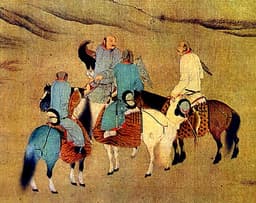
Yelu Abaoji
Emperor · Medieval
62.7Total
Basic Information
Born
1757
872
Died
1828
926
Era
Modern
Medieval
Nationality
Saxe-Weimar
China
Occupation
Emperor
Emperor
Civilization
Western
Eastern
Score Comparison
Military (10%)
20.0
77.2
Political (20%)
70.0
59.6
Influence (20%)
55.0
68.0
Legacy (20%)
52.0
40.0
Leadership (15%)
82.0
80.3
Strategy (15%)
42.3
69.6
TOTAL
55.8
62.7
Charles Augustus of Saxe-Weimar — Complete Timeline
1775 AD
Patronage of Johann Wolfgang von GoetheCultural◆ Major
Charles Augustus invited Goethe to Weimar and appointed him to various governmental positions. This patronage created the Weimar Classicism cultural movement and made Weimar a major intellectual center in Europe.
Weimar ClassicismGoetheCultural Patronage
Impact: globalconstructive
1806 AD
Joined the Rhine ConfederationPolitical Action◆ Major
Charles Augustus allied Saxe-Weimar with Napoleon's Confederation of the Rhine, gaining territorial enlargement and sovereign status. This decision preserved his duchy's autonomy during the Napoleonic Wars but tied it to French hegemony.
Napoleonic WarsConfederation of the RhineAlliance
Impact: regional
1813 AD
Fought at the Battle of LeipzigWar◆ Major
Charles Augustus switched sides and fought with the Allied coalition against Napoleon at the Battle of Leipzig. His troops participated in the decisive defeat of Napoleon, contributing to the liberation of German states from French control.
Battle of LeipzigNapoleonic WarsCoalition
Impact: regional
1816 AD
Granted the Constitution of 1816Political Action◆ Major
Charles Augustus issued a constitution for Saxe-Weimar-Eisenach, making him the first German ruler to grant a constitution. This established a bicameral parliament and guaranteed basic rights, setting a precedent for constitutionalism in the German states.
ConstitutionConstitutionalismGerman States
Impact: nationalprogressive
Yelu Abaoji — Complete Timeline
907 AD
Unified Khitan tribesPolitical Action◆ Major
Yelu Abaoji was elected khagan of the Khitan tribes, unifying them under his leadership. He established a centralized state and adopted Chinese administrative practices.
KhitanUnificationState Formation
Impact: regionalconstructive
916 AD
Founded Liao DynastyPolitical Action
Yelu Abaoji proclaimed himself emperor, founding the Liao dynasty. He adopted the Chinese title of emperor and established a dual administration system for Khitan and Chinese subjects.
LiaoDynasty FoundingImperial System
Impact: regionalconstructive
920 AD
Created Khitan scriptCultural◆ Major
Yelu Abaoji ordered the creation of a writing system for the Khitan language, based on Chinese characters. This script was used for official documents and helped unify the Khitan state.
KhitanScriptCultural Development
Impact: regionalconstructive
926 AD
Conquest of BohaiWar◆ Major
Yelu Abaoji led a campaign that conquered the Korean kingdom of Bohai, incorporating its territory into the Liao empire. This expanded Liao's influence into Manchuria and Korea.
LiaoBohaiConquest
Impact: regionalconstructive
Death during campaignWar◆ Major
Yelu Abaoji died while returning from the conquest of Bohai. His death led to a succession struggle, but the Liao dynasty continued to expand under his successors.
LiaoDeathSuccession
Impact: regionaltragic
Expert Analysis
Charles Augustus of Saxe-Weimar vs Yelu Abaoji
### The Emperor and the Enlightener
In the year 916, a Khitan chieftain whose name would echo across the steppes proclaimed himself emperor of a new dynasty, wielding Chinese titles and a script he had ordered carved from borrowed characters. Nine centuries later, in a tiny German duchy, a young prince invited a poet to his court and, in doing so, planted the seeds of a very different kind of rule. Yelu Abaoji and Charles Augustus of Saxe-Weimar both led, but they led worlds apart—one forged an empire from the ashes of tribal warfare, the other shaped a principality through patronage and constitutional reform. What drove these two men, separated by time and temperament, to such different destinies?
### Origins
Yelu Abaoji was born in 872 into the fractious world of the Khitan, a nomadic people living on the northern fringe of Chinese civilization. His era was one of constant struggle: the Tang dynasty was collapsing, and the steppes were a mosaic of warring tribes. Survival demanded cunning, strength, and the ability to unite. Abaoji learned early that power came not from birth alone but from the sword and the promise of order. His upbringing was harsh, mobile, and steeped in the rhythms of the horse and the yurt.
Charles Augustus, born in 1757, entered a world of courts, libraries, and Enlightenment ideas. The duchy of Saxe-Weimar was small, its influence negligible on the European stage. But his mother, Duchess Anna Amalia, cultivated a court that prized learning and the arts. Charles Augustus grew up surrounded by thinkers, reading Voltaire and Rousseau, and absorbing the belief that a ruler’s duty was not merely to command but to improve. His era—the late 18th century—was one of revolution in thought, if not yet in politics.
### Rise to Power
Abaoji’s path was forged in battle. By 907, after years of maneuvering among rival Khitan clans, he was elected khagan—a title that meant little without enforcement. He immediately centralized authority, crushing dissent and demanding loyalty. His power rested on his ability to lead warriors and to outthink his enemies. The key turning point came in 916, when he abandoned the old tribal title and proclaimed himself emperor of the Liao dynasty, adopting Chinese court rituals and asserting a divine mandate. It was a bold leap from chieftain to sovereign.
Charles Augustus rose to power more quietly. He became duke of Saxe-Weimar at the age of 18 in 1775, inheriting a state that was small but stable. His first major act was not a conquest but an invitation: he called Johann Wolfgang von Goethe to Weimar and appointed him to government posts. This decision, born of youthful enthusiasm and a love for poetry, would define his reign. While Abaoji conquered tribes, Charles Augustus cultivated minds.
### Leadership & Governance
Abaoji’s leadership was a blend of Khitan ferocity and Chinese sophistication. He created a dual administration—one for the nomadic tribes, one for the settled Chinese population—allowing him to rule a diverse empire. His political score of 90.0 reflects a genius for structure: he established a centralized state, ordered the creation of a Khitan script in 920 based on Chinese characters, and promoted agriculture and trade. Yet his military score of 73.3 shows he was no mere conqueror; his strategy was pragmatic, not reckless. He expanded the Liao empire methodically, culminating in the 926 conquest of the Korean kingdom of Bohai.
Charles Augustus governed on a smaller scale but with a different vision. His political score of 80.0 and leadership score of 82.0 highlight a ruler who understood the power of ideas. In 1806, he allied with Napoleon’s Confederation of the Rhine, gaining territory and sovereignty—a move of survival, not idealism. But in 1813, he switched sides at the Battle of Leipzig, fighting alongside the Allies. His greatest reform came in 1816, when he granted Saxe-Weimar-Eisenach a constitution, making him the first German ruler to do so. It was a quiet revolution, establishing a parliament and civil rights, guided by the Enlightenment principles he had absorbed as a youth.
### Triumph & Tragedy
Abaoji’s greatest triumph was the conquest of Bohai in 926, which doubled his empire’s territory and secured its eastern flank. Yet his tragedy came immediately after: he died on the return march, leaving a succession struggle that threatened his life’s work. His death was a reminder that even the mightiest warlord cannot control the future.
Charles Augustus’s triumph was the Weimar court itself—a cultural flowering that drew Goethe, Schiller, and Herder, turning a backwater into a beacon of German classicism. His tragedy was more subtle: his constitution, though progressive, was limited by the conservative forces of the era, and his duchy remained a minor power. He never saw the unification of Germany or the full realization of his ideals.
### Character & Destiny
Abaoji was a pragmatist and a visionary. He saw that the Khitan could not survive as a loose confederation; they needed a state, a script, a bureaucracy. His personality was one of relentless ambition tempered by calculation. He died with his empire intact, but his destiny was to build, not to enjoy.
Charles Augustus was a romantic who became a reformer. His patronage of Goethe was not mere vanity; it was a recognition that culture shapes governance. He believed that a ruler’s legacy was measured in the quality of his people’s lives. His destiny was to prove that small states could lead through ideas, not armies.
### Legacy
Abaoji’s legacy is the Liao dynasty, which ruled northern China for two centuries, influencing the Song and later the Mongol conquest. His script and dual-administration system were models for later steppe empires. He is remembered as a founder, a unifier, a bridge between nomadic and settled worlds.
Charles Augustus is remembered as a patron and a pioneer of constitutionalism. His constitution of 1816 was a forerunner of the liberal reforms that would sweep Germany in the 19th century. His court remains a symbol of Weimar Classicism, and his friendship with Goethe is a byword for enlightened rule.
### Conclusion
One built an empire on the steppes, the other a principality on the page. Yelu Abaoji and Charles Augustus both wielded power, but they understood it differently: one as the sword that carves order from chaos, the other as the pen that writes a better future. Their stories remind us that leadership is not a single path but a choice of what to value—and that the greatest rulers are those who leave behind not just territory, but a way of thinking.
Rankings
🥇
Yelu AbaojiLeader
Mil: 77.2Pol: 59.6Inf: 68.0
62.7
🥈
Charles Augustus of Saxe-Weimar
Mil: 20.0Pol: 70.0Inf: 55.0
55.8
+6.9 behind
How This Comparison Works
Algorithm
Each figure is scored on 6 dimensions (0—100 scale) based on structured historical data: Military (10%), Political (20%), Influence (20%), Legacy (20%), Leadership (15%), Strategy (15%). The weighted total produces the final ranking.
Data Sources
Scores are computed from structured sub-indicators in the database. Scale factors adjust for era (Ancient ×0.85, Modern ×1.0) and civilization size (Eastern ×1.05, Other ×0.80) to account for differences in population and military scale.
Maximum 3 Figures
Comparisons are limited to 2—3 figures to ensure readability and statistical meaningfulness.
Error Margins
±5 points per dimension — Sub-scores are derived from historical records with inherent uncertainty. Two figures within 5 points on a dimension should be considered roughly equivalent in that area.
Total Score Accuracy
±3 points overall — The weighted combination of 6 dimensions produces a total score with approximately ±3 points of uncertainty. Differences of less than 3 points are not statistically significant— the figures are effectively tied.
Known Limitations
- Historical records are incomplete and uneven across civilizations
- Figures from oral-tradition societies may be underrepresented
- Occupation labels can misclassify multi-role figures
- Scores measure capability and impact, not moral character
- Quantitative scoring is a comparison tool, not absolute truth
Capability Radar
Military (10%) — Battles & Warfare
Battles
5
75
Win Rate
5
80
Expansion
5
82
Political (20%) — Governance & Reform
Reform
75
88
Diplomacy
60
75
Economy
55
70
Influence (20%) — Cultural & Global Reach
Cultural
65
60
Global
40
55
Legacy (20%) — Historical Impact
Historical
60
70
Longevity
50
65
Leadership (15%) — Power & Stability
Tenure
70
72
Stability
65
65
Strategy (15%) — Tactics & Innovation
Strategy
5
78
Tactics
5
70
Reform
10
85
Similar Comparisons
Comments & Discussion
SteppeMaster50006/16/2026
Yelu Abaoji didn't just conquer tribes—he literally invented a script in 920 CE to glue his empire together. That's hardcore nation-building. Charles Augustus? Basically a rich kid who bought Goethe a fancy apartment. Real leadership means creating systems that last centuries, not hosting salons for poets. Abaoji's Liao Dynasty ruled northern China for 200 years. Goethe wrote some plays. Case closed.
数据老炮儿6/16/2026
说阿保机“统一部落”听着厉害,可数据摆那儿:他926年去世时,辽朝实际控制耕地不到20万平方公里,还不如唐代一个中等节度使辖区。卡尔·奥古斯特治理的萨克森-魏玛是弹丸之地,但1789年起他搞了宪法改革、取消农奴制,人口识字率翻了三倍。软实力的代际影响比军事扩张更经得起统计检验,别吹游牧帝国的“硬核”了。
WeimarWolf6/16/2026
The real flex isn't conquering land—it's attracting Goethe. Charles Augustus gave Weimar the intellectual firepower to punch way above its weight class. Abaoji forced a script onto conquered people; Charles Augustus funded *Wilhelm Meister's Apprenticeship*, a novel that shaped modern psychology. Which legacy do you want your kids studying in school? Cavalry tactics or *Faust*? I'm choosing the guy who made art thrive.
经典修辞派6/16/2026
“马背与毡帐的节奏”对比“宫廷与图书馆的世界”?拜托,这是历史比较,不是文艺青年摆拍。阿保机916年建辽,用的是汉字变体写的契丹大字,说明他承认中原文明资源的价值。卡尔·奥古斯特呢?1775年接掌公国时,魏玛才6000人口,靠的是启蒙思想包装的小国寡民。两者都在借力打力:一个借汉字,一个借歌德——策略本质没差,别装得谁比谁崇高。
SkepticalScribe6/16/2026
Calling Karl August "enlightened" ignores that he initially opposed the French Revolution and only granted reforms to keep his throne stable. Meanwhile, Abaoji crushed the Jurchen tribes in 924 CE, executed their leaders, and built an empire on ethnic hierarchy. Both rulers were pragmatic authoritarians—one used poets, the other used horse archers. Let's stop romanticizing "patronage" as noble when it's just another form of control dressed up in better PR.