Loading...
Chadli Bendjedid vs Zhu Rongji
Zhu Rongji leads by 14.9 pts · 2 figures compared
…
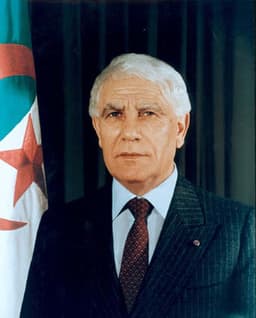
Chadli Bendjedid
Politician · Modern
50.3Total

Zhu Rongji
Politician · Modern
65.2Total
Basic Information
Born
1929
1928
Died
—
—
Era
Modern
Modern
Nationality
Algeria
China
Occupation
Politician
Politician
Civilization
Middle Eastern
Eastern
Score Comparison
Military (10%)
41.3
12.5
Political (20%)
68.0
84.4
Influence (20%)
52.5
82.0
Legacy (20%)
41.7
65.0
Leadership (15%)
53.2
72.0
Strategy (15%)
44.3
37.0
TOTAL
50.3
65.2
Chadli Bendjedid — Complete Timeline
1979 AD
Elected President of AlgeriaPolitical Action◆ Major
Bendjedid was elected president after the death of Houari Boumediene. His election marked a shift from the revolutionary era to a period of political and economic liberalization in Algeria.
Algerian PoliticsSuccessionLiberalization
Impact: national
1988 AD
Introduced Political and Economic ReformsReform◆ Major
After the October 1988 riots, Bendjedid introduced a new constitution that ended the one-party system and allowed for multiparty elections. He also implemented economic liberalization measures, moving away from state socialism.
Constitutional ReformMultiparty SystemEconomic Liberalization
Impact: nationalprogressive
1992 AD
Resigned Under Military Pressure Amid Civil WarPolitical Action
Facing a likely victory by the Islamic Salvation Front (FIS) in the second round of parliamentary elections, Bendjedid resigned under pressure from the military. His resignation triggered the Algerian Civil War, a decade-long conflict between the government and Islamist insurgents.
Algerian Civil WarMilitary InterventionIslamist Conflict
Impact: nationaltragic
Zhu Rongji — Complete Timeline
1987 AD
Became Mayor of ShanghaiPolitical Action◆ Major
Zhu Rongji was appointed Mayor of Shanghai, where he implemented market-oriented reforms and improved infrastructure. His success in transforming Shanghai's economy earned him national recognition.
ShanghaiEconomic ReformUrban Development
Impact: regionalconstructive
1991 AD
Appointed Vice Premier for economic affairsPolitical Action◆ Major
Zhu Rongji was promoted to Vice Premier, tasked with tackling inflation and reforming state-owned enterprises. He implemented tight monetary policies and began restructuring the banking system.
Economic ReformVice PremierInflation Control
Impact: nationalconstructive
1998 AD
Became Premier of the People's Republic of ChinaPolitical Action◆ Major
Zhu Rongji became Premier, succeeding Li Peng. He accelerated economic reforms, including joining the World Trade Organization, privatizing state enterprises, and reducing tariffs.
PremierEconomic ReformWTO Accession
Impact: globalconstructive
2001 AD
Oversaw China's accession to the WTOPolitical Action
Under Zhu Rongji's leadership, China joined the World Trade Organization, committing to extensive trade liberalization. This integration into the global economy spurred rapid economic growth and foreign investment.
WTOGlobalizationEconomic Growth
Impact: globalconstructive
2003 AD
Retired from politicsPolitical Action
Zhu Rongji stepped down as Premier after two terms, retiring from public life. He was succeeded by Wen Jiabao, and his reforms continued to shape China's economy.
RetirementPolitical TransitionEconomic Legacy
Impact: national
Expert Analysis
Origins
Chadli Bendjedid was born in 1929 in Sebaou, Algeria, into a peasant family. He joined the French army briefly before deserting to fight with the National Liberation Front (FLN) during the Algerian War (1954–1962). After independence, he rose through military ranks under President Houari Boumediene, becoming a colonel and commander of the Oran military region. Bendjedid's background was purely military, with no formal economic training.
Zhu Rongji was born in 1928 in Changsha, China, into a scholarly family. He studied electrical engineering at Tsinghua University, graduating in 1951. During the Cultural Revolution, he was labeled a "rightist" and sent to labor in the countryside for five years. Unlike Bendjedid, Zhu's early career was in technical and planning roles, working in the State Economic Commission and later as a deputy director of the State Planning Commission. His education and experience in economic management shaped his technocratic approach.
Rise to Power
Bendjedid was selected as a compromise candidate for president after Boumediene's death in 1978. He was elected in 1979 by the FLN congress, defeating more prominent figures. His rise was not due to personal ambition but party consensus. Key turning point: the October 1988 riots, which he quelled violently (killing hundreds), then pivoted to reforms, adopting a new constitution in 1989 that ended one-party rule.
Zhu Rongji rose through merit. He became mayor of Shanghai in 1987, where he transformed the city with market reforms and infrastructure. In 1991, he was appointed Vice Premier, tasked with curbing inflation and reforming state-owned enterprises. He became Premier in 1998, succeeding Li Peng. His rise was propelled by his reputation as a capable economic manager, not political maneuvering.
Leadership & Governance
Bendjedid's leadership was reactive. He initially maintained Boumediene's socialist policies but after the 1988 riots, he introduced multiparty elections and economic liberalization. However, he failed to manage the transition: the Islamic Salvation Front (FIS) won the 1991 elections, and the military forced him to resign in 1992, triggering a civil war. His governance scored 53.2 in leadership, reflecting indecisiveness.
Zhu Rongji was a decisive reformer. He cut subsidies, privatized state enterprises, and reduced tariffs to join the WTO in 2001. His austerity measures in the 1990s curbed inflation from 24% to near zero. He also launched massive infrastructure projects. His political score of 84.4 reflects his effectiveness within China's system, though he lacked democratic legitimacy.
Triumph & Tragedy
Bendjedid's greatest success was initiating democratic reforms—Algeria's first multiparty elections. However, his tragedy was the civil war that followed his resignation, leaving 100,000–200,000 dead. He died in 2012, largely forgotten.
Zhu Rongji's triumph was China's WTO accession, which quadrupled trade and lifted hundreds of millions out of poverty. His tragedy was the uneven distribution of benefits: state-owned enterprise reforms caused massive layoffs (estimated 30 million workers lost jobs), and his austerity policies slowed growth temporarily. His legacy score of 65.0 reflects enduring impact but with social costs.
Character & Destiny
Bendjedid was cautious and consensus-seeking, but indecisive. He believed in gradual reform but lost control of the process. His character—more bureaucrat than revolutionary—led him to resign rather than confront the military, sealing his fate.
Zhu Rongji was blunt, technocratic, and uncompromising. Known for his sharp tongue, he pushed reforms against opposition. His character was suited to a system that valued results over process. He retired in 2003, his reforms firmly embedded.
Legacy
Bendjedid's legacy is mixed: he introduced democracy but his failure led to civil war. Algeria's political system remains fragile. His scores: military 41.3, political 68.0, influence 52.5, legacy 41.7.
Zhu Rongji's legacy is transformative: he integrated China into the global economy, setting the stage for its rise as an economic superpower. His scores: military 12.5, political 84.4, influence 82.0, legacy 65.0. His reforms are still foundational.
Conclusion
Zhu Rongji had greater impact. His economic reforms reshaped the world's most populous nation, lifting 400 million from poverty, while Bendjedid's reforms collapsed into civil war. Zhu's total score of 65.2 vs Bendjedid's 50.3 reflects this. In the data-driven comparison, Zhu Rongji stands as a more effective reformer, despite operating within an authoritarian framework.
Rankings
🥇
Zhu RongjiLeader
Mil: 12.5Pol: 84.4Inf: 82.0
65.2
🥈
Chadli Bendjedid
Mil: 41.3Pol: 68.0Inf: 52.5
50.3
+14.9 behind
How This Comparison Works
Algorithm
Each figure is scored on 6 dimensions (0—100 scale) based on structured historical data: Military (10%), Political (20%), Influence (20%), Legacy (20%), Leadership (15%), Strategy (15%). The weighted total produces the final ranking.
Data Sources
Scores are computed from structured sub-indicators in the database. Scale factors adjust for era (Ancient ×0.85, Modern ×1.0) and civilization size (Eastern ×1.05, Other ×0.80) to account for differences in population and military scale.
Maximum 3 Figures
Comparisons are limited to 2—3 figures to ensure readability and statistical meaningfulness.
Error Margins
±5 points per dimension — Sub-scores are derived from historical records with inherent uncertainty. Two figures within 5 points on a dimension should be considered roughly equivalent in that area.
Total Score Accuracy
±3 points overall — The weighted combination of 6 dimensions produces a total score with approximately ±3 points of uncertainty. Differences of less than 3 points are not statistically significant— the figures are effectively tied.
Known Limitations
- Historical records are incomplete and uneven across civilizations
- Figures from oral-tradition societies may be underrepresented
- Occupation labels can misclassify multi-role figures
- Scores measure capability and impact, not moral character
- Quantitative scoring is a comparison tool, not absolute truth
Capability Radar
Military (10%) — Battles & Warfare
Battles
20
14
Win Rate
24
16
Expansion
29
23
Political (20%) — Governance & Reform
Reform
55
95
Diplomacy
50
75
Economy
40
98
Influence (20%) — Cultural & Global Reach
Cultural
30
50
Global
25
80
Legacy (20%) — Historical Impact
Historical
30
85
Longevity
20
70
Leadership (15%) — Power & Stability
Tenure
65
70
Stability
35
80
Strategy (15%) — Tactics & Innovation
Strategy
30
20
Tactics
31
24
Reform
37
30
Similar Comparisons
Comments & Discussion
No comments yet. Be the first to share your thoughts!