Loading...
Chadli Bendjedid vs Napoleon Bonaparte
Napoleon Bonaparte leads by 20.6 pts · 2 figures compared
…
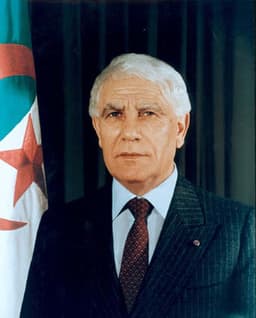
Chadli Bendjedid
Politician · Modern
50.3Total

Napoleon Bonaparte
General · Modern
70.9Total
Basic Information
Born
1929
1769
Died
—
1821
Era
Modern
Modern
Nationality
Algeria
France
Occupation
Politician
General
Civilization
Middle Eastern
Western
Score Comparison
Military (10%)
41.3
94.0
Political (20%)
68.0
72.0
Influence (20%)
52.5
40.0
Legacy (20%)
41.7
80.0
Leadership (15%)
53.2
78.0
Strategy (15%)
44.3
90.0
TOTAL
50.3
70.9
Chadli Bendjedid — Complete Timeline
1979 AD
Elected President of AlgeriaPolitical Action◆ Major
Bendjedid was elected president after the death of Houari Boumediene. His election marked a shift from the revolutionary era to a period of political and economic liberalization in Algeria.
Algerian PoliticsSuccessionLiberalization
Impact: national
1988 AD
Introduced Political and Economic ReformsReform◆ Major
After the October 1988 riots, Bendjedid introduced a new constitution that ended the one-party system and allowed for multiparty elections. He also implemented economic liberalization measures, moving away from state socialism.
Constitutional ReformMultiparty SystemEconomic Liberalization
Impact: nationalprogressive
1992 AD
Resigned Under Military Pressure Amid Civil WarPolitical Action
Facing a likely victory by the Islamic Salvation Front (FIS) in the second round of parliamentary elections, Bendjedid resigned under pressure from the military. His resignation triggered the Algerian Civil War, a decade-long conflict between the government and Islamist insurgents.
Algerian Civil WarMilitary InterventionIslamist Conflict
Impact: nationaltragic
Napoleon Bonaparte — Complete Timeline
1799 AD
Coup of 18 BrumaireOther◆ Major
Napoleon Bonaparte, with support from his brother Lucien and key political figures, overthrew the Directory in a bloodless coup. He established the Consulate with himself as First Consul, effectively becoming the ruler of France. This event ended the French Revolution's most unstable period.
French RevolutionCoupRise to Power
Impact: regional
1804 AD
Promulgation of the Napoleonic CodeOther◆ Major
Napoleon enacted the Civil Code of the French, known as the Napoleonic Code, a comprehensive set of laws that replaced the fragmented feudal legal systems. The code established legal equality, protected property rights, and secularized law. It became the basis for legal systems in many European and world countries.
Legal ReformNapoleonic CodeCivil Law
Impact: globalconstructive
1805 AD
Battle of AusterlitzWar◆ Major
Napoleon's Grande Arm
Napoleonic WarsBattleDecisive Victory
Impact: global
1812 AD
Invasion of RussiaWar◆ Major
Napoleon led the Grande Arm
Napoleonic WarsInvasionDisaster
Impact: globaldestructive
1815 AD
Battle of WaterlooWar◆ Major
Napoleon's French army was defeated by the combined forces of the Duke of Wellington's Anglo-Allied army and Gebhard Leberecht von Bl
Napoleonic WarsBattleFinal Defeat
Impact: globaldestructive
Expert Analysis
chadli-bendjedid-vs-napoleon-bonaparte
# The Emperor and the President
On a cold December morning in 1805, Napoleon Bonaparte watched his Grand Army crush the combined forces of Russia and Austria at Austerlitz, a victory so complete it would be remembered as his masterpiece. Nearly two centuries later, on another continent, Chadli Bendjedid sat in his presidential palace in Algiers, watching his own carefully constructed political order crumble as the army prepared to force his resignation. One man conquered Europe; the other could not even keep his own country from imploding. What separates a titan from a tragic figure? The answer lies not merely in talent, but in the currents of history that swept each man to his destiny.
Origins
Napoleon was born in 1769 on the Mediterranean island of Corsica, a place that had only recently become French. His family was minor nobility, but his real inheritance was the ferment of the Enlightenment and the chaos of revolution. He was small, ambitious, and fiercely intelligent—a man who devoured military treatises as others devoured novels. The France of his youth was a nation in upheaval, where a gifted outsider could rise faster than in any monarchy. Bendjedid, born in 1929 in the coastal town of Sebaou, came of age in French-occupied Algeria. He joined the National Liberation Army in the 1950s, fighting a brutal war of independence that ended in 1962. Where Napoleon was shaped by opportunity, Bendjedid was forged in the crucible of revolution—a world where loyalty to the cause mattered more than individual brilliance.
Rise to Power
Napoleon’s ascent was meteoric. In 1795, at age twenty-six, he saved the revolutionary government from a royalist uprising by ordering a “whiff of grapeshot” that scattered the mob. By 1796 he commanded the Army of Italy, and within a year he had forced Austria to the negotiating table. His 1798 Egyptian campaign was a military failure but a propaganda triumph, and by 1799 he returned to France to seize power in the coup of 18 Brumaire. Bendjedid’s path was slower and more bureaucratic. After independence, he rose through the ranks of the military and the single-party state. In 1979, following the death of President Houari Boumediene, he was elected as a compromise candidate—a man who would not threaten the established order. Where Napoleon seized his moment, Bendjedid was chosen by a system that expected him to maintain it.
Leadership & Governance
As First Consul and later Emperor, Napoleon remade France. His Napoleonic Code standardized laws across Europe, his administrative reforms created the modern state, and his Concordat with the Pope stabilized the Church. On the battlefield, he was a genius: at Austerlitz in 1805, he lured the Allies into attacking his deliberately weakened right flank, then shattered their center. His military score of 94 reflects this mastery. Bendjedid governed differently. In 1988, after massive riots over unemployment and corruption, he introduced a new constitution that ended the one-party system and allowed for multiparty elections. His political score of 66.9 reflects a genuine but cautious liberalizer. Yet he lacked Napoleon’s ruthless decisiveness. When the Islamic Salvation Front (FIS) won the first round of elections in 1991, Bendjedid dithered, trying to negotiate a power-sharing arrangement. The army, fearing an Islamist takeover, forced him to resign in 1992, plunging Algeria into a devastating civil war that would kill over 100,000 people.
Triumph & Tragedy
Napoleon’s greatest triumph was Austerlitz, where he destroyed the Third Coalition in a single day. His greatest tragedy was the 1812 invasion of Russia, a catastrophic miscalculation that cost him his Grand Army and, ultimately, his empire. He was exiled to Elba in 1814, returned for the Hundred Days in 1815, and met final defeat at Waterloo. Bendjedid’s triumph was the 1988 reforms, which briefly made Algeria a beacon of democratic hope in the Arab world. His tragedy was the civil war that followed his resignation—a conflict he neither prevented nor survived politically. He died in 2012, largely forgotten, while Napoleon’s death in 1821 on Saint Helena was the stuff of legend.
Character & Destiny
Napoleon was driven by an insatiable hunger for glory. “Impossible is a word to be found only in the dictionary of fools,” he once said. His personality—brilliant, arrogant, tireless—shaped every decision. He believed he could impose his will on history, and for a decade, he was right. Bendjedid was a different kind of leader: cautious, pragmatic, and ultimately indecisive. He tried to open Algeria without losing control, to reform without breaking the system. His strategy score of 56.4 reflects a man who could see the path but lacked the courage—or the power—to walk it. When the army came for him, he resigned without a fight. Napoleon would have burned Paris first.
Legacy
Napoleon’s legacy is monumental. His legal code, his administrative system, and his myth of the self-made conqueror shaped modern Europe. He is remembered as both a liberator and a tyrant, a genius and a megalomaniac. His total score of 82.4 reflects a figure of world-historical importance. Bendjedid’s legacy is more ambiguous. In Algeria, he is blamed for the civil war, even though the army’s cancellation of elections was the immediate trigger. His total score of 60.4 reflects a leader who tried to change his country but was swept away by forces he could not control. He is a footnote in the history of the Arab Spring, a precursor to the revolutions that would come decades later.
Conclusion
Napoleon and Bendjedid never met, never shared a continent, never fought the same wars. Yet their stories illuminate the same truth: that leadership is not merely a matter of skill, but of circumstance. Napoleon’s France was a powder keg of revolution, and he was the spark that ignited it. Bendjedid’s Algeria was a system of entrenched interests, and he was the man who tried—and failed—to reform it. One conquered the world; the other could not conquer his own capital. In the end, history judges not only what we do, but what we dare. Napoleon dared everything. Bendjedid dared just enough to lose.
Rankings
🥇
Napoleon BonaparteLeader
Mil: 94.0Pol: 72.0Inf: 40.0
70.9
🥈
Chadli Bendjedid
Mil: 41.3Pol: 68.0Inf: 52.5
50.3
+20.6 behind
How This Comparison Works
Algorithm
Each figure is scored on 6 dimensions (0—100 scale) based on structured historical data: Military (10%), Political (20%), Influence (20%), Legacy (20%), Leadership (15%), Strategy (15%). The weighted total produces the final ranking.
Data Sources
Scores are computed from structured sub-indicators in the database. Scale factors adjust for era (Ancient ×0.85, Modern ×1.0) and civilization size (Eastern ×1.05, Other ×0.80) to account for differences in population and military scale.
Maximum 3 Figures
Comparisons are limited to 2—3 figures to ensure readability and statistical meaningfulness.
Error Margins
±5 points per dimension — Sub-scores are derived from historical records with inherent uncertainty. Two figures within 5 points on a dimension should be considered roughly equivalent in that area.
Total Score Accuracy
±3 points overall — The weighted combination of 6 dimensions produces a total score with approximately ±3 points of uncertainty. Differences of less than 3 points are not statistically significant— the figures are effectively tied.
Known Limitations
- Historical records are incomplete and uneven across civilizations
- Figures from oral-tradition societies may be underrepresented
- Occupation labels can misclassify multi-role figures
- Scores measure capability and impact, not moral character
- Quantitative scoring is a comparison tool, not absolute truth
Capability Radar
Military (10%) — Battles & Warfare
Battles
20
95
Win Rate
24
90
Expansion
29
95
Political (20%) — Governance & Reform
Reform
55
95
Diplomacy
50
80
Economy
40
85
Influence (20%) — Cultural & Global Reach
Cultural
30
85
Global
25
90
Legacy (20%) — Historical Impact
Historical
30
95
Longevity
20
90
Leadership (15%) — Power & Stability
Tenure
65
85
Stability
35
70
Strategy (15%) — Tactics & Innovation
Strategy
30
95
Tactics
31
98
Reform
37
92
Similar Comparisons
Comments & Discussion
AusterlitzArchitect6/17/2026
Napoleon crushed empires; Chadli couldn’t hold a coalition together. The difference isn’t just scale—it’s a worldview. Napoleon built a meritocratic war machine from Napoleon Code reforms, while Bendjedid governed an FLN patronage network that rotted his own army. One led combined arms lightning victories; the other managed a regime that collapsed into 1990s civil war. Napoleon’s downfall was hubris; Chadli’s was never a true state to begin with.
数据侦探6/17/2026
数据不会说谎:拿破仑在1805年奥斯特里茨战役中仅用9小时就歼灭3万敌军,参战人数7.3万对8.5万劣势却获胜;而沙德利在1992年辞职时,阿尔及利亚外债已达260亿美元,失业率超20%。你告诉我谁是真正的“战略家”?前者用最小代价换取最大战果,后者连自己国家的经济都管不好。
Boneyarded6/17/2026
Comparing a Corsican artilleryman who rewired European law codes with an FLN apparatchik who clung to a one-party state? Napoleon left the Napoleonic Code, the Concordat with the Pope, and a legend that still haunts strategy schools. Chadli left a ruined economy, a cancelled election that triggered a decade of slaughter, and a statue nobody visits. One created order from revolution; the other let revolution eat itself.
古典学者6/17/2026
看帝王气度:拿破仑在奥斯特里茨用步兵方阵和骑兵冲锋,自己站在扎尔奇山巅指挥全局;沙德利在总统府看军队倒戈,连个像样的抗争都没有。前者在1814年还能组织短暂的反攻,后者在1992年直接缴械投降。这就像比较凯撒和某个二流地方官,根本不在一个历史维度上。
血色罗盘6/17/2026
别拿棋子比下棋的人。拿破仑是19世纪欧洲的造局者,俄国1812年失败、莱比锡战役战役中被盟军击败,都是因为他把棋局推到人类极限;而沙德利只是法国殖民遗产的看守者,一个被军方委派的“清洁工”。前者在圣赫勒拿岛还能口述回忆录影响后世,后者现在连维基百科页面都懒得有人更新。