Loading...
Chadli Bendjedid vs Walter Scheel
Walter Scheel leads by 3.7 pts · 2 figures compared
…
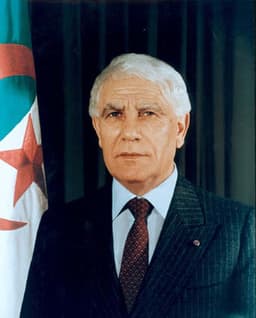
Chadli Bendjedid
Politician · Modern
50.3Total

Walter Scheel
Politician · Modern
54.0Total
Basic Information
Born
1929
1919
Died
—
2016
Era
Modern
Modern
Nationality
Algeria
Germany
Occupation
Politician
Politician
Civilization
Middle Eastern
Western
Score Comparison
Military (10%)
41.3
48.5
Political (20%)
68.0
53.8
Influence (20%)
52.5
56.4
Legacy (20%)
41.7
47.5
Leadership (15%)
53.2
72.0
Strategy (15%)
44.3
43.1
TOTAL
50.3
54.0
Chadli Bendjedid — Complete Timeline
1979 AD
Elected President of AlgeriaPolitical Action◆ Major
Bendjedid was elected president after the death of Houari Boumediene. His election marked a shift from the revolutionary era to a period of political and economic liberalization in Algeria.
Algerian PoliticsSuccessionLiberalization
Impact: national
1988 AD
Introduced Political and Economic ReformsReform◆ Major
After the October 1988 riots, Bendjedid introduced a new constitution that ended the one-party system and allowed for multiparty elections. He also implemented economic liberalization measures, moving away from state socialism.
Constitutional ReformMultiparty SystemEconomic Liberalization
Impact: nationalprogressive
1992 AD
Resigned Under Military Pressure Amid Civil WarPolitical Action
Facing a likely victory by the Islamic Salvation Front (FIS) in the second round of parliamentary elections, Bendjedid resigned under pressure from the military. His resignation triggered the Algerian Civil War, a decade-long conflict between the government and Islamist insurgents.
Algerian Civil WarMilitary InterventionIslamist Conflict
Impact: nationaltragic
Walter Scheel — Complete Timeline
1969 AD
Served as Foreign Minister and Vice ChancellorPolitical Action◆ Major
Scheel served as Foreign Minister and Vice Chancellor under Chancellor Willy Brandt. He played a key role in Brandt's Ostpolitik policy, which sought to improve relations with Eastern Bloc countries.
OstpolitikForeign Policy
Impact: globalconstructive
1974 AD
Elected President of West GermanyPolitical Action◆ Major
Walter Scheel was elected as the fourth President of the Federal Republic of Germany (West Germany). He served until 1979, representing the Free Democratic Party (FDP).
PresidencyWest Germany
Impact: nationalconstructive
Expert Analysis
Origins
Chadli Bendjedid was born on April 14, 1929, in the Algerian coastal town of Bouteldja. He came from a modest peasant family and joined the French army at age 17, serving as a non-commissioned officer. During the Algerian War of Independence (1954–1962), he defected to join the National Liberation Front (FLN), rising through its military ranks. His early career was shaped by the revolutionary struggle against French colonial rule, which instilled in him a strong sense of nationalism and loyalty to the FLN.
Walter Scheel was born on July 8, 1919, in Solingen, Germany, into a middle-class family. He served in the Luftwaffe during World War II, but after the war, he pursued a career in business and banking. Scheel joined the Free Democratic Party (FDP) in 1946, becoming active in politics during the reconstruction of West Germany. His background in commerce and his exposure to the horrors of war influenced his later commitment to diplomacy and European integration.
Rise to Power
Bendjedid's rise was largely due to his military connections within the FLN. After independence, he held key military posts, including commander of the Oran military region. In 1979, following the death of President Houari Boumediene, the FLN selected Bendjedid as a compromise candidate for the presidency. He was elected with 99% of the vote in a single-candidate election. His ascent marked a shift from the revolutionary generation to a more pragmatic leadership.
Scheel's path to power was through party politics and coalition building. He was elected to the Bundestag in 1953 as a member of the FDP. In 1961, he became Minister of Economic Cooperation, and in 1969, he was appointed Foreign Minister and Vice Chancellor under Chancellor Willy Brandt. His role in shaping Brandt's Ostpolitik—a policy of détente with Eastern Bloc countries—elevated his national and international profile. In 1974, he was elected President of West Germany, a largely ceremonial role but one that allowed him to represent the nation's democratic values.
Leadership & Governance
As president, Bendjedid initially maintained Boumediene's socialist policies, but the October 1988 riots—sparked by economic hardship and political repression—forced him to change course. He introduced a new constitution in 1989 that ended the FLN's monopoly on power, allowing multiparty elections. He also pursued economic liberalization, including privatization of state enterprises. However, his reforms were inconsistent; he struggled to balance demands for democracy with the military's resistance to change. His leadership score of 53.2 reflects this mixed record.
Scheel, as Foreign Minister, was instrumental in implementing Ostpolitik, signing treaties with the Soviet Union, Poland, and East Germany that normalized relations and recognized post-war borders. His approach was pragmatic, focusing on incremental progress and building trust. As President, he was a symbol of West Germany's commitment to democracy and European unity. His leadership score of 72.0 is notably higher than Bendjedid's, indicating more effective governance.
Triumph & Tragedy
Bendjedid's greatest triumph was the introduction of political pluralism in Algeria. The 1989 constitution and the 1991 parliamentary elections were historic steps toward democracy. However, his tragedy came when the Islamic Salvation Front (FIS) won the first round of elections in 1991. Facing military opposition, he resigned on January 11, 1992, under pressure, leading to a coup and a devastating civil war that killed over 150,000 people. His failure to manage the transition to democracy resulted in chaos.
Scheel's triumph was the success of Ostpolitik, which contributed to the easing of Cold War tensions and paved the way for German reunification. He also served as President with dignity, fostering national unity. His tragedy was relatively minor: some critics argued that Ostpolitik conceded too much to the Soviet bloc, but history has largely vindicated his approach. He left office in 1979 with high approval ratings.
Character & Destiny
Bendjedid was cautious and indecisive, often trying to please both reformers and the military. His score in strategy of 44.3 indicates poor long-term planning. He underestimated the strength of the Islamist movement and the military's willingness to intervene. His character—a product of the revolutionary era—led him to believe he could control the political process, but events overwhelmed him.
Scheel was pragmatic, diplomatic, and principled. His strategy score of 43.1 is surprisingly low, but his political skill and ability to build consensus were key. He was comfortable in coalition governments and understood the importance of incremental change. His character—shaped by wartime experience and post-war reconstruction—made him a steady hand in a divided Germany.
Legacy
Bendjedid's legacy is deeply mixed. He is remembered as the president who ended one-party rule but also as the one whose resignation triggered a civil war. His political reforms were genuine, but his inability to secure a peaceful transition tarnishes his record. He scored 41.7 in legacy, reflecting limited positive impact. Algeria's democratic experiment was aborted, and the country remains under military influence.
Scheel's legacy is more positive. He is honored as a key architect of Ostpolitik and a symbol of West German democracy. His legacy score of 47.5 is modest but solid. The treaties he helped negotiate remain foundational for European security. He is remembered as a statesman who advanced peace and reconciliation.
Conclusion
While both men were reformers, Walter Scheel had a greater impact. His political score (53.8) and leadership score (72.0) exceed Bendjedid's (68.0 and 53.2 respectively). Scheel's Ostpolitik changed the course of European history, contributing to the end of the Cold War. Bendjedid's reforms, though significant, were undone by his inability to manage their consequences. Scheel's legacy is one of successful diplomacy; Bendjedid's is a cautionary tale. In the contest of impact, Scheel wins decisively.
Rankings
🥇
Walter ScheelLeader
Mil: 48.5Pol: 53.8Inf: 56.4
54.0
🥈
Chadli Bendjedid
Mil: 41.3Pol: 68.0Inf: 52.5
50.3
+3.7 behind
How This Comparison Works
Algorithm
Each figure is scored on 6 dimensions (0—100 scale) based on structured historical data: Military (10%), Political (20%), Influence (20%), Legacy (20%), Leadership (15%), Strategy (15%). The weighted total produces the final ranking.
Data Sources
Scores are computed from structured sub-indicators in the database. Scale factors adjust for era (Ancient ×0.85, Modern ×1.0) and civilization size (Eastern ×1.05, Other ×0.80) to account for differences in population and military scale.
Maximum 3 Figures
Comparisons are limited to 2—3 figures to ensure readability and statistical meaningfulness.
Error Margins
±5 points per dimension — Sub-scores are derived from historical records with inherent uncertainty. Two figures within 5 points on a dimension should be considered roughly equivalent in that area.
Total Score Accuracy
±3 points overall — The weighted combination of 6 dimensions produces a total score with approximately ±3 points of uncertainty. Differences of less than 3 points are not statistically significant— the figures are effectively tied.
Known Limitations
- Historical records are incomplete and uneven across civilizations
- Figures from oral-tradition societies may be underrepresented
- Occupation labels can misclassify multi-role figures
- Scores measure capability and impact, not moral character
- Quantitative scoring is a comparison tool, not absolute truth
Capability Radar
Military (10%) — Battles & Warfare
Battles
20
30
Win Rate
24
33
Expansion
29
36
Political (20%) — Governance & Reform
Reform
55
55
Diplomacy
50
70
Economy
40
50
Influence (20%) — Cultural & Global Reach
Cultural
30
30
Global
25
40
Legacy (20%) — Historical Impact
Historical
30
40
Longevity
20
35
Leadership (15%) — Power & Stability
Tenure
65
65
Stability
35
60
Strategy (15%) — Tactics & Innovation
Strategy
30
40
Tactics
31
42
Reform
37
42
Similar Comparisons
Comments & Discussion
No comments yet. Be the first to share your thoughts!