Loading...
Chadli Bendjedid vs Julius Caesar
Julius Caesar leads by 32.5 pts · 2 figures compared
…
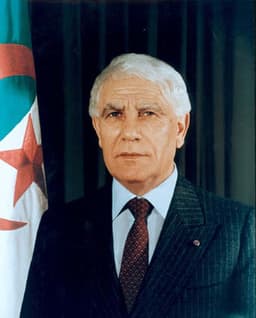
Chadli Bendjedid
Politician · Modern
50.3Total

Julius Caesar
General · Ancient
82.8Total
Basic Information
Born
1929
-100
Died
—
-44
Era
Modern
Ancient
Nationality
Algeria
Roman Republic
Occupation
Politician
General
Civilization
Middle Eastern
Western
Score Comparison
Military (10%)
41.3
88.0
Political (20%)
68.0
78.0
Influence (20%)
52.5
85.0
Legacy (20%)
41.7
82.0
Leadership (15%)
53.2
80.0
Strategy (15%)
44.3
85.0
TOTAL
50.3
82.8
Chadli Bendjedid — Complete Timeline
1979 AD
Elected President of AlgeriaPolitical Action◆ Major
Bendjedid was elected president after the death of Houari Boumediene. His election marked a shift from the revolutionary era to a period of political and economic liberalization in Algeria.
Algerian PoliticsSuccessionLiberalization
Impact: national
1988 AD
Introduced Political and Economic ReformsReform◆ Major
After the October 1988 riots, Bendjedid introduced a new constitution that ended the one-party system and allowed for multiparty elections. He also implemented economic liberalization measures, moving away from state socialism.
Constitutional ReformMultiparty SystemEconomic Liberalization
Impact: nationalprogressive
1992 AD
Resigned Under Military Pressure Amid Civil WarPolitical Action
Facing a likely victory by the Islamic Salvation Front (FIS) in the second round of parliamentary elections, Bendjedid resigned under pressure from the military. His resignation triggered the Algerian Civil War, a decade-long conflict between the government and Islamist insurgents.
Algerian Civil WarMilitary InterventionIslamist Conflict
Impact: nationaltragic
Julius Caesar — Complete Timeline
58 BC
Gallic WarsWar◆ Major
Caesar, as proconsul of Gaul, launched a series of campaigns that conquered all of Gaul (modern France, Belgium, and parts of Switzerland). He fought numerous battles, including against the Helvetii, the Belgae, and the Gallic chieftain Vercingetorix. The wars brought immense wealth and a loyal army to Caesar.
Gallic WarsConquestRoman Expansion
Impact: regional
49 BC
Crossing the RubiconPolitical Action◆ Major
Caesar led Legio XIII across the Rubicon River into Italy, defying the Roman Senate's order to disband his army. This act triggered a civil war against Pompey and the Optimates, ultimately leading to Caesar's dictatorship and the end of the Roman Republic.
Roman Civil WarEnd of RepublicPower Struggle
Impact: global
48 BC
Battle of PharsalusWar◆ Major
Caesar's outnumbered army defeated the larger forces of Pompey the Great at Pharsalus in Greece. Caesar's tactical use of a reserve line to counter Pompey's cavalry charge proved decisive. Pompey fled to Egypt, where he was assassinated, leaving Caesar as the undisputed master of the Roman world.
Roman Civil WarBattleDecisive Victory
Impact: regional
44 BC
Appointment as Dictator for LifePolitical Action◆ Major
The Roman Senate appointed Caesar dictator perpetuo (dictator for life), granting him unprecedented personal power. This move concentrated military, legislative, and judicial authority in one person, effectively ending the Roman Republic's traditional system of checks and balances and alarming many senators.
DictatorshipEnd of RepublicPower Consolidation
Impact: regionaldestructive
Assassination on the Ides of MarchPolitical Action◆ Major
A group of Roman senators, led by Marcus Junius Brutus and Gaius Cassius Longinus, stabbed Caesar to death at a meeting of the Senate in the Theatre of Pompey. The assassination was intended to restore the Republic, but instead triggered another civil war that led to the rise of the Roman Empire.
AssassinationRoman PoliticsEnd of Republic
Impact: globaldestructive
Expert Analysis
chadli-bendjedid-vs-julius-caesar
# The Weight of a Crown: Caesar and Bendjedid
On a March morning in 44 BCE, Gaius Julius Caesar walked into the Senate chamber in Rome, unaware that sixty conspirators waited with daggers hidden in their togas. On a January evening in 1992, Chadli Bendjedid sat alone in the presidential palace in Algiers, knowing that his own military chiefs had already decided his fate. Two men, separated by two thousand years, both reached for power in times of crisis. Both saw their worlds collapse around them. But the differences between them reveal something profound about how ambition meets history—and how history, in turn, crushes those who cannot bend.
Origins
Caesar was born into the twilight of the Roman Republic, a world of fierce aristocratic competition, civil wars, and a Senate that had long lost its moral compass. His family, the Julii, claimed descent from the goddess Venus, but they were politically marginal. Young Caesar watched his uncle Gaius Marius wage brutal civil wars against Sulla, and he learned early that in Rome, survival meant flexibility. He fled Sulla’s proscriptions, bribed pirates who captured him, and studied oratory in Rhodes. The Republic was dying, and Caesar would be its midwife.
Chadli Bendjedid was born in 1929 in the coastal town of Sebaou, then part of French Algeria. His father was a farmer, his world one of colonial subjugation. Bendjedid joined the National Liberation Front (FLN) in the 1950s, fighting in the brutal Algerian War of Independence. When Algeria won freedom in 1962, the FLN became the only party, and Bendjedid rose through its ranks—not as a charismatic revolutionary like Ahmed Ben Bella, but as a quiet, loyal soldier. By 1979, when President Houari Boumediene died, Bendjedid was defense minister. The party needed a compromise candidate, someone who would not threaten the old guard. He was elected president precisely because he seemed safe.
Rise to Power
Caesar’s path was neither safe nor quiet. He forged the First Triumvirate with Pompey and Crassus in 60 BCE, an informal alliance that let him secure a governorship in Gaul. Over the next eight years, he conquered what is now France and Belgium, crossing the Rhine and landing in Britain. His *Commentaries on the Gallic War* were both military reports and political propaganda—he was building a legend and an army loyal to him, not the Republic. When the Senate ordered him to disband his legions, Caesar chose war. In 49 BCE, he crossed the Rubicon River into Italy, declaring, *"The die is cast."* Within three months, he was master of Rome.
Bendjedid’s rise was quieter but no less decisive. He inherited a one-party state, a socialist economy dependent on oil and gas, and a population of young Algerians who had known only war and poverty. For nearly a decade, he governed cautiously, avoiding the grand gestures of his predecessors. But in October 1988, when riots exploded in Algiers over unemployment and corruption, Bendjedid made a choice that would define his legacy: he ordered the army to fire on protesters, killing hundreds. Then, in a stunning reversal, he announced a new constitution ending one-party rule and allowing multiparty elections. It was a gamble—and it would consume him.
Leadership & Governance
Caesar ruled Rome as dictator, first for ten years, then for life. He reformed the calendar, granted citizenship to Gauls, launched massive public works, and centralized power in his own hands. He was a military genius who wrote his own battle reports, a politician who pardoned his enemies, and a reformer who understood that the Republic’s institutions were too rotten to save. But he never built a lasting system. He ruled by personality, not law. When he told the Senate, *"I am Caesar, not king,"* he was lying—to them and to himself.
Bendjedid governed in a very different key. He was not a conqueror but a manager. He privatized state industries, opened Algeria to foreign investment, and allowed opposition parties to form. By 1991, the Islamic Salvation Front (FIS) had become the most powerful opposition force, winning local elections and threatening to take the parliament. Bendjedid, caught between the generals and the Islamists, tried to navigate. He called for new elections in December 1991. The FIS won the first round overwhelmingly. The second round, scheduled for January 1992, would have given them control of the state.
Triumph & Tragedy
Caesar’s greatest triumph was his conquest of Gaul—a feat that doubled Rome’s territory and made him the most powerful man in the Mediterranean. His greatest tragedy was that he did not know when to stop. He refused to restore the Republic, refused to share power, refused to listen to warnings. On the Ides of March 44 BCE, as the daggers fell, he reportedly said to his friend Brutus, *"Et tu, Brute?"* He had trusted too many enemies.
Bendjedid’s tragedy was the opposite. He knew when to stop, but he could not stop the forces he had unleashed. On January 11, 1992, facing a certain Islamist victory, the military demanded his resignation. Bendjedid refused. The generals arrested him, dissolved the parliament, and canceled the elections. Algeria plunged into a civil war that would kill over 100,000 people. Bendjedid lived under house arrest for years, a ghost of his own making. He had tried to open the door to democracy, but the generals kicked it shut—and him out.
Character & Destiny
Caesar was a gambler, a seducer, a man who believed that fortune favored the bold. He fought in fifty battles, survived shipwrecks and conspiracies, and wrote his own story. His arrogance was his genius and his flaw. He believed he could remake the world alone. He was wrong.
Bendjedid was a survivor, a man who rose by not offending anyone. He was not a visionary; he was a bureaucrat in a revolutionary’s uniform. He tried to reform Algeria from within, but he lacked the ruthlessness to control the army or the charisma to win the people. He was caught between two forces—the generals and the Islamists—and he could not master either.
Legacy
Caesar’s legacy is the Roman Empire, which his adopted heir Augustus built from the ruins of the Republic. His name became a title—*Kaiser, Tsar*—and his life became a template for every would-be dictator. He is remembered as a genius and a tyrant, a man who destroyed one world to create another.
Bendjedid’s legacy is more ambiguous. He is blamed for the civil war, but also credited with starting Algeria’s halting movement toward democracy. His reforms were real, but they came too late. Today, Algerians remember him as a well-meaning man who lost control of his country.
Conclusion
Two men, two paths, two very different falls. Caesar died by the sword of a friend; Bendjedid died in obscurity in 2012, forgotten by the nation he once led. One built an empire; the other watched his country burn. Both remind us that power is a double-edged blade—and that history judges not by intentions, but by outcomes. The die is always cast. The question is whether you can live with where it lands.
Rankings
🥇
Julius CaesarLeader
Mil: 88.0Pol: 78.0Inf: 85.0
82.8
🥈
Chadli Bendjedid
Mil: 41.3Pol: 68.0Inf: 52.5
50.3
+32.5 behind
How This Comparison Works
Algorithm
Each figure is scored on 6 dimensions (0—100 scale) based on structured historical data: Military (10%), Political (20%), Influence (20%), Legacy (20%), Leadership (15%), Strategy (15%). The weighted total produces the final ranking.
Data Sources
Scores are computed from structured sub-indicators in the database. Scale factors adjust for era (Ancient ×0.85, Modern ×1.0) and civilization size (Eastern ×1.05, Other ×0.80) to account for differences in population and military scale.
Maximum 3 Figures
Comparisons are limited to 2—3 figures to ensure readability and statistical meaningfulness.
Error Margins
±5 points per dimension — Sub-scores are derived from historical records with inherent uncertainty. Two figures within 5 points on a dimension should be considered roughly equivalent in that area.
Total Score Accuracy
±3 points overall — The weighted combination of 6 dimensions produces a total score with approximately ±3 points of uncertainty. Differences of less than 3 points are not statistically significant— the figures are effectively tied.
Known Limitations
- Historical records are incomplete and uneven across civilizations
- Figures from oral-tradition societies may be underrepresented
- Occupation labels can misclassify multi-role figures
- Scores measure capability and impact, not moral character
- Quantitative scoring is a comparison tool, not absolute truth
Capability Radar
Military (10%) — Battles & Warfare
Battles
20
95
Win Rate
24
92
Expansion
29
97
Political (20%) — Governance & Reform
Reform
55
90
Diplomacy
50
85
Economy
40
82
Influence (20%) — Cultural & Global Reach
Cultural
30
88
Global
25
94
Legacy (20%) — Historical Impact
Historical
30
95
Longevity
20
96
Leadership (15%) — Power & Stability
Tenure
65
75
Stability
35
60
Strategy (15%) — Tactics & Innovation
Strategy
30
94
Tactics
31
96
Reform
37
88
Similar Comparisons
Comments & Discussion
1. **LegionarySkeptic6/17/2026
** Comparing Caesar to Bendjedid is like comparing a stallion to a mule. Caesar rewrote the map of Europe and left a legacy that echoes in every dictator since. Bendjedid? He couldn't even manage a coup d'état. The man's "socialist reforms" tanked Algeria's economy and his military shut him out like a junior staffer. Facts: Caesar had Cleopatra's navy; Bendjedid couldn't keep his own ministers in line. History isn't kind to the forgettable.
2. **数据侦探6/17/2026
** 你们政治迷都在谈命运,但看看数据就知道了。凯撒在公元前1世纪的战争中入侵高卢,杀死了约100万人并奴役了更多。本杰迪德的1988年“黑色十月”抗议中,军队在安全部队中杀害了数百人。一个是帝国建设者,另一个是镇压者。凯撒至少有一个愿景,本杰迪德只是1980年代石油价格暴跌的受害者。数字不会说谎。
3. **ClassicsBuff6/17/2026
** Look at the moment they lost power. Caesar was assassinated by senators who feared his ambition, a political death befitting a titan. Bendjedid was ousted by his own generals because the economic mess was too deep. One died with a plan for empire; the other retired to write a memoir no one reads. Caesar's Republic fell into civil war; Bendjedid's Algeria fell into a decade-long civil war. Both failed, but Caesar's failure inspired Shakespeare. Bendjedid's failure inspired terror.
4. **历史补丁匠6/17/2026
** 我认为比较两者是在侮辱复杂性。凯撒是一个天才战略家,在短时间内在高卢不列颠和埃及实施了革命性的军事改革。本杰迪德是一名游击战士,在阿尔及利亚从法国独立的斗争中脱颖而出,但无法适应和平时期的管理。凯撒像一场突然的暴风雨,让罗马重塑自己。本杰迪德像一个缓慢的漏水,让阿尔及利亚的政治结构崩溃。这不只是大小的差异——这是本质的差异。
5. **RebelHistorian6/17/2026
** You're all missing the real issue: Bendjedid was a puppet of the FLN elite, a bureaucrat who never had Caesar's power. Caesar built his own army, crossed the Rubicon, and seized power. Bendjedid was elected by a party committee and then dumped by a military junta when he tried to open up politics. One was a revolutionary who changed the world; the other was a placeholder who got caught in a power struggle he couldn't win. Compare apples to oranges, but at least apples grow on trees—Bendjedid