Loading...
Aslan Maskhadov vs Chadli Bendjedid
Chadli Bendjedid leads by 3.0 pts · 2 figures compared
…

Aslan Maskhadov
Politician · Modern
47.3Total
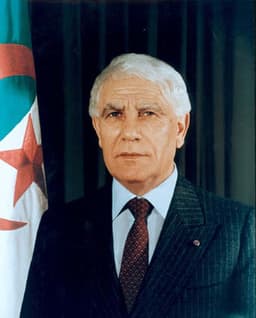
Chadli Bendjedid
Politician · Modern
50.3Total
Basic Information
Born
1951
1929
Died
—
—
Era
Modern
Modern
Nationality
Chechnya
Algeria
Occupation
Politician
Politician
Civilization
Western
Middle Eastern
Score Comparison
Military (10%)
50.0
41.3
Political (20%)
36.5
68.0
Influence (20%)
54.1
52.5
Legacy (20%)
44.2
41.7
Leadership (15%)
51.9
53.2
Strategy (15%)
45.0
44.3
TOTAL
47.3
50.3
Aslan Maskhadov — Complete Timeline
1997 AD
Elected President of IchkeriaPolitical Action◆ Major
Aslan Maskhadov was elected as the second president of the Chechen Republic of Ichkeria after Dudayev's death. He won a democratic election but faced challenges from radical factions within Chechnya.
ChechnyaElectionIchkeria
Impact: regionalconstructive
1999 AD
Second Chechen War BeginsWar
Russian forces launched a second invasion of Chechnya after the apartment bombings in Russia. Maskhadov led the Chechen resistance but was unable to prevent Russian forces from capturing Grozny and establishing control.
Chechen WarRussiaInvasion
Impact: regionaltragic
2005 AD
Killed by Russian ForcesWar◆ Major
Maskhadov was killed by Russian special forces during a raid in the village of Tolstoy-Yurt. His death was a major victory for Russia in the Second Chechen War. He was succeeded by radical leaders.
AssassinationChechnyaRussia
Impact: regionaltragic
Chadli Bendjedid — Complete Timeline
1979 AD
Elected President of AlgeriaPolitical Action◆ Major
Bendjedid was elected president after the death of Houari Boumediene. His election marked a shift from the revolutionary era to a period of political and economic liberalization in Algeria.
Algerian PoliticsSuccessionLiberalization
Impact: national
1988 AD
Introduced Political and Economic ReformsReform◆ Major
After the October 1988 riots, Bendjedid introduced a new constitution that ended the one-party system and allowed for multiparty elections. He also implemented economic liberalization measures, moving away from state socialism.
Constitutional ReformMultiparty SystemEconomic Liberalization
Impact: nationalprogressive
1992 AD
Resigned Under Military Pressure Amid Civil WarPolitical Action
Facing a likely victory by the Islamic Salvation Front (FIS) in the second round of parliamentary elections, Bendjedid resigned under pressure from the military. His resignation triggered the Algerian Civil War, a decade-long conflict between the government and Islamist insurgents.
Algerian Civil WarMilitary InterventionIslamist Conflict
Impact: nationaltragic
Expert Analysis
Origins
Aslan Maskhadov was born on September 21, 1951, in the village of Novye Atagi, Chechnya, then part of the Soviet Union. He came from a Chechen family that had been deported to Central Asia in 1944. Maskhadov pursued a military career, graduating from the Tbilisi Higher Artillery Command School and later the Military Academy of the General Staff in Moscow. He served as a Soviet artillery officer, reaching the rank of colonel. His formative experiences included the Chechen deportation and his service in the Soviet military, which gave him technical expertise but also exposed him to the systemic discrimination against Chechens.
Chadli Bendjedid was born on April 14, 1929, in the village of Sebaa, near Annaba, Algeria, into a peasant family. He fought in the Algerian War of Independence (1954-1962) as a member of the National Liberation Army (ALN), rising to the rank of colonel. After independence, he held various military and political positions, including commander of the Oran military region. His background was rooted in revolutionary nationalism and military hierarchy.
Rise to Power
Maskhadov rose to prominence during the First Chechen War (1994-1996). As chief of staff of the Chechen armed forces, he planned and executed the successful defense of Grozny and the subsequent guerrilla campaign. In 1997, after the death of Dzhokhar Dudayev, Maskhadov was elected President of the Chechen Republic of Ichkeria with 59% of the vote. His rise was based on his military reputation and perceived moderation, but he inherited a devastated country with weak institutions.
Bendjedid became president in 1979 following the death of Houari Boumediene. He was selected as a compromise candidate by the FLN (National Liberation Front) and the military. His rise was a product of the party apparatus and the military establishment, not popular election. He initially continued Boumediene's socialist policies but gradually shifted toward economic liberalization.
Leadership & Governance
Maskhadov's leadership was defined by his inability to control the radical factions within Chechnya, such as Shamil Basayev and the Arab mujahideen. He sought a negotiated settlement with Russia but was undermined by his own commanders. In governance, he attempted to establish a secular state with Islamic law as a basis, but his authority was constantly challenged. His military score of 50.0 reflects his tactical competence but strategic failure, while his political score of 36.5 indicates his weak control over the political landscape.
Bendjedid introduced significant reforms after the October 1988 riots. He oversaw a new constitution in 1989 that ended one-party rule and allowed multiparty elections. He also implemented economic liberalization, including privatization of state enterprises. However, his political score of 68.0 is offset by his indecisiveness during the 1991-1992 crisis. He allowed the Islamic Salvation Front (FIS) to win local elections and the first round of parliamentary elections, which triggered a military coup and a civil war.
Triumph & Tragedy
Maskhadov's greatest success was his military leadership in the First Chechen War, forcing Russia to negotiate the Khasavyurt Accord in 1996, which effectively granted Chechnya de facto independence. His greatest failure was his inability to prevent the rise of Islamist extremists and the subsequent Second Chechen War (1999-2009), which led to his death in 2005. He was killed in a Russian special forces raid, scoring 44.2 in legacy.
Bendjedid's triumph was the introduction of political pluralism and economic reforms, which initially brought hope for democratization. His tragedy was the descent into a brutal civil war (1991-2002) that killed over 100,000 people. His resignation under military pressure in 1992 triggered the conflict, and his legacy score of 41.7 reflects the association with the civil war.
Character & Destiny
Maskhadov was a cautious, pragmatic leader who preferred negotiation over confrontation. His character as a Soviet-trained officer made him seek compromise with Russia, but his inability to control radicals sealed his fate. He was criticized by both Russian authorities and Chechen extremists. Historical assessments note his genuine desire for peace but fatal lack of ruthlessness.
Bendjedid was a conciliatory figure who underestimated the strength of Islamist movements. His indecisiveness during the 1991 election crisis led to his ouster. He was seen as a transitional figure, not a strong leader. His score of 53.2 in leadership reflects his moderate approach but lack of decisive action.
Legacy
Maskhadov is remembered in Chechnya as a legitimate president who fought for independence but failed to maintain unity. His legacy is overshadowed by the brutality of the Second Chechen War and the rise of Ramzan Kadyrov. He is often compared to other failed separatist leaders. His influence score of 54.1 reflects his symbolic importance to Chechen nationalism.
Bendjedid's legacy is mixed. He is credited with initiating reforms that ended the single-party system, but his tenure is also blamed for the civil war. Algeria's political system still bears marks of his reforms, but the military remains dominant. His influence score of 52.5 indicates moderate impact on Algeria's political evolution.
Conclusion
While Bendjedid's total score of 50.3 edges Maskhadov's 47.3, the gap is narrow. However, Bendjedid's impact is more significant because his reforms fundamentally altered Algeria's political landscape, even if the outcome was unintended. Maskhadov, despite his military skill, failed to establish a viable state. Bendjedid's legacy, though tied to civil war, includes the introduction of multiparty politics that outlasted him. Therefore, Bendjedid had greater historical impact.
Rankings
🥇
Chadli BendjedidLeader
Mil: 41.3Pol: 68.0Inf: 52.5
50.3
🥈
Aslan Maskhadov
Mil: 50.0Pol: 36.5Inf: 54.1
47.3
+3.0 behind
How This Comparison Works
Algorithm
Each figure is scored on 6 dimensions (0—100 scale) based on structured historical data: Military (10%), Political (20%), Influence (20%), Legacy (20%), Leadership (15%), Strategy (15%). The weighted total produces the final ranking.
Data Sources
Scores are computed from structured sub-indicators in the database. Scale factors adjust for era (Ancient ×0.85, Modern ×1.0) and civilization size (Eastern ×1.05, Other ×0.80) to account for differences in population and military scale.
Maximum 3 Figures
Comparisons are limited to 2—3 figures to ensure readability and statistical meaningfulness.
Error Margins
±5 points per dimension — Sub-scores are derived from historical records with inherent uncertainty. Two figures within 5 points on a dimension should be considered roughly equivalent in that area.
Total Score Accuracy
±3 points overall — The weighted combination of 6 dimensions produces a total score with approximately ±3 points of uncertainty. Differences of less than 3 points are not statistically significant— the figures are effectively tied.
Known Limitations
- Historical records are incomplete and uneven across civilizations
- Figures from oral-tradition societies may be underrepresented
- Occupation labels can misclassify multi-role figures
- Scores measure capability and impact, not moral character
- Quantitative scoring is a comparison tool, not absolute truth
Capability Radar
Military (10%) — Battles & Warfare
Battles
45
20
Win Rate
40
24
Expansion
10
29
Political (20%) — Governance & Reform
Reform
25
55
Diplomacy
40
50
Economy
15
40
Influence (20%) — Cultural & Global Reach
Cultural
30
30
Global
25
25
Legacy (20%) — Historical Impact
Historical
35
30
Longevity
20
20
Leadership (15%) — Power & Stability
Tenure
35
65
Stability
10
35
Strategy (15%) — Tactics & Innovation
Strategy
50
30
Tactics
55
31
Reform
30
37
Similar Comparisons
Comments & Discussion
No comments yet. Be the first to share your thoughts!