Loading...
Chadli Bendjedid vs Gloria Macapagal Arroyo
Gloria Macapagal Arroyo leads by 2.9 pts · 2 figures compared
…
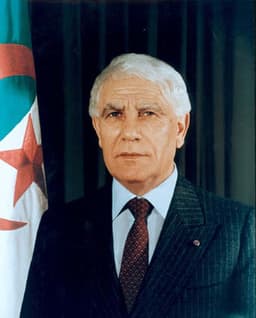
Chadli Bendjedid
Politician · Modern
50.3Total

Gloria Macapagal Arroyo
Politician · Modern
53.2Total
Basic Information
Born
1929
1947
Died
—
—
Era
Modern
Modern
Nationality
Algeria
Philippines
Occupation
Politician
Politician
Civilization
Middle Eastern
Eastern
Score Comparison
Military (10%)
41.3
47.6
Political (20%)
68.0
57.4
Influence (20%)
52.5
56.4
Legacy (20%)
41.7
46.7
Leadership (15%)
53.2
63.6
Strategy (15%)
44.3
45.0
TOTAL
50.3
53.2
Chadli Bendjedid — Complete Timeline
1979 AD
Elected President of AlgeriaPolitical Action◆ Major
Bendjedid was elected president after the death of Houari Boumediene. His election marked a shift from the revolutionary era to a period of political and economic liberalization in Algeria.
Algerian PoliticsSuccessionLiberalization
Impact: national
1988 AD
Introduced Political and Economic ReformsReform◆ Major
After the October 1988 riots, Bendjedid introduced a new constitution that ended the one-party system and allowed for multiparty elections. He also implemented economic liberalization measures, moving away from state socialism.
Constitutional ReformMultiparty SystemEconomic Liberalization
Impact: nationalprogressive
1992 AD
Resigned Under Military Pressure Amid Civil WarPolitical Action
Facing a likely victory by the Islamic Salvation Front (FIS) in the second round of parliamentary elections, Bendjedid resigned under pressure from the military. His resignation triggered the Algerian Civil War, a decade-long conflict between the government and Islamist insurgents.
Algerian Civil WarMilitary InterventionIslamist Conflict
Impact: nationaltragic
Gloria Macapagal Arroyo — Complete Timeline
2001 AD
Elected President of the PhilippinesPolitical Action◆ Major
Gloria Macapagal Arroyo became president after the EDSA II Revolution ousted Joseph Estrada. She was the second female president of the Philippines and daughter of former President Diosdado Macapagal.
PresidencyEDSA IIPolitical Transition
Impact: national
2003 AD
Survived the Oakwood MutinyPolitical Action◆ Major
A group of junior military officers seized the Oakwood Premier Hotel in Makati, demanding Arroyo's resignation over corruption allegations. The mutiny was peacefully resolved, but it highlighted military unrest.
Military MutinyPolitical CrisisCorruption
Impact: national
2005 AD
Implemented the Expanded Value-Added TaxReform◆ Major
Arroyo signed the Expanded Value-Added Tax law, raising the VAT rate from 10% to 12% to address fiscal deficits. The reform increased government revenue but faced public opposition and legal challenges.
Tax ReformFiscal PolicyEconomic Reform
Impact: national
2011 AD
Arrested for electoral sabotagePolitical Action◆ Major
Arroyo was arrested on charges of electoral sabotage related to the 2007 senatorial elections. She was detained at the Veterans Memorial Medical Center, becoming the first former Philippine president to be held on such charges.
ArrestElectoral SabotageLegal Case
Impact: nationaldestructive
2016 AD
Pardoned by President Rodrigo DutertePolitical Action
President Rodrigo Duterte granted Arroyo absolute pardon for her electoral sabotage conviction, citing her poor health. The pardon allowed her release from detention and eventual return to politics as a congresswoman.
PardonLegal CaseDuterte
Impact: national
Expert Analysis
Origins
Chadli Bendjedid was born in 1929 in Bouteldja, Algeria, into a peasant family. He joined the French army but later defected to the National Liberation Front (FLN) during the Algerian War of Independence. After independence, he rose through military ranks, becoming a colonel. Gloria Macapagal Arroyo was born in 1947 in San Juan, Philippines, to President Diosdado Macapagal and his wife Evangelina. She studied economics at Georgetown University and earned a PhD from the University of the Philippines. Arroyo began her career as a professor and later entered politics, serving as senator and vice president.
Rise to Power
Bendjedid became president in 1979 after the death of Houari Boumediene, elected by the FLN as a compromise candidate. He initially maintained Boumediene's socialist policies but gradually shifted. His rise was marked by the 1980 Berber Spring protests, which he suppressed. Arroyo rose to prominence as a senator and was elected vice president in 1998 under Joseph Estrada. When Estrada was ousted in the 2001 EDSA II Revolution, Arroyo succeeded him, becoming the second female president of the Philippines. She won a full term in 2004 amid allegations of electoral fraud.
Leadership & Governance
Bendjedid's leadership was defined by cautious reform. After the October 1988 riots, he introduced a new constitution ending the one-party system and legalized multiparty elections. He also initiated economic liberalization, but his reforms were slow and faced opposition from the military and Islamists. Arroyo focused on fiscal discipline, implementing the Expanded Value-Added Tax (EVAT) in 2005, raising the rate from 10% to 12%. She also pursued infrastructure projects and economic growth, averaging 4.5% GDP growth during her tenure. However, her administration was plagued by corruption scandals and coup attempts, including the 2003 Oakwood Mutiny.
Triumph & Tragedy
Bendjedid's greatest triumph was introducing political pluralism to Algeria, enabling the first multiparty elections in 1991. However, his tragedy was the ensuing civil war when the military canceled the elections to prevent an Islamist victory. He resigned under military pressure in 1992, and the conflict led to over 100,000 deaths. Arroyo's triumphs included stabilizing the Philippine economy after the Asian financial crisis and passing the EVAT, which boosted government revenues. Her tragedy was her arrest in 2011 for electoral sabotage related to the 2007 senatorial elections, tarnishing her legacy. She was detained until 2016, when President Duterte granted her a pardon.
Character & Destiny
Bendjedid was a cautious reformer, often described as indecisive. His attempt to balance military, Islamist, and secularist factions ultimately failed, leading to his resignation. His character reflected a desire for gradual change but an inability to manage crises. Arroyo was pragmatic and determined, but her reputation was marred by accusations of corruption and authoritarian tendencies. She survived multiple impeachment attempts and coup plots, but her arrest showed the consequences of political miscalculation. Historians assess Bendjedid as a well-intentioned leader overwhelmed by events, while Arroyo is seen as a capable but controversial figure.
Legacy
Bendjedid's legacy is mixed: he is credited with ending the one-party state but blamed for the civil war. His reforms paved the way for Algeria's later political evolution, but the military's intervention undermined democracy. Arroyo's legacy includes economic reforms and infrastructure, but her corruption allegations overshadow achievements. She scored 53.2 overall, higher than Bendjedid's 50.3, reflecting stronger political skills (68.0 vs 57.4) and leadership (63.6 vs 53.2). However, Bendjedid's influence (52.5) and legacy (41.7) are comparable, though his military score is lower (41.3 vs 47.6).
Conclusion
Gloria Macapagal Arroyo had greater impact due to her longer tenure and concrete economic reforms. While Bendjedid introduced political liberalization, his inability to prevent civil war diminished his achievements. Arroyo's EVAT and economic growth (4.5% average) provided tangible benefits, despite her legal troubles. Her political score (57.4) and leadership (63.6) exceed Bendjedid's, and her survival of multiple crises shows resilience. Bendjedid's resignation and the subsequent violence make his legacy more tragic. Thus, Arroyo's overall score of 53.2 reflects a more effective, though flawed, leadership.
Rankings
🥇
Gloria Macapagal ArroyoLeader
Mil: 47.6Pol: 57.4Inf: 56.4
53.2
🥈
Chadli Bendjedid
Mil: 41.3Pol: 68.0Inf: 52.5
50.3
+2.9 behind
How This Comparison Works
Algorithm
Each figure is scored on 6 dimensions (0—100 scale) based on structured historical data: Military (10%), Political (20%), Influence (20%), Legacy (20%), Leadership (15%), Strategy (15%). The weighted total produces the final ranking.
Data Sources
Scores are computed from structured sub-indicators in the database. Scale factors adjust for era (Ancient ×0.85, Modern ×1.0) and civilization size (Eastern ×1.05, Other ×0.80) to account for differences in population and military scale.
Maximum 3 Figures
Comparisons are limited to 2—3 figures to ensure readability and statistical meaningfulness.
Error Margins
±5 points per dimension — Sub-scores are derived from historical records with inherent uncertainty. Two figures within 5 points on a dimension should be considered roughly equivalent in that area.
Total Score Accuracy
±3 points overall — The weighted combination of 6 dimensions produces a total score with approximately ±3 points of uncertainty. Differences of less than 3 points are not statistically significant— the figures are effectively tied.
Known Limitations
- Historical records are incomplete and uneven across civilizations
- Figures from oral-tradition societies may be underrepresented
- Occupation labels can misclassify multi-role figures
- Scores measure capability and impact, not moral character
- Quantitative scoring is a comparison tool, not absolute truth
Capability Radar
Military (10%) — Battles & Warfare
Battles
20
34
Win Rate
24
38
Expansion
29
38
Political (20%) — Governance & Reform
Reform
55
55
Diplomacy
50
60
Economy
40
58
Influence (20%) — Cultural & Global Reach
Cultural
30
40
Global
25
40
Legacy (20%) — Historical Impact
Historical
30
45
Longevity
20
35
Leadership (15%) — Power & Stability
Tenure
65
72
Stability
35
45
Strategy (15%) — Tactics & Innovation
Strategy
30
39
Tactics
31
45
Reform
37
49
Similar Comparisons
Comments & Discussion
No comments yet. Be the first to share your thoughts!