Loading...
Cao Kun vs Pham Minh Chinh
Pham Minh Chinh leads by 14.2 pts · 2 figures compared
…
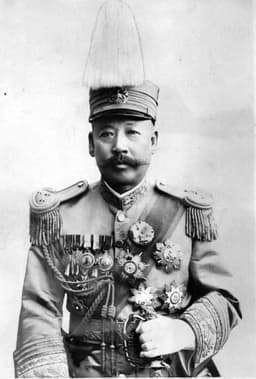
Cao Kun
General · Modern
43.2Total

Pham Minh Chinh
General · Modern
57.4Total
Basic Information
Born
1862
1958
Died
1938
—
Era
Modern
Modern
Nationality
China
Vietnam
Occupation
General
General
Civilization
Eastern
Eastern
Score Comparison
Military (10%)
38.3
60.6
Political (20%)
30.8
72.0
Influence (20%)
51.0
51.8
Legacy (20%)
40.8
41.7
Leadership (15%)
50.7
68.0
Strategy (15%)
41.7
69.3
TOTAL
43.2
57.4
Cao Kun — Complete Timeline
1920 AD
Zhili-Anhui WarWar◆ Major
Cao Kun led the Zhili clique to victory over the Anhui clique in the Zhili-Anhui War. This battle established the Zhili faction as the dominant force in northern China and expanded Cao Kun's political and military power.
Warlord EraWarZhili Clique
Impact: national
1922 AD
First Zhili-Fengtian WarWar◆ Major
Cao Kun's Zhili forces defeated the Fengtian clique under Zhang Zuolin in the First Zhili-Fengtian War. This victory solidified Zhili control over Beijing and the central government.
Warlord EraWarZhili Clique
Impact: national
1923 AD
Presidential Bribery ScandalPolitical Action
Cao Kun bribed members of the National Assembly to elect him President of the Republic of China, spending millions of yuan. This scandal discredited the Republican government and deepened public cynicism toward warlord politics.
Republic of ChinaCorruptionPresidency
Impact: nationaldestructive
1924 AD
Second Zhili-Fengtian WarWar◆ Major
Cao Kun's Zhili clique was defeated by the Fengtian clique in the Second Zhili-Fengtian War. The loss led to his overthrow and house arrest, ending his political career and the Zhili dominance.
Warlord EraWarDefeat
Impact: nationaltragic
Pham Minh Chinh — Complete Timeline
2021 AD
Appointed Prime Minister of VietnamPolitical Action◆ Major
Pham Minh Chinh was appointed Prime Minister of Vietnam by the National Assembly. He previously served as head of the Central Organizing Committee and was known for his security background.
Prime MinisterAppointmentVietnam
Impact: national
Leadership in COVID-19 ResponsePolitical Action◆ Major
Chinh led Vietnam's response to the COVID-19 pandemic, implementing strict lockdowns and a vaccination campaign. Vietnam initially had low case numbers but faced a Delta variant surge in mid-2021.
COVID-19Public HealthCrisis Management
Impact: national
2022 AD
Promotion of Digital Economy and InfrastructureReform
Chinh announced policies to boost Vietnam's digital economy and infrastructure development, including investments in 5G and smart cities. These reforms aimed to attract foreign investment and modernize the economy.
Digital EconomyInfrastructureReform
Impact: nationalconstructive
Expert Analysis
Origins
Cao Kun (born 1862) came from a modest family in Tianjin, China. He joined the Huai Army under Li Hongzhang, later studying at the Tianjin Military Academy. His early career was shaped by the patronage of Yuan Shikai, for whom he commanded troops during the Xinhai Revolution. Cao Kun's background was purely military, with no formal political education, which influenced his later governance.
Pham Minh Chinh (born 1958) was born in Thanh Hoa Province, North Vietnam. He studied at the Hanoi University of Foreign Studies and later at the Ho Chi Minh National Academy of Politics. Chinh served in the People's Public Security forces, rising through intelligence and party organization roles. His background in security and party work gave him a bureaucratic and technocratic foundation.
Rise to Power
Cao Kun rose to prominence as a Beiyang general under Yuan Shikai. After Yuan's death in 1916, Cao became leader of the Zhili clique. In 1920, he led the Zhili-Anhui War, defeating Duan Qirui's Anhui clique (scoring 38.3 military). In 1922, he won the First Zhili-Fengtian War against Zhang Zuolin, solidifying control over Beijing. However, his ambition led him to the 1923 Presidential Bribery Scandal: he spent 5 million yuan to bribe National Assembly members to elect him President. This turning point tarnished his reputation.
Pham Minh Chinh rose through the Communist Party of Vietnam's security apparatus. He served as Deputy Minister of Public Security and later as head of the Central Organizing Committee. In 2021, he was appointed Prime Minister by the National Assembly, succeeding Nguyen Xuan Phuc. His rise was marked by loyalty to party leadership and administrative competence, not military conquest.
Leadership & Governance
Cao Kun's governance was marked by corruption and short-termism. His presidency lasted only one year (1923-1924) before the Second Zhili-Fengtian War ended his rule. He focused on consolidating power through bribery and patronage, ignoring reforms. His political score of 30.8 reflects his inability to build lasting institutions.
Pham Minh Chinh's leadership is technocratic and pragmatic. He led Vietnam's response to COVID-19, implementing strict lockdowns and accelerating vaccination. Under him, Vietnam's digital economy grew, with policies promoting 5G and smart cities. His political score of 72.0 indicates effective governance within a one-party system. However, critics note limited political freedoms.
Triumph & Tragedy
Cao Kun's greatest triumph was winning the Zhili-Anhui and First Zhili-Fengtian Wars, making the Zhili clique dominant. His tragedy was the 1923 bribery scandal, which discredited the presidency and led to his downfall. After losing the Second Zhili-Fengtian War in 1924, he was placed under house arrest, dying in 1938.
Pham Minh Chinh's triumph is Vietnam's relatively low COVID-19 death toll early in the pandemic, with strict measures. His tragedy may be the economic slowdown from lockdowns and the rise of authoritarian controls. Legacy score of 41.7 reflects an ongoing career.
Character & Destiny
Cao Kun was opportunistic and corrupt, prioritizing personal power over national stability. His character led to his isolation and defeat. Historians view him as a symbol of warlord-era decay.
Pham Minh Chinh is disciplined and bureaucratic, reflecting his security background. He avoids personal charisma, focusing on party directives. His destiny is tied to Vietnam's economic growth and political stability.
Legacy
Cao Kun's legacy is negative: he epitomizes the corruption of the Beiyang government. His bribery scandal weakened Chinese democracy. No lasting reforms or institutions bear his name.
Pham Minh Chinh's legacy is still forming. He may be remembered for modernizing Vietnam's economy and handling the pandemic. His influence score of 51.8 is moderate.
Conclusion
Pham Minh Chinh clearly surpasses Cao Kun in impact and effectiveness. Chinh's total score of 57.4 versus Cao's 43.2 reflects better governance, political acumen, and strategic management. While Cao Kun briefly dominated warlord politics, his corruption and lack of vision left no positive legacy. Chinh, despite being in office, has demonstrated competent leadership in a modern context. The gap of 14.2 points is decisive: Chinh's pragmatic approach outshines Cao's corrupt militarism.
Rankings
🥇
Pham Minh ChinhLeader
Mil: 60.6Pol: 72.0Inf: 51.8
57.4
🥈
Cao Kun
Mil: 38.3Pol: 30.8Inf: 51.0
43.2
+14.2 behind
How This Comparison Works
Algorithm
Each figure is scored on 6 dimensions (0—100 scale) based on structured historical data: Military (10%), Political (20%), Influence (20%), Legacy (20%), Leadership (15%), Strategy (15%). The weighted total produces the final ranking.
Data Sources
Scores are computed from structured sub-indicators in the database. Scale factors adjust for era (Ancient ×0.85, Modern ×1.0) and civilization size (Eastern ×1.05, Other ×0.80) to account for differences in population and military scale.
Maximum 3 Figures
Comparisons are limited to 2—3 figures to ensure readability and statistical meaningfulness.
Error Margins
±5 points per dimension — Sub-scores are derived from historical records with inherent uncertainty. Two figures within 5 points on a dimension should be considered roughly equivalent in that area.
Total Score Accuracy
±3 points overall — The weighted combination of 6 dimensions produces a total score with approximately ±3 points of uncertainty. Differences of less than 3 points are not statistically significant— the figures are effectively tied.
Known Limitations
- Historical records are incomplete and uneven across civilizations
- Figures from oral-tradition societies may be underrepresented
- Occupation labels can misclassify multi-role figures
- Scores measure capability and impact, not moral character
- Quantitative scoring is a comparison tool, not absolute truth
Capability Radar
Military (10%) — Battles & Warfare
Battles
30
63
Win Rate
35
66
Expansion
25
69
Political (20%) — Governance & Reform
Reform
10
60
Diplomacy
20
55
Economy
15
60
Influence (20%) — Cultural & Global Reach
Cultural
15
20
Global
10
20
Legacy (20%) — Historical Impact
Historical
25
20
Longevity
10
20
Leadership (15%) — Power & Stability
Tenure
40
65
Stability
10
55
Strategy (15%) — Tactics & Innovation
Strategy
30
73
Tactics
25
77
Reform
20
81
Similar Comparisons
Comments & Discussion
No comments yet. Be the first to share your thoughts!